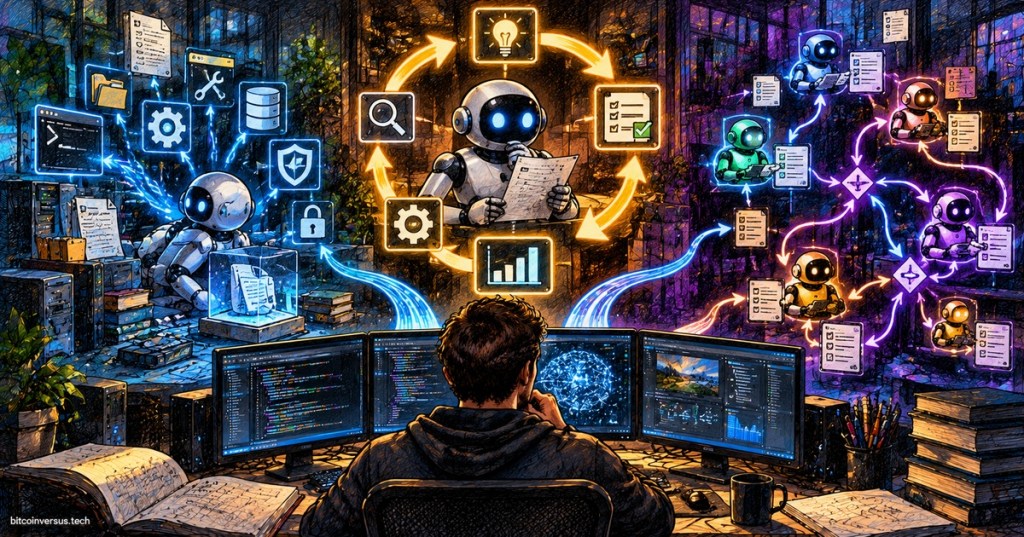
AI-agent engineering is starting to split into three different jobs that are often discussed as if they were the same thing: agent harness engineering, loop engineering, and graph engineering. The distinction matters because each layer solves a different class of failure. A stronger model will not fix a missing permission boundary, a runaway retry cycle, or a workflow whose branches are impossible to reason about.
The cleanest shorthand is environment → feedback → flow. Harness engineering builds the machinery around the model. Loop engineering designs how the agent repeatedly acts, checks, and improves. Graph engineering makes the allowed workflow paths explicit with nodes, edges, branches, joins, state transitions, and controlled cycles.
That framing was summarized in a widely shared X post from @beamnxw. The labels are still emerging rather than perfectly standardized, but the architecture behind them is already visible across OpenAI, Anthropic, IBM, LangChain, and Microsoft agent tooling.
The 30-Second Comparison
| Layer | Main Question | Typical Components | Failure It Fixes |
|---|---|---|---|
| Harness Engineering | What can the agent safely do? | Tools, memory, sandbox, permissions, context, approvals, tracing | The model cannot reliably or safely operate in the real environment |
| Loop Engineering | How should the agent keep working? | Plan, act, observe, verify, retry, stop conditions, budgets | The agent gives up too early, repeats bad work, or burns tokens |
| Graph Engineering | What is allowed to happen next? | Nodes, edges, branches, joins, shared state, interrupts, cycles | The workflow becomes too complex to reason about or control |
Harness Engineering Builds the Environment Around the Model
An agent harness is the system that turns a raw model into something that can actually operate. Anthropic describes an agent harness as the system that enables a model to act as an agent by processing inputs, orchestrating tool calls, and returning results. OpenAI’s current Agents architecture similarly separates the agent harness, execution environment, and application server.
That makes harness engineering broader than prompt engineering. The harness decides which tools exist, which files the agent can read, where code executes, what credentials stay hidden, which actions require approval, how state survives between turns, how traces are recorded, and what happens when a tool fails.
For a coding agent, the harness might include repository access, shell commands, a sandbox, test execution, live documentation access, patch application, Git history, approval gates, and logging. If the agent understands the task but cannot inspect the right file or safely run the right command, that is mainly a harness problem.
Loop Engineering Designs the Repeated Work Cycle
A capable harness still does not tell the agent how long to keep trying. That is where loop engineering comes in. IBM defines loop engineering as designing agentic workflows that repeatedly guide an agent toward a goal with minimal human intervention. The basic rhythm is familiar: observe the current state, decide what to do, act, inspect the result, then continue or stop.
The engineering work is in the control rules around that repetition. How many retries are allowed? What counts as progress? When should the agent re-plan? What evidence proves the task is done? When should it ask a human? What token or cost budget should terminate the run?
BitcoinVersus.Tech’s coverage of Genex using AI agents, local models, and visual checks in a game-development loop is a concrete example. The important part is not merely that an agent can edit code. The loop repeatedly plans, changes files, runs the project, inspects the result, rejects bad changes, and keeps working until an acceptance condition is reached.
This is also where evaluation becomes operational rather than academic. OpenAI’s agent-improvement loop connects traces, feedback, evals, and implementation changes so evidence from previous runs can improve the next version of the harness. A loop can therefore operate inside one task, across many tasks, or even across versions of the agent system itself.
Graph Engineering Makes Complex Flow Explicit
A loop is enough when one agent can repeatedly work toward a goal. Graph engineering becomes useful when the workflow has distinct stages, specialist agents, deterministic branches, parallel work, joins, human approvals, or recovery paths that need to be visible and enforceable.
Microsoft’s AutoGen GraphFlow documentation describes exactly this style of orchestration. A directed graph controls which agents may execute, with support for sequential steps, parallel fan-out, conditional branching, and loops with exit conditions. The graph is not just a picture—it is executable control flow.
Imagine an enterprise coding system. One node analyzes an issue. Another reproduces the bug. Two specialist agents investigate different subsystems in parallel. A reviewer node compares the patches. A security node can block risky changes. A human approval node may be required before production deployment. The graph makes those transitions explicit instead of leaving every routing decision inside one giant prompt.
That same architectural pressure is showing up throughout the agentic stack. BitcoinVersus.Tech has covered agents receiving their own databases, AI code-review systems being tested against real bugs, and agents consuming far more tokens than ordinary human-driven chat. As agents gain more state, tools, and autonomy, explicit orchestration becomes more valuable.
The Layers Nest Rather Than Compete
The most useful way to understand these terms is not as competing methodologies. A production agent can use all three at once.
The harness supplies tools, state, permissions, sandboxing, tracing, and runtime controls. Inside that harness, a loop lets the agent repeatedly work until it has enough evidence to stop. If the job grows beyond one repeated path, a graph coordinates multiple loops, agents, deterministic functions, reviewers, branches, and approvals.
One simple mental model is: the loop is the heartbeat, the graph is the anatomy, and the harness is the operating environment keeping the entire system alive.
How to Diagnose the Wrong Layer
If an agent knows what to do but cannot access the right tool, loses state, violates permissions, or cannot recover its workspace, inspect the harness. If it keeps repeating the same weak attempt, declares success too early, or has no reliable stop condition, inspect the loop. If the system has many agents or stages and nobody can clearly explain which component runs next, inspect the graph.
This distinction can save teams from the most expensive debugging mistake in agent engineering: replacing the model when the failure is actually architectural. A better model inside a weak harness still lacks tools and boundaries. A better model inside a bad loop can still burn tokens. A better model inside an opaque workflow can still route work incorrectly.
Start With a Harness, Add a Loop, Earn the Graph
The safest design order is usually simple. First, give one agent a clean harness with the minimum tools and permissions required. Next, design a bounded loop with measurable progress and a real stop condition. Only introduce explicit graph orchestration when distinct stages, specialists, branches, or human gates make a single loop difficult to understand.
That order avoids overengineering. Graphs can make a complicated process inspectable, but a 40-node workflow is not automatically better than one capable agent with a strong harness and a disciplined loop. The right architecture is the simplest one that makes capability, feedback, and control visible enough to debug.
The Bigger Shift Beyond Prompt Engineering
Prompt engineering is not disappearing, but it is moving lower in the stack. Once agents operate across files, APIs, codebases, databases, browsers, and production systems, reliability depends on far more than the wording of a system prompt.
That is why the emerging agentic AI stack increasingly looks like software engineering again: runtime design, state management, feedback control, permissions, observability, testing, and explicit orchestration. The model remains important, but the system around the model determines whether intelligence can be turned into reliable work.
Harness engineering makes the agent capable. Loop engineering makes it persistent. Graph engineering makes complex behavior controllable. Knowing which layer is broken may become one of the core debugging skills of the agent era.
BitcoinVersus.Tech
Advertisement
BitcoinVersus.Tech covers AI agents, coding, software architecture, semiconductors, hardware, and the infrastructure behind modern computing.
Editor’s Note
We volunteer daily to help keep the information on this platform verifiably accurate. Support our independent research through the support options available on BitcoinVersus.Tech.
BitcoinVersus.tech is not a financial advisor. Content is provided for informational purposes.


Leave a comment