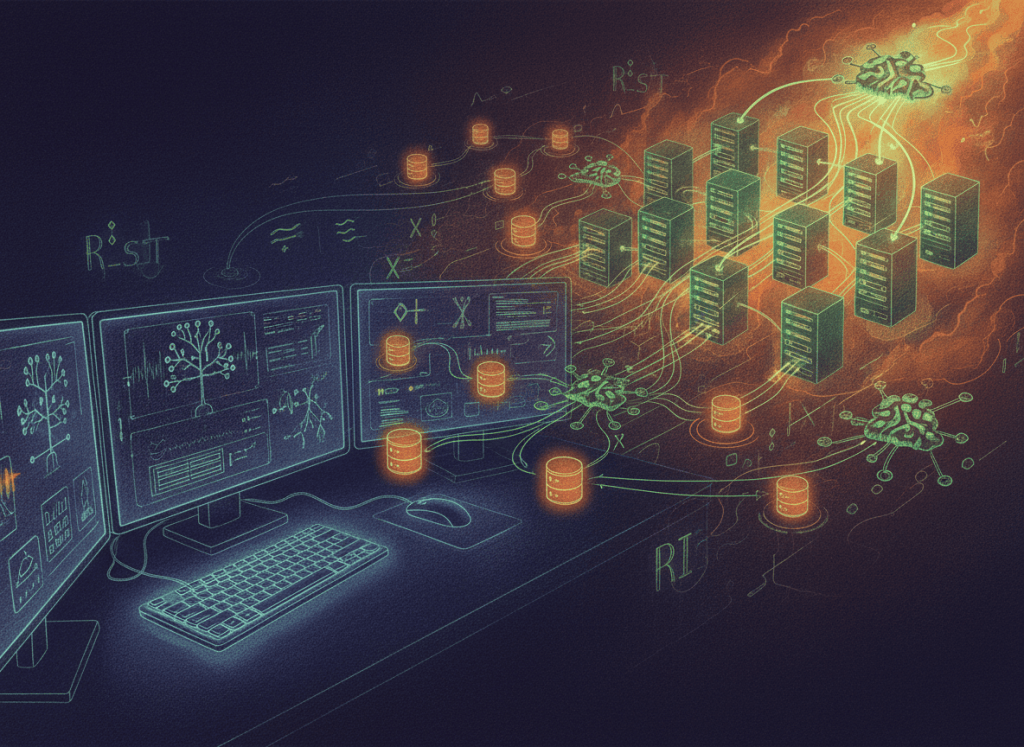
Supabase is acquiring Turso, the database company that rebuilt SQLite in Rust, in a deal aimed at one of the fastest-growing infrastructure problems in software: AI coding agents are creating databases faster than humans ever did.
In its October 2 acquisition announcement, Supabase said it is already launching more than one million databases per week. Its thesis is simple: if an AI agent can create an application, branch a codebase and test a feature in seconds, it should be able to create an isolated database just as cheaply and quickly.
Turso confirmed the deal in a specific X announcement, saying the two companies are building database infrastructure that can stretch from lightweight per-agent databases to Postgres at petabyte scale.
Supabase is betting that AI agents need databases like files
The old application model usually starts with a developer deliberately provisioning a database, defining a schema and then connecting an application to it. Agentic coding changes the frequency of that operation. One agent can generate prototypes, temporary workspaces, tests and customer-specific environments continuously.
Provisioning a full dedicated database server for every short-lived experiment is expensive and slow. Turso’s architecture attacks that problem by treating small databases as lightweight objects that can be loaded when needed and suspended when idle. Supabase says a single Turso server can manage millions of databases.
That design is closely related to the broader shift we covered when GitHub used AI agents while rewriting Copilot’s 430,000-line TypeScript runtime in Rust. AI agents are no longer only generating snippets. They are beginning to operate against entire software systems, which means the infrastructure beneath them has to become more disposable, isolated and machine-operable.
Why Turso rebuilt SQLite in Rust
SQLite is unusually attractive for agent-created software because it is embedded, compact and does not require a separate database server for every workload. Turso pushed that model further by rebuilding SQLite in Rust and designing cloud infrastructure around enormous numbers of small databases.
Rust matters here because database engines live in the part of the stack where memory safety, concurrency, I/O behavior and predictable performance matter constantly. The language is also moving deeper into mainstream systems programming, as shown by our recent look at Rust 1.99’s C-variadic, Cargo CI and LLVM 23 changes.
The acquisition does not mean Supabase is abandoning Postgres. Supabase says Postgres remains its production foundation while Turso continues developing its SQLite-based platform. The intended path is more like a ladder: an agent can start with a tiny isolated database, then graduate into Postgres as the application becomes durable and traffic grows.
The money follows the agent-database thesis
SiliconANGLE reports that Supabase announced approximately ₿1,770 ($150 million) in new funding alongside the acquisition, led by GIC with participation from CapitalG, IronArc and SquarePeg. The Turso purchase price itself was not disclosed, so the funding round should not be confused with the acquisition price.
Using the same October 2 Bitcoin conversion, the new round follows a roughly ₿5,899 ($500 million) Series F only four months earlier. The amount of capital matters because database infrastructure is not simply a software-library problem: global low-latency service, storage, replication, observability and reliability all become expensive once millions of machine-created databases begin appearing continuously.
Turso’s founder says the companies fit technically and culturally
Turso co-founder Glauber Costa described the combination as a shared commitment to developers, open infrastructure and agentic databases.
The strategic fit is clearer when viewed from the agent’s perspective. A coding agent does not want to wait for a human to click through a dashboard every time it needs a sandbox. It needs an API-level primitive it can create, query, discard and recreate safely.
That is the same economic pressure showing up higher in the stack. Our report on how AI systems are beginning to optimize CUDA kernels that engineers once hand-tuned showed agents moving closer to low-level performance work. The database layer now has to assume software itself may be the most frequent infrastructure customer.
What AI developers should watch next
The important question is not whether an agent can create a database. That is already easy. The difficult engineering work is lifecycle management: permissions, schema migrations, credentials, rollback, replication, cost limits, observability and deciding when a disposable SQLite workload should become a durable Postgres application.
If Supabase and Turso can make that transition automatic, the acquisition could turn databases into something closer to files or containers from an agent’s point of view: cheap to create, isolated by default and disposable until the workload proves it deserves permanent infrastructure.
That would be a meaningful change in how software is built. The next generation of database customers may not open dashboards at all. They may be coding agents creating thousands of temporary backends while humans only see the applications that survive.
BitcoinVersus.Tech
Advertisement
Editor’s Note
We volunteer daily to ensure the credibility of the information on this platform is Verifiably True. If you would like to support to help further secure the integrity of our research initiatives, please donate here: 3C9o19EH5HSiwEPyCTmEKzxhNCbo2X6TTb
BitcoinVersus.tech is not a financial advisor. This media platform reports on financial subjects purely for informational purposes.


Leave a Reply