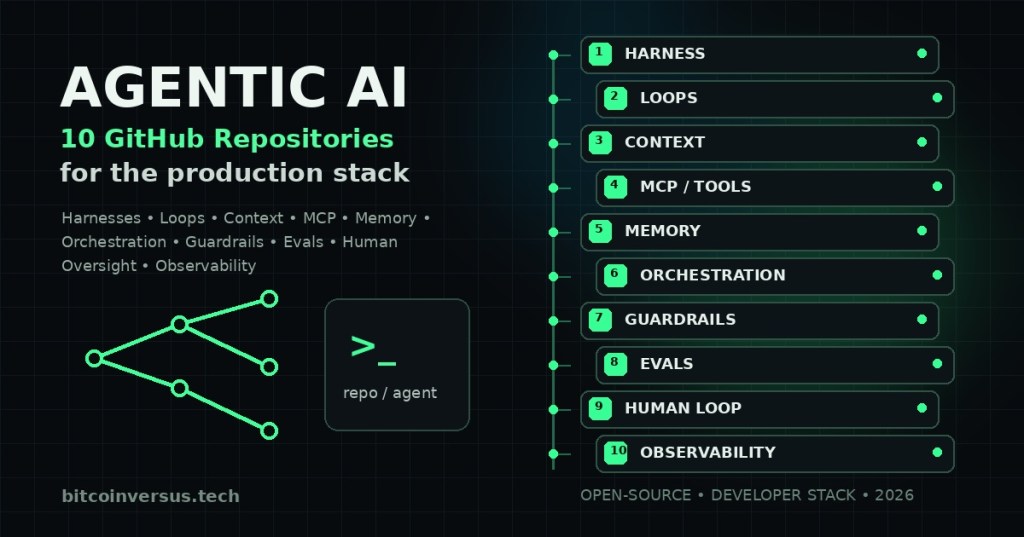
A September 29 post from developer-resource curator Avinash Singh is drawing attention to a shift in how developers are learning agentic AI: away from prompt tricks alone and toward the engineering systems that make autonomous software usable in production.
The post points to ten public GitHub repositories covering harness engineering, loop design, context engineering, Model Context Protocol tooling, memory, orchestration, guardrails, evaluations, human oversight and observability. BitcoinVersus checked the repositories directly; all ten were live, public and not archived at the time of publication.
Avinash Singh’s September 29 post organizes ten GitHub repositories into a practical agentic AI learning stack for developers heading into 2027.
The list is really a map of the production agent stack
The ten repositories are: walkinglabs/awesome-harness-engineering, cobusgreyling/loop-engineering, yzfly/awesome-context-engineering, modelcontextprotocol/servers, mnemoverse/awesome-agent-memory, vivy-yi/awesome-agent-orchestration, enguard-ai/awesome-ai-guardrails, benchflow-ai/awesome-evals, cloudflare/agents and anhermon/awesome-agent-observability.
Taken together, they show why “agentic AI” is becoming a systems-engineering problem. A useful agent needs more than a model call: it needs a controlled runtime, a loop for deciding what happens next, context selection, tool interfaces, persistent memory, coordination logic, safety boundaries, tests, human intervention paths and telemetry that explains what happened after a run goes wrong.
The clearest primary-source example is the official Model Context Protocol reference-server repository. Its maintainers describe the included servers as educational reference implementations rather than production-ready components and explicitly tell developers to evaluate security requirements against their own threat model. That warning is part of the lesson: connecting a model to tools is easy; operating that connection safely is the engineering work.
Open Data Science and AI Conference examines MCP’s move toward stateless architecture, tool design and agent skills.
Harnesses, loops and context sit above the raw model
Harness engineering focuses on the environment around an agent: instructions, state, verification, retries, tool boundaries and runtime controls. Loop engineering narrows in on repeated decision cycles, while context engineering deals with what information enters the model’s working window at each step. Those layers determine whether a strong model behaves like a reliable worker or an expensive autocomplete loop.
That distinction matches the direction of recent BitcoinVersus coverage. NVIDIA’s OO Agents framework treats agent behavior as software architecture rather than a single prompt, while OpenAI’s always-on Dots agents push stateful automation across applications. More recently, NVIDIA’s TensorRT Model Connect work has highlighted how coding agents increasingly depend on the surrounding tool and execution stack.
Redis CTO Benjamin Renaud and Head of AI Products Simba Khadder discuss how context engineering changes as AI agents move toward production workloads.
Memory, orchestration and human control make agents persistent
The middle of the list covers the problems that appear when an agent must operate longer than one prompt. Memory systems decide what to retain and retrieve across sessions. Orchestration frameworks coordinate multiple agents, tools or workflow branches. Human-in-the-loop systems add checkpoints where a person can approve, reject or redirect an action before it becomes irreversible.
Cloudflare’s Agents repository is a concrete example of that shift. Its framework gives each agent persistent state, storage and lifecycle management through Durable Objects, with support for scheduling, model calls, workflows and MCP. The design treats an agent as a long-lived software process with state rather than a disposable chat completion.
That persistent model also expands the security surface. An agent that can remember, schedule work and call external systems needs explicit limits on what it may access and what actions it may take.
Cloudflare’s September 28 post describes applying Zero Trust controls to autonomous agents reaching the Internet, private applications, MCP servers and models.
Guardrails, evals and observability are the difference between a demo and an operated system
The final repositories in Singh’s list focus on failure management. Guardrails constrain unsafe or unwanted behavior. Evaluations test whether an agent actually completes tasks correctly across many runs. Observability captures traces, tool calls, model decisions and quality signals so developers can inspect failures that ordinary HTTP status codes will never explain.
That makes the list useful less as a ranking and more as a checklist. A developer does not need to adopt every repository. The stronger lesson is that production agent engineering now spans software architecture, data flow, security, testing and operations at the same time.
The original post frames the repositories as concepts developers should know before 2027. The exact deadline is subjective, but the architecture behind the list is already visible in current agent platforms: models are becoming one component inside a larger execution system, and the competitive engineering work is increasingly happening around them.
BitcoinVersus.Tech
Advertisement
BitcoinVersus.Tech advertisement on X.
Editor’s Note
We volunteer daily to ensure the credibility of the information on this platform is Verifiably True. If you would like to support to help further secure the integrity of our research initiatives, please donate here: 3C9o19EH5HSiwEPyCTmEKzxhNCbo2X6TTb
BitcoinVersus.tech is not a financial advisor. This media platform reports on financial subjects purely for informational purposes.


Leave a Reply