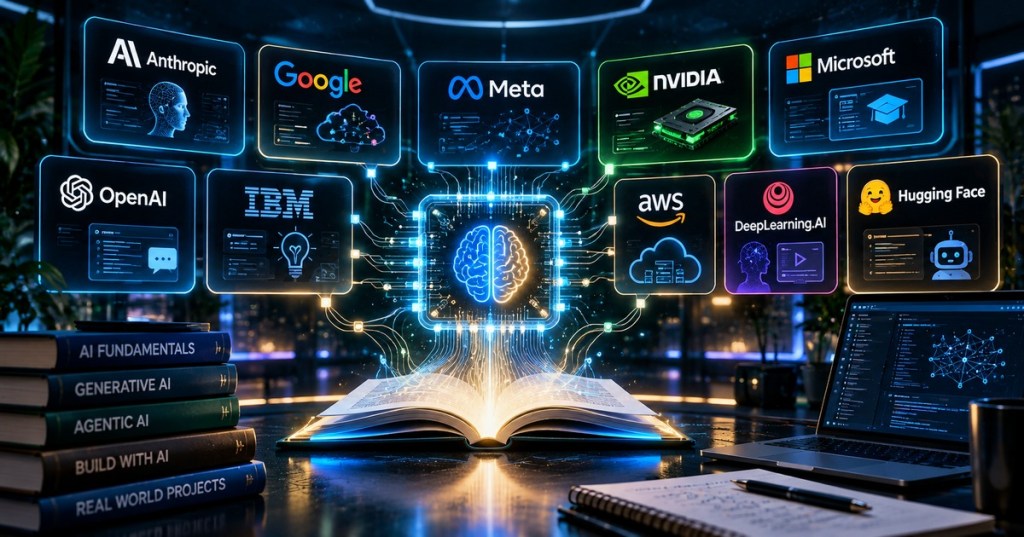
A September 30 X post from Ana packages a useful idea into one bookmarkable list: people trying to learn artificial intelligence can increasingly start with material published by the companies and organizations building the technology.
The post points readers to Anthropic, Google, Meta, NVIDIA, Microsoft, OpenAI, IBM, AWS, DeepLearning.AI and Hugging Face. BitcoinVersus checked the destinations before publication. Nine resolved directly to active learning or developer-resource pages, while AWS Skill Builder’s indexed catalog currently includes generative-AI and agentic-AI training even though its root portal did not return extractable page content during our check.
Ana’s September 30 post collects ten direct AI-learning and developer-resource destinations from major technology organizations.
The companies are becoming classrooms
The list is broader than a conventional online-course directory. Anthropic’s course portal currently includes Claude 101, Claude Code 101, Claude Platform 101 and AI Fluency material. Google’s AI training page spans beginner skills and professional-certificate material. Meta’s AI resources lean toward frameworks, tools, models, datasets, demos and research publications.
NVIDIA takes the list deeper into the compute layer. Its CUDA developer hub covers the CUDA Toolkit, CUDA Python, CUDA Tile and Nsight developer tools, giving learners a route from AI concepts into the GPU programming infrastructure underneath modern accelerated computing. BitcoinVersus previously covered NVIDIA’s free AI course push, but the current directory shows how much wider the direct-from-industry learning ecosystem has become.
NVIDIA Developer’s CUDA Live session walks through learning paths for parallel programming and GPU computing.
OpenAI, Microsoft and IBM target practical skills
OpenAI Academy now separates learning paths for knowledge workers, builders, leaders and education. Its builder track points toward Codex and API development, while its workplace material emphasizes prompting, review, repeatable workflows and directing work with agents.
Microsoft Learn takes a modular approach with self-directed learning paths, individual modules and instructor-led options. IBM SkillsBuild is especially explicit about access: the platform describes its learning as 100% free and currently offers AI, cybersecurity, data and other career-oriented material in more than 20 languages.
That direct corporate-learning model echoes an earlier BitcoinVersus argument that technology companies are increasingly acting like institutions of higher learning. The difference in 2026 is how quickly AI product development and AI education are beginning to occupy the same websites.
A recent overview of OpenAI Academy highlights its expanding learning paths, events and community programs for practical AI skills.
Hugging Face and DeepLearning.AI fill the builder gap
Hugging Face Learn currently offers dedicated material on large language models, context engineering for coding agents, robotics with LeRobot, post-training, AI agents, reinforcement learning, computer vision, audio and machine learning for games. DeepLearning.AI similarly spans foundational AI, Python, prompt engineering and multi-agent workflows.
That matters because the learning path no longer has to stop at “how to use a chatbot.” A motivated learner can move from AI literacy into APIs, agent construction, open-source models, GPU programming, evaluation and deployment using resources maintained close to the underlying technology.
The same shift is visible in open-source development. BitcoinVersus recently mapped ten GitHub repositories across the agentic AI production stack, where context, tools, memory, orchestration, guardrails, evaluations and observability sit around the model itself.
“Free” needs one important footnote
The social post describes the collection as a way to “learn AI for free,” and there is substantial no-cost material across the listed destinations. That should not be read as a guarantee that every course, certificate, lab, subscription or advanced program offered by every provider is free. Google, for example, promotes both training and professional-certificate offerings, while other platforms mix open resources with paid options.
The more durable takeaway is access. The distance between a curious beginner and primary educational material from leading AI organizations has become remarkably short. The companies competing to build the AI stack are also publishing documentation, courses, labs and learning paths that explain how to use it.
BitcoinVersus.Tech
Advertisement
BitcoinVersus.Tech advertisement on X.
Editor’s Note
We volunteer daily to ensure the credibility of the information on this platform is Verifiably True. If you would like to support to help further secure the integrity of our research initiatives, please donate here: 3C9o19EH5HSiwEPyCTmEKzxhNCbo2X6TTb
BitcoinVersus.tech is not a financial advisor. This media platform reports on financial subjects purely for informational purposes.


Leave a Reply