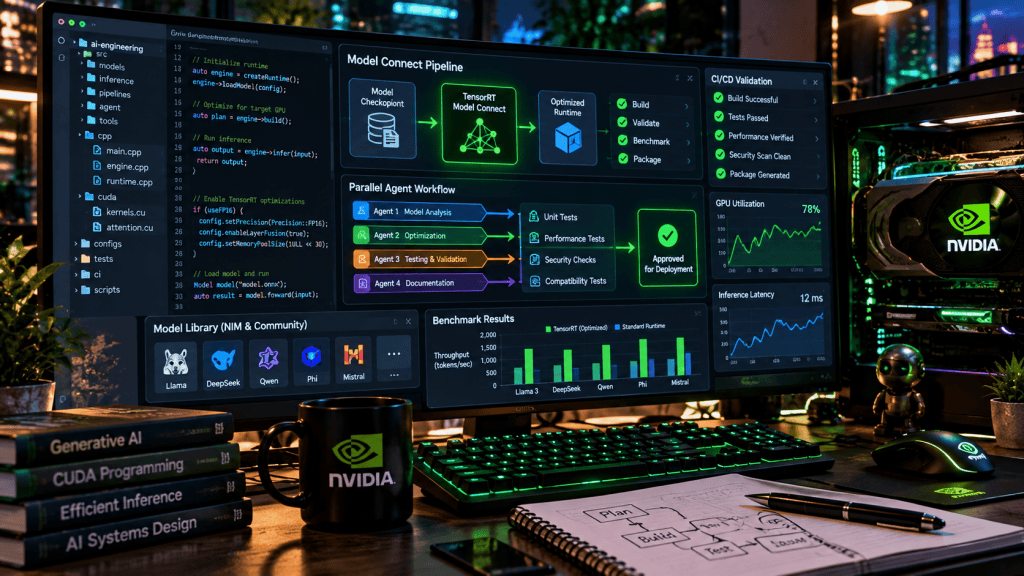
NVIDIA is using TensorRT Model Connect to test a different way of building production software: coding agents generate candidate implementations in parallel, while architecture, reproducible tests and human review decide what actually ships.
In a September 29 engineering account, NVIDIA describes TensorRT Model Connect as an open-source collection of C++ model reference implementations built on TensorRT. The project turns supported Hugging Face or local checkpoints into versioned bundles and exposes task-oriented native APIs for workloads including text, vision, audio, diffusion, segmentation, embeddings and forecasting.
Agents make candidate code cheaper
The central engineering lesson is not that AI can write code. NVIDIA’s team argues that agent-generated candidate implementations can be produced quickly enough that validation becomes the limiting resource. Instead of giving every agent a rigid recipe, the project gives it an outcome, reference behavior and acceptance criteria, then forces the resulting work through tests, performance checks and human inspection.
That approach resembles the orchestration questions BitcoinVersus examined in NVIDIA’s OO Agents Python framework, where the useful unit is not a single prompt but a controlled workflow with explicit tools, state and handoffs.
Model families are isolated on purpose
NVIDIA says the project keeps model-family builders, runtime pipelines, helper kernels, configuration and validation evidence close to the family that owns them. The goal is to keep one failed experiment from destabilizing unrelated model work. Shared infrastructure is promoted only when multiple independent owners need the same contract.
The team also favors reversible changes, or what it calls two-way doors. If a candidate implementation is easy to evaluate and easy to back out, the project can explore aggressively without turning development speed into permission to weaken reliability.
Independent research published on September 23 provides useful context for the same class of problem. A paper on agent-driven model conversion across heterogeneous inference runtimes describes staged verification loops and runtime-specific knowledge for moving models across OpenVINO, RKNN, TensorRT and ONNX Runtime. It is a separate project, but it reinforces why conversion and deployment workflows need explicit validation rather than treating a successful code-generation pass as proof of correctness.
TensorRT Model Connect is already moving onto edge systems
The project is not confined to a datacenter demo. A September 23 deployment shared by Seeed Studio shows TensorRT Model Connect running a Qwen3-4B FP16 workflow on a Jetson AGX Orin system without an intermediate x86 ONNX export. That example connects NVIDIA’s software-architecture claims to the practical developer goal: shortening the path from a checkpoint to a native runtime on target hardware.
The edge angle also overlaps with NVIDIA Isaac ROS 5.0 bringing AI agents into robot development, where deployment quality depends on more than model intelligence alone. Runtime boundaries, hardware support, observability and repeatable testing become part of the product.
Evidence becomes the production bottleneck
NVIDIA says TensorRT Model Connect covered 128 model families tested on GB300 in the public comparison referenced by its September 29 article. The company explicitly warns that the count should not be read as a simple productivity score for coding agents. More parallel agents can increase the amount of software that needs validation faster than they increase the amount of software that is safe to accept.
That is why the project treats QA as an adversarial collaborator rather than a downstream sign-off step. Automated checks, reference comparisons and reproducible CI establish the baseline, while human-legible outputs give reviewers a final way to spot behavior that the test suite may not have captured.
It is the same control problem BitcoinVersus recently covered from a security angle in NVIDIA’s hardware watchdog for autonomous AI agents: increased autonomy only becomes useful when the surrounding system can constrain, inspect and reject unsafe behavior.
TensorRT Model Connect remains a public-preview project, and NVIDIA says important questions are still open, including how far tasks can be decomposed, how quickly validation capacity can scale and how much orchestration should be added when repeated failure modes appear. The experiment is therefore less a claim that agents have replaced software engineers than a demonstration of where engineers may move their attention: toward architecture, evidence, acceptance criteria and release accountability.
BitcoinVersus.Tech
Advertisement
Editor’s Note:
We volunteer daily to ensure the credibility of the information on this platform is Verifiably True. If you would like to support to help further secure the integrity of our research initiatives, please donate here: 3C9o19EH5HSiwEPyCTmEKzxhNCbo2X6TTb
BitcoinVersus.tech is not a financial advisor. This media platform reports on financial subjects purely for informational purposes.


Leave a Reply