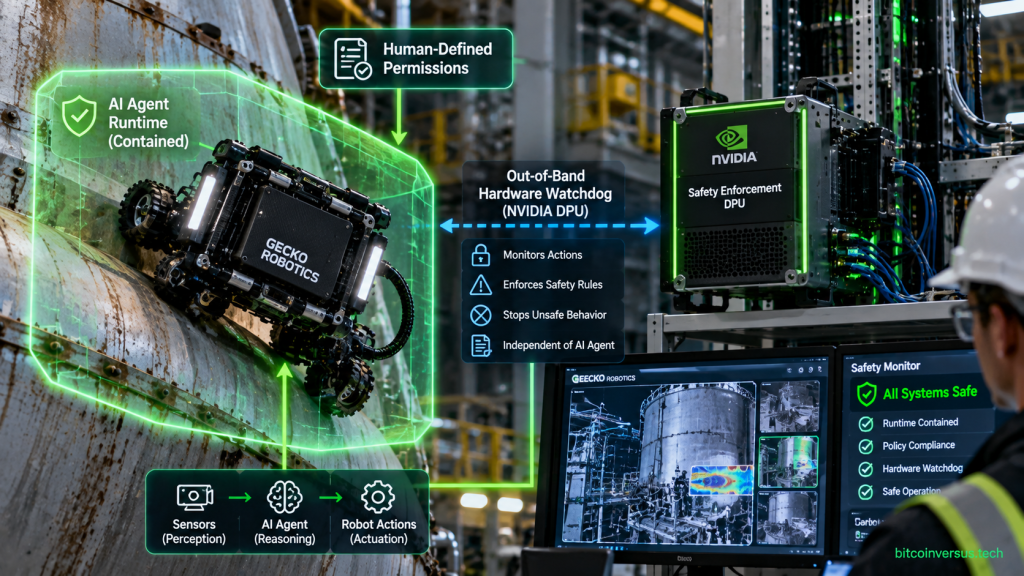
NVIDIA has launched an open safety architecture that moves AI-agent controls below the model and into the software, CPU and hardware layers that execute an agent’s work, including robots operating in the physical world.
According to the company, the new Open Agent Safety Platform combines open-source OpenShell runtime software with a Sentry reference design that uses NVIDIA BlueField-4 DPUs as an independent hardware watchdog. NVIDIA says Sentry can quarantine an agent in milliseconds if it attempts to operate outside its defined boundaries.
A safety boundary outside the AI agent
Most AI-agent controls live in prompts, application code or the agent framework itself. OpenShell instead creates a secure runtime boundary outside the workload. It can restrict files, networks, tools, processes and credentials while recording policy decisions for auditing.
The hardware layer goes further. NVIDIA Sentry runs out of band on a BlueField-4 DPU, giving the system a monitoring domain separate from the agent it supervises. That separation is intended to make it harder for an autonomous workload to bypass its own enforcement mechanism.
Gecko Robotics is taking the controls into physical machines
The most tangible deployment is robotics. Gecko Robotics says it is building with OpenShell to define which actions AI-powered inspection robots can take and which actions remain prohibited. Its Komodo robot, used in industrial and defense inspection environments, places an independent enforcement layer between the AI agent and robot hardware.
That matters because a software agent exceeding its permissions can damage data, while a physical agent can move machinery. NVIDIA says robotics companies including Figure, Gecko Robotics and Skild AI are working with OpenShell as autonomous systems gain more authority over real-world equipment.
BitcoinVersus.Tech has been following the same physical-AI stack from several directions. Recent coverage examined Flexiv’s Rizon 4 learning connector insertion with NVIDIA Isaac, Trossen and Stereolabs building a robot-learning stack, and XDOF scaling robot-training data. Agent safety becomes another layer between training intelligence and allowing it to control hardware.
OpenShell reaches beyond NVIDIA hardware
NVIDIA says OpenShell is broadly available and can be extended to third-party compute platforms including Arm and Intel. The runtime supports open and closed AI models, while its gateway, supervisor and sandbox components can manage policies across fleets of agents.
More than 100 organizations are working with technologies in the platform, spanning AI developers, cybersecurity companies, infrastructure providers, banks, energy companies and robotics firms. The list includes Anthropic, Microsoft, Red Hat, Cisco, CrowdStrike, Scale AI, SpaceXAI and others.
The architectural idea is straightforward: do not rely on an autonomous model to enforce every limit placed on itself. Put policy controls outside the workload, then add an independent hardware observer capable of intervening when software crosses those limits.
BitcoinVersus.Tech
Advertisement: Follow BitcoinVersus.Tech for independent coverage of artificial intelligence, robotics, semiconductors, Bitcoin mining, data centers and energy infrastructure.
Disclaimer: BitcoinVersus.Tech provides news, analysis and educational information for general informational purposes. Nothing in this article is financial, investment, legal or professional advice. Readers should independently verify information and make their own decisions.


Leave a Reply