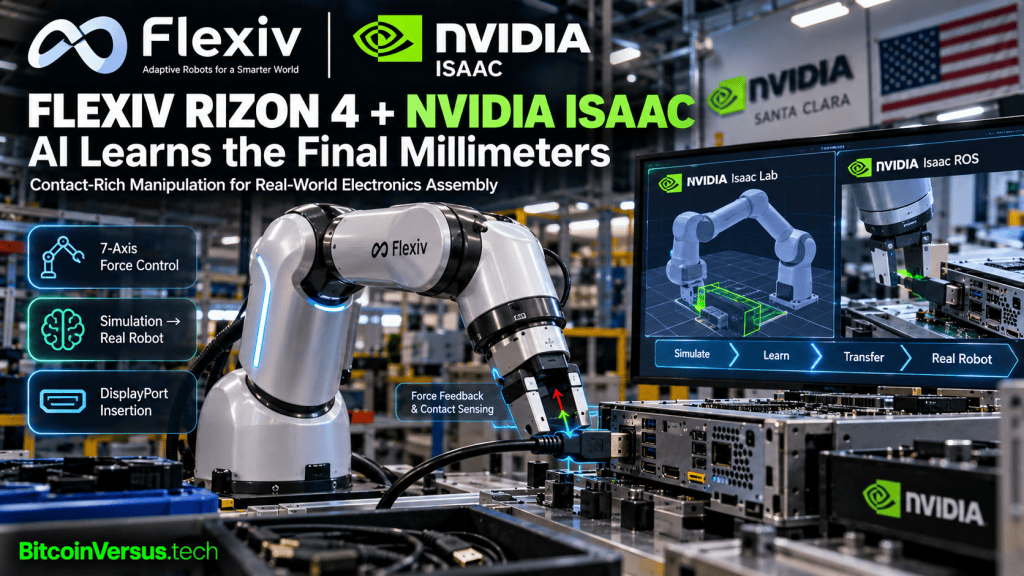
Flexiv’s seven-axis Rizon 4 adaptive robot is now supported in NVIDIA Isaac, with the arm serving as reference hardware for a new contact-rich workflow that trains an AI policy in simulation and transfers it to a physical robot to insert a DisplayPort cable.
The company announced the integration on September 23. The important part is not simply that another robot appears in a software compatibility list. The reference workflow tackles the final millimeters of electronics assembly, where small alignment errors and physical contact can defeat rigid, position-only automation.
Flexiv’s Rizon 4 combines seven-axis motion, integrated force sensing and NVIDIA Isaac software for contact-rich electronics assembly.
The robot learns insertion in simulation first
The workflow begins in NVIDIA Isaac Lab. A reinforcement-learning policy is trained with variation in socket position, contact properties and robot dynamics so the system learns how to respond when the real connector is not perfectly aligned.
The policy then moves to the physical Rizon 4 through Isaac ROS. FoundationPose estimates the target pose and cuMotion handles the approach. During the final contact phase, the robot’s force-control system closes the loop and adjusts its movement based on what it physically feels.
That sim-to-real pipeline builds directly on earlier Flexiv and NVIDIA work. Flexiv’s June 2025 Isaac Bridge demonstration showed the same broader idea of validating force-controlled behavior virtually before transferring it to real hardware. Because I could not independently confirm that the previously inserted YouTube URL remains third-party playable, it has been removed rather than leaving a broken player in the article.
Flexiv’s earlier Isaac simulation work provides context for the new contact-rich insertion workflow without relying on an unverified video embed.
Why DisplayPort insertion is difficult
A cable connector looks simple to a human because people naturally make tiny corrections after contact. A conventional industrial robot following a fixed trajectory has a harder problem. Fixtures shift, tolerances accumulate and the socket may be fractions of a millimeter away from its expected position.
Flexiv says the Rizon 4 streams low-level motion commands at up to 1,000 Hz and includes joint-torque and force-torque sensing. Those capabilities allow a learned policy to make high-rate physical corrections instead of forcing the connector through resistance.
The approach is part of the wider physical-AI transition BitcoinVersus.tech has tracked through Trossen and Stereolabs’ robot-learning stack, Ambarella’s low-power X7 accelerator and QBit’s single-chip robot control platform.
NVIDIA is turning Isaac into a deployment path
NVIDIA’s published Isaac assets include an insertion policy for the Flexiv Rizon 4s with the company’s Grav gripper. NVIDIA’s Isaac Lab documentation also describes training and deploying contact-rich assembly policies on Flexiv hardware.
That matters because the difficult part of physical AI is often not producing a convincing simulation. It is preserving useful behavior when a policy encounters friction, compliance, tolerances and imperfect sensing on a real production line.
BitcoinVersus.tech recently covered NVIDIA Isaac ROS 5.0’s agentic robotics tools. The Flexiv integration shows the other side of that software push: a specific force-controlled industrial arm and a reproducible manipulation task.
The new workflow connects perception, motion planning and force feedback instead of treating robot intelligence as a purely visual problem.
Force control gives physical AI a sense of touch
Traditional position-controlled robots excel when every part arrives in nearly the same place. Force-controlled systems target the messier jobs where surfaces move slightly, materials flex or successful completion depends on recognizing physical contact.
Flexiv positions Rizon 4 for insertion, assembly, polishing and other contact-rich applications. That puts it in a different part of the robotics stack from the humanoid systems BitcoinVersus.tech has covered, including Apptronik’s U.S. humanoid hardware push and Agility’s Digit 5.
The same trend is visible in sensing. Aeva and LG Innotek are moving 4D lidar toward robot production, while Flexiv is emphasizing what happens after perception, when the machine actually touches the object.
The reference workflow arrives in October
Flexiv says NVIDIA plans to release the contact-rich insertion workflow and simulation assets in October. Developers will be able to reproduce the DisplayPort example and adapt the recipe to other connectors, sockets and fixtures.
The test for manufacturers will be repeatability across real production variation. But the engineering direction is clear: train at scale in simulation, use GPU-accelerated perception and planning to reach the target, then let force-sensitive hardware handle the physical uncertainty that remains.
For electronics manufacturing, the breakthrough is not that a robot can plug in a cable. It is that the robot can learn how to recover when the cable and socket are not exactly where the simulation expected them to be.
Advertisement:
Support BitcoinVersus.tech’s independent technology reporting and research.
BitcoinVersus.Tech Editor’s Note & Disclaimer:
We volunteer daily to ensure the credibility of the information on this platform is Verifiably True. BitcoinVersus.tech provides news, technical analysis and educational information and does not provide financial or investment advice. Verify technical specifications and operational requirements with the manufacturer before making purchasing, deployment or investment decisions. If you would like to support to help further secure the integrity of our research initiatives, please donate here: 3C9o19EH5HSiwEPyCTmEKzxhNCbo2X6TTb


Leave a Reply