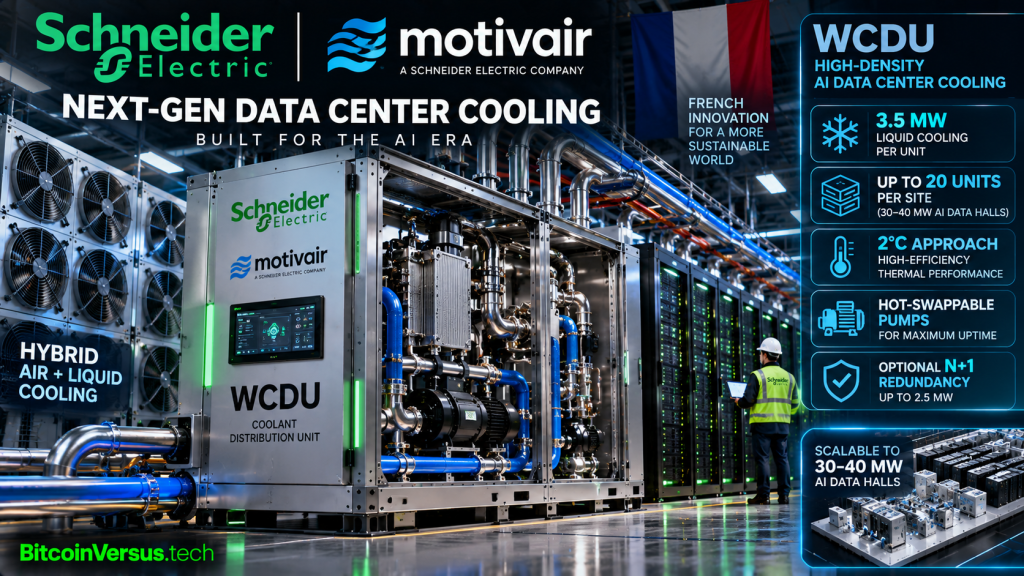
Schneider Electric has launched a new Motivair WCDU capable of removing up to 3.5 MW of heat per unit, giving high-density AI data centers a hybrid path between fan-wall air cooling and direct liquid cooling without rebuilding the entire data hall.
The company announced the WCDU on September 23 as a technical-corridor coolant distribution unit built for rapidly changing AI rack densities.
Schneider Electric’s new Motivair WCDU combines liquid-cooling distribution with existing fan-wall architectures for high-density AI infrastructure.
3.5 MW from one cooling distribution unit
A single WCDU is rated for up to 3.5 MW at 1.5 liters per minute per kilowatt. At 2.0 L/min/kW, capacity is 2.5 MW. Up to 20 units can operate together in group mode, giving operators enough coordinated cooling capacity for today’s 30–40 MW AI data halls.
The WCDU integrates pumps, heat exchangers and other critical components into one steel frame. Top-entry connections and zero lateral clearance are intended to make corridor installation and maintenance easier while preserving valuable white-space floor area.
That scale continues a rapid escalation BitcoinVersus.tech has tracked across Delta’s 3 MW AI cooling platform, Vertiv’s 2.3 MW DSX Ready cooling unit and NVIDIA DSX Ready power and cooling infrastructure.
Hybrid cooling avoids an all-or-nothing retrofit
The central engineering idea is flexibility. Data-center operators can adjust the ratio of air and liquid cooling as server configurations change instead of committing the entire hall to one cooling architecture before final workloads are known.
Motivair’s technical release says the WCDU is optimized for technical corridors, where large operators increasingly place CDUs to simplify service access. Existing fan-wall deployments can therefore gain a path toward liquid cooling without consuming as much compute-floor space.
The WCDU is designed for the transition period in which conventional air-cooled equipment and increasingly dense liquid-cooled AI racks operate inside the same facility.
A 2°C approach targets cooling efficiency
Motivair says the WCDU can operate with an approach temperature as low as 2°C. A smaller approach means the coolant loop can operate closer to facility-water temperature, supporting warmer water and reducing the work required elsewhere in the heat-rejection system.
The unit includes hot-swappable pumps, pressure-independent control valves, 25-micron filters and a 15-inch touchscreen HMI. For deployments up to 2.5 MW, operators can specify N+1 redundancy so a pump or valve failure does not automatically remove the entire cooling path.
The focus on serviceability matters as AI facilities grow. BitcoinVersus.tech has also covered Vertiv’s expansion of liquid-cooling services and Enphase’s 800 VDC AI power modules, both reflecting the shift from individual server components toward facility-scale electrical and thermal systems.
Cooling is scaling with AI power
The WCDU arrives as AI infrastructure increasingly gets discussed in megawatts rather than individual racks. BitcoinVersus.tech recently reported on Applied Digital’s Alabama AI campus and Bitdeer’s planned 30 MW Bhutan facility with a path toward 500 MW.
As compute density rises, cooling architecture becomes part of the power architecture. A facility cannot deploy another megawatt of accelerators unless it can move the resulting heat out of the racks, through the coolant loop and ultimately outside the building.
At 3.5 MW per unit and up to 20 coordinated units, Schneider Electric is designing the WCDU around the scale of the AI data hall rather than the scale of a conventional server room.
Shipping begins in October
Schneider Electric says WCDU shipments will begin in select regions in October 2026, with U.S. pre-orders opening in early 2027. The launch expands Motivair’s end-to-end CDU range from 105 kW to 3.5 MW.
The bigger story is how quickly cooling infrastructure is being redesigned around accelerated computing. Power distribution is moving toward higher-voltage architectures, optical networks are moving toward multi-terabit links, and liquid cooling is moving from specialized HPC installations into the basic design language of AI factories.
Advertisement:
Support BitcoinVersus.tech’s independent technology reporting and research.
BitcoinVersus.Tech Editor’s Note & Disclaimer:
We volunteer daily to ensure the credibility of the information on this platform is Verifiably True. BitcoinVersus.tech provides news, technical analysis and educational information and does not provide financial or investment advice. Verify technical specifications and operational requirements with the manufacturer before making purchasing, deployment or investment decisions. If you would like to support to help further secure the integrity of our research initiatives, please donate here: 3C9o19EH5HSiwEPyCTmEKzxhNCbo2X6TTb


Leave a Reply