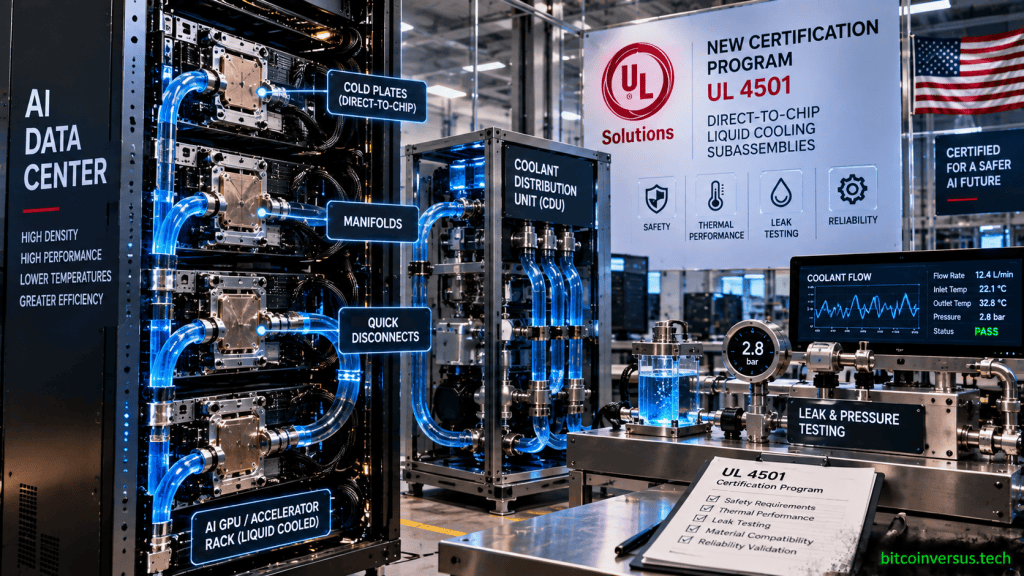
UL Solutions has launched a new certification program for direct-to-chip liquid-cooling subassemblies used in AI data centers, creating a formal test path for cold plates, manifolds and quick disconnects before those components are integrated into complete high-density cooling systems.
The September 29 announcement says the program uses UL 4501, the Outline of Investigation for Safety, Performance and Interoperability of Liquid-Filled Components and Assemblies Used in Liquid Cooling Systems. UL Solutions says eligible parts are evaluated for coolant compatibility, pressure and leak integrity, durability, liquid flow, interoperability, production controls and installation requirements.
The move targets a fast-growing operational problem in AI infrastructure. Modern accelerators can exceed the practical limits of conventional air cooling, so more data-center designs are moving heat directly from processors into liquid-cooled cold plates and then into a larger coolant loop.
Direct-to-chip cooling adds new failure modes
Liquid cooling can remove heat more efficiently at the chip, but it also introduces risks that do not exist in the same form with conventional air cooling. Leaks, corrosion, incompatible wetted materials, incorrect pressure ranges and coolant contamination can affect both reliability and safety.
UL Solutions says the new certification is intended to evaluate those subassemblies before they disappear inside a larger rack or facility-level cooling system. That can help manufacturers identify compatibility problems earlier instead of repeating tests after full system integration.
A same-day market post highlighted the launch as UL Solutions moved the certification into the public market conversation.
Cold plates are only one part of the loop
A direct-to-chip system typically moves coolant through a cold plate mounted directly to the processor package. Manifolds distribute that coolant across multiple servers or rack positions. Quick disconnects allow maintenance without draining the entire loop. A coolant distribution unit then manages heat exchange, pressure, temperature and flow between the IT loop and facility water system.
The following English-language JetCool video shows how cold-plate liquid cooling fits into a broader data-center cooling architecture.
BitcoinVersus.Tech recently covered Schneider Electric’s 3.5 MW WCDU, which shows how quickly coolant-distribution capacity is scaling. We also examined Vertiv’s expansion of AI liquid-cooling services and BitSink’s effort to move high-density mining cooling into AI data centers.
Testing pressure, flow and materials matters before deployment
Independent component testing matters because a liquid-cooling loop is only as reliable as the interfaces between its parts. Two components can physically connect while still using incompatible coolants, seal materials, pressure limits or operating temperatures.
The Open Compute Project presentation below provides a technical look at how coolant distribution units are tested for thermal performance, capacity, fluid compatibility, pressure, flow and control behavior.
Cooling is becoming part of the data-center power problem
Data-center thermal design now affects electrical design directly. The U.S. Department of Energy has estimated that cooling can account for up to 40% of a data center’s energy use. As GPU rack densities increase, operators are therefore trying to remove more heat while reducing the energy overhead of doing it.
UL Solutions’ certification does not solve those thermodynamic limits, but it addresses a different bottleneck: whether the liquid-filled components entering a rack have been independently evaluated for the operating environment they are expected to survive.
Certification could make multi-vendor cooling easier
AI infrastructure is increasingly assembled from components supplied by different vendors. That creates pressure for common test methods and interoperability requirements, particularly around cold plates, manifolds, hoses, connectors and CDUs.
UL Solutions says its program can also support evaluation of additional cooling equipment under other applicable UL standards, including CDUs, self-contained liquid-filled systems, liquid-cooled busways, cables, connectors, power whips, gaskets, O-rings and hoses.
The larger shift is that cooling hardware is becoming a first-class part of AI infrastructure rather than a secondary mechanical system. Certification, telemetry and interoperability are starting to matter as much to liquid-cooling deployment as raw thermal capacity.
BitcoinVersus.Tech
Advertisement: Follow BitcoinVersus.Tech for independent coverage of Bitcoin mining, ASIC hardware, semiconductors, AI infrastructure, data centers, cooling and energy.
BitcoinVersus.Tech Editor’s Note:
We volunteer daily to ensure the credibility of the information on this platform is Verifiably True. If you would like to support to help further secure the integrity of our research initiatives, please donate here: 3C9o19EH5HSiwEPyCTmEKzxhNCbo2X6TTb
BitcoinVersus.tech is not a financial advisor. This media platform reports on financial subjects purely for informational purposes.


Leave a Reply