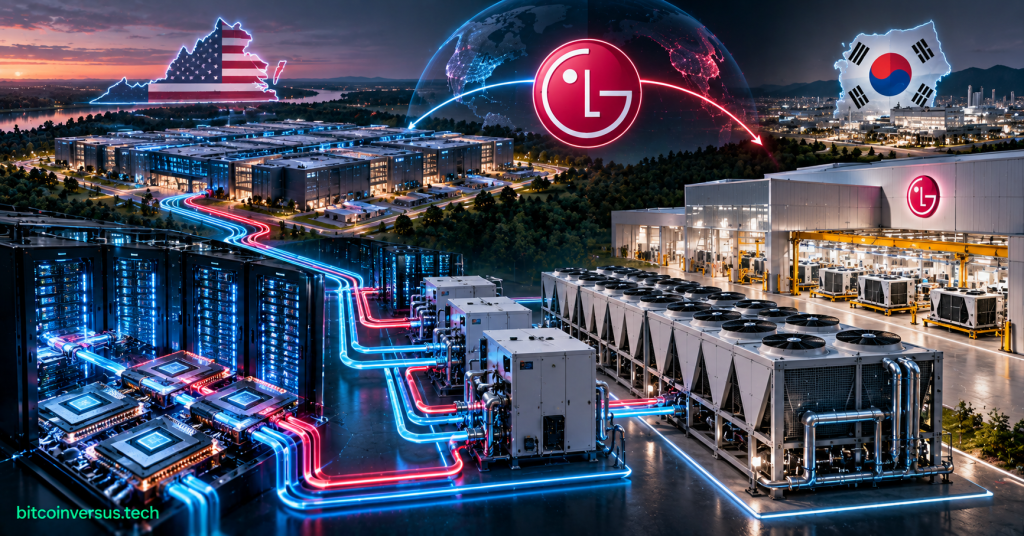
LG Electronics is building its first U.S. chiller factory in Virginia to serve the AI data center market, turning one of the least glamorous parts of computing infrastructure into a major manufacturing priority.
In its October 1 announcement, LG said the new facility will sit on a 43-acre site in Isle of Wight County and span roughly 350,000 square feet. Production of air-cooled chillers for AI data centers is scheduled to begin in the first half of 2027.
AI infrastructure is turning cooling into a manufacturing race
AI data centers concentrate enormous amounts of computing hardware into relatively small footprints. GPUs, accelerators, power electronics and networking equipment all release heat continuously, so cooling capacity has to scale alongside electrical capacity.
Independent coverage from Business Facilities confirms that the Virginia plant will be LG’s first U.S. chiller production site and is expected to create more than 150 jobs while supporting North American data-center growth.
BitcoinVersus has already covered the other end of LG’s cooling stack through LG’s 2.6 MW coolant distribution unit for AI data centers. That system operates closer to the racks, moving coolant through the liquid loop that ultimately has to reject heat somewhere else.
LG is building a “chip-to-chiller” cooling chain
LG describes its strategy as “Chip-to-Chiller.” At the chip level, cold plates pull heat directly away from processors. Coolant distribution units regulate and circulate the liquid inside the data center. Chillers then sit farther out in the thermal chain, removing heat from the overall cooling system so the process can continue.
That full-stack approach is becoming more important as AI racks get denser. BitcoinVersus recently covered Trane’s 3.5 MW 800 V DC chiller for AI data centers, another sign that cooling systems are scaling into multi-megawatt infrastructure rather than remaining conventional building HVAC.
The engineering challenge is no longer just keeping server rooms comfortable. Modern AI cooling systems increasingly have to coordinate direct-to-chip liquid loops, pumps, heat exchangers, controls, power systems and large external chillers as one thermal platform.
LG is also expanding chiller production in South Korea
The Virginia plant is only one part of the expansion. LG is adding air-cooled chiller production lines at its existing Pyeongtaek and Changwon factories in South Korea and is introducing conveyor-based production intended to make chiller manufacturing more repeatable at higher volume.
That is an important shift. Chillers have historically looked like specialized mechanical infrastructure built project by project. AI demand is pushing manufacturers toward something closer to industrialized, repeatable production because hyperscale data centers need large quantities of cooling equipment on predictable construction schedules.
Cooling is becoming part of the AI hardware stack
LG’s own Air Solutions overview provides useful context for that strategy. The company connects central cooling chiller plants, AI data-center thermal management and building control systems as parts of the same infrastructure portfolio.
The same trend is showing up in safety and certification. BitcoinVersus recently covered UL’s certification program for direct-to-chip AI cooling, which reflects how thermal hardware is moving from an engineering niche into a standardized part of the computing stack.
Virginia puts the factory close to one of the world’s largest data-center markets
Virginia is already one of the most concentrated data-center markets in the United States. Putting chiller production closer to that demand can shorten delivery distances for equipment that is large, heavy and tightly tied to the construction schedule of a data-center campus.
That proximity matters because a completed GPU hall still cannot operate at design load unless its electrical and thermal infrastructure is ready at the same time. The cooling plant is not an accessory to the AI system; it is part of the system.
LG’s first U.S. chiller factory is another sign that the AI buildout is spreading far beyond chip fabs and server assembly. The boom now reaches pumps, heat exchangers, chillers, cold plates, power gear and the factories needed to manufacture all of them at scale.
BitcoinVersus.Tech
Advertisement
Editor’s Note:
We volunteer daily to ensure the credibility of the information on this platform is Verifiably True. If you would like to support to help further secure the integrity of our research initiatives, please donate here: 3C9o19EH5HSiwEPyCTmEKzxhNCbo2X6TTb
BitcoinVersus.tech is not a financial advisor. This media platform reports on financial subjects purely for informational purposes.


Leave a Reply