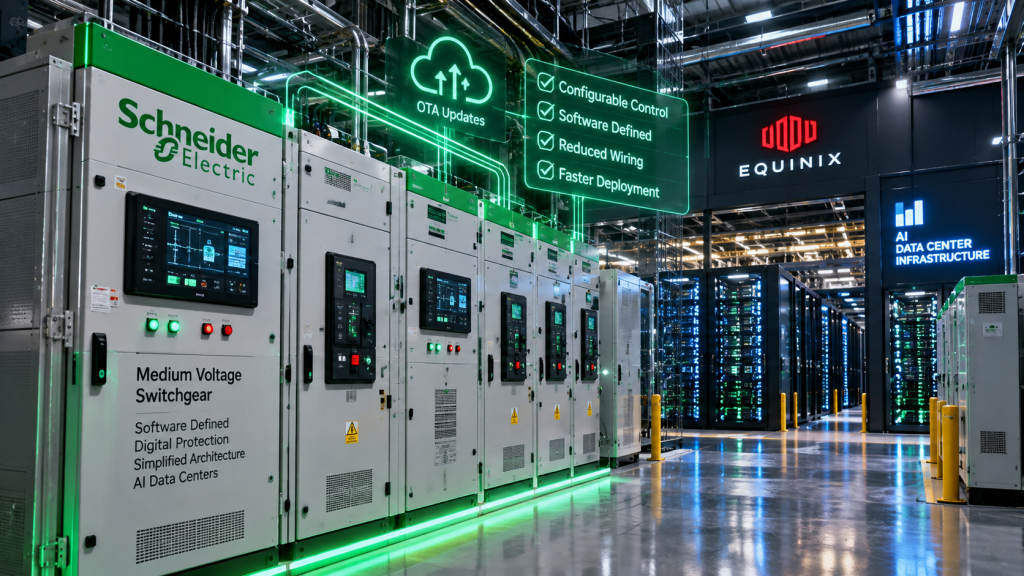
Schneider Electric is moving one of the data center’s most hardware-heavy electrical systems into software. Its new software-defined medium-voltage switchgear virtualizes protection, control, metering and monitoring functions that traditionally require separate devices, extensive control wiring and custom engineering.
Unveiled September 28 at YOTTA 2026, Schneider’s new architecture is aimed at hyperscale and colocation data centers where power infrastructure has to be deployed quickly enough to keep pace with AI compute. The company says the system can cut lead time by as much as 3× and commissioning time by as much as 2×.
Switchgear becomes a configurable software platform
Traditional medium-voltage systems can contain protection relays, power meters, transducers, gateways, PLCs and control modules selected and wired for a particular site. Schneider’s approach replaces multiple hardware functions with standardized merging units and virtualized software capabilities.
That changes the deployment model from engineer-to-order toward configure-to-order. Schneider says software can add or modify functions over the air without replacing physical equipment or taking the system offline. It also says predictive maintenance and AI agents can reduce maintenance requirements by up to 40%.
Independent engineering coverage reports that Schneider has already deployed the architecture in a live colocation data-center pilot with Equinix. In a 20-panel comparison cited by the company, the software-defined configuration used 87% less control wiring, 91% fewer terminals and 85% less copper in the control wiring.
The focus on faster electrical deployment complements the thermal side of AI infrastructure. BitcoinVersus recently covered Schneider Electric’s 3.5 MW WCDU, which addresses the other half of the power-and-heat problem created by increasingly dense accelerator racks.
Equinix is testing the architecture in a live facility
The Equinix pilot is important because Schneider is not presenting software-defined MV only as a future concept. The architecture is operating in a colocation environment while pilot programs continue through 2027. Broader availability is planned for 2028.
A specific September 28 X update summarized the launch and highlighted Schneider’s 3× ordering-and-manufacturing target and 2× commissioning target.
The launch arrives as NVIDIA is trying to standardize more of the infrastructure surrounding AI factories. BitcoinVersus has tracked that transition through NVIDIA’s DSX Ready qualification program, which treats power and cooling equipment as integral parts of accelerator deployment rather than generic facility systems.
RM AirSeT 38 pushes the design to 38 kV
Schneider also introduced RM AirSeT 38 Software Defined, extending its secondary gas-insulated switchgear platform from 24 kV to 38 kV. The design uses pressurized pure air insulation and vacuum interruption instead of sulfur hexafluoride or proprietary fluorinated gas mixtures.
The 38 kV architecture is aimed specifically at next-generation AI data centers as operators consider higher-voltage distribution to support denser campuses. Order intake is planned for 2027, with first deliveries expected in 2028.
That higher-voltage direction also intersects with the industry’s move toward new rack-level power architectures. BitcoinVersus recently examined Delta’s 800 VDC power and 3 MW cooling architecture, another example of data-center electrical design being rebuilt around AI-scale loads.
AI factories are forcing electrical infrastructure to behave more like computing
The larger change is architectural. Software-defined networking and storage separated functionality from fixed hardware years ago. Schneider is now applying a similar concept to medium-voltage electrical distribution, where standardized physical equipment can gain or change functions through software.
The performance claims remain Schneider’s design comparisons rather than universal results for every deployment, and broader commercial availability is still ahead. But the live Equinix pilot gives the concept a real operating environment and makes software-defined power distribution a concrete part of the AI data-center buildout rather than simply a roadmap idea.
BitcoinVersus.Tech
Advertisement
Editor’s Note:
We volunteer daily to ensure the credibility of the information on this platform is Verifiably True. If you would like to support our research initiatives, please donate here: 3C9o19EH5HSiwEPyCTmEKzxhNCbo2X6TTb
BitcoinVersus.tech is not a financial advisor. This media platform reports on financial subjects purely for informational purposes.


Leave a Reply