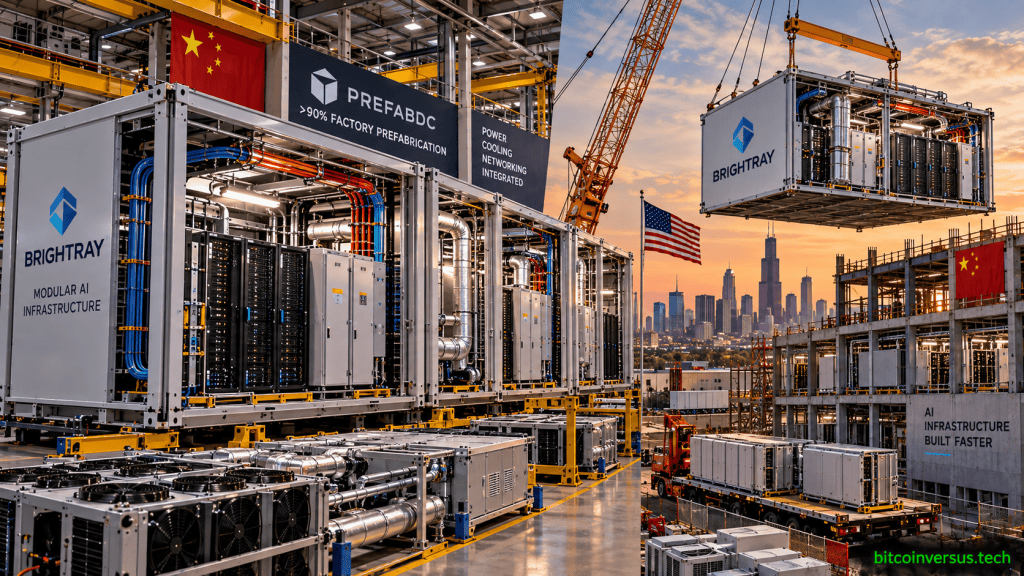
Chinese data-center manufacturers are looking at the U.S. AI construction boom with a different proposition: build most of the data center in a factory, ship the modules to the site and assemble them like an industrial product.
The approach is the focus of the CNBC report supplied with this story. Brightray, a Singapore-registered AI infrastructure company whose sole manufacturer is China’s PrefabDC, says its prefabricated approach can reduce construction time by at least half compared with the roughly two-to-three-year U.S. build cycle cited in the report.
The video is embedded below so the factory-built structures, electrical systems and installation process can be viewed directly rather than reduced to a construction diagram.
More than a container beside a warehouse
Modular data centers are not new. What Brightray calls its FPD, or fully prefabricated data-center solution, pushes modular construction farther into the permanent building itself.
Regulatory disclosures describe steel structures that become the building’s load-bearing frame after assembly. More than 90% of the module can be prefabricated, including structural work, interior fit-out, key equipment, cable trays, piping, power distribution, HVAC, low-voltage systems and selected fire-protection equipment.
Foundations and municipal work can proceed while the modules are being manufactured. The completed sections are then transported to the site, lifted into position, connected and commissioned as a complete facility.
AI has made construction time a computing constraint
The attraction is straightforward. GPUs and accelerators can arrive faster than utilities, substations, switchgear, cooling plants and buildings. Every month a powered AI rack waits for physical infrastructure is a month expensive compute capacity is not producing work.
BitcoinVersus.Tech has been tracking the same bottleneck from several directions. Small gas turbines are being used to accelerate AI data-center power, while Schneider Electric is scaling liquid cooling into multi-megawatt systems. A prefabricated building tries to compress another part of the schedule.
A 40 MW project provides a real-world test
Brightray is not relying entirely on a U.S. sales pitch. On September 25 its subsidiary signed a framework agreement involving a planned approximately 40 MW AI data center in Coloane, Macao.
The project announcement describes a proposed five-storey facility on roughly 9,000 square meters using the FPD system, with delivery targeted for the third quarter of 2027 and a design intended to meet Tier III standards.
There is an important qualification. The framework agreement does not itself obligate the parties to buy or supply the modules. A definitive contract depends on Brightray securing a tenant and that customer executing a binding lease. Pricing is also provisional.
The U.S. opportunity comes with supply-chain politics
CNBC’s report says Chinese suppliers already participate in U.S. data-center supply chains through equipment such as transformers, batteries and fiber-optic cable. Long domestic lead times make overseas manufacturing capacity attractive when developers are racing to energize AI campuses.
But data-center infrastructure is also increasingly treated as strategic infrastructure. Potential U.S. restrictions on additional Chinese data-center components could therefore limit the market Brightray is targeting. No U.S. Brightray customer was identified in the reporting.
The tension is similar to the hardware-supply problem behind Civo’s plan for 40 distributed AI data centers: the industry wants more compute closer to demand, but every deployment still depends on physical power, cooling, networking and construction capacity.
Data centers are becoming manufactured products
The larger engineering shift may outlast the trade debate. Standardized racks already turned computing into repeatable hardware. Prefabricated electrical skids and cooling modules did something similar for supporting infrastructure. Fully prefabricated structures extend that logic to the building.
If the approach works at scale, the construction site becomes more like a final integration point. Structure, piping, cabling, electrical distribution and cooling arrive in tested modules instead of being assembled almost entirely in the field.
That does not eliminate the hardest constraints. Grid interconnection, land, permits, fiber and water remain local. But as AI developers compete for months rather than years, industrializing the portion of the data center that can be manufactured elsewhere could become another way to compress the deployment schedule.
BitcoinVersus.Tech
Advertisement: Follow BitcoinVersus.Tech for independent coverage of artificial intelligence, data centers, semiconductors, Bitcoin mining, ASIC hardware and energy infrastructure.
BitcoinVersus.Tech Editor’s Note:
We volunteer daily to ensure the credibility of the information on this platform is Verifiably True. If you would like to support to help further secure the integrity of our research initiatives, please donate here: 3C9o19EH5HSiwEPyCTmEKzxhNCbo2X6TTb
BitcoinVersus.tech is not a financial advisor. This media platform reports on financial subjects purely for informational purposes.


Leave a Reply