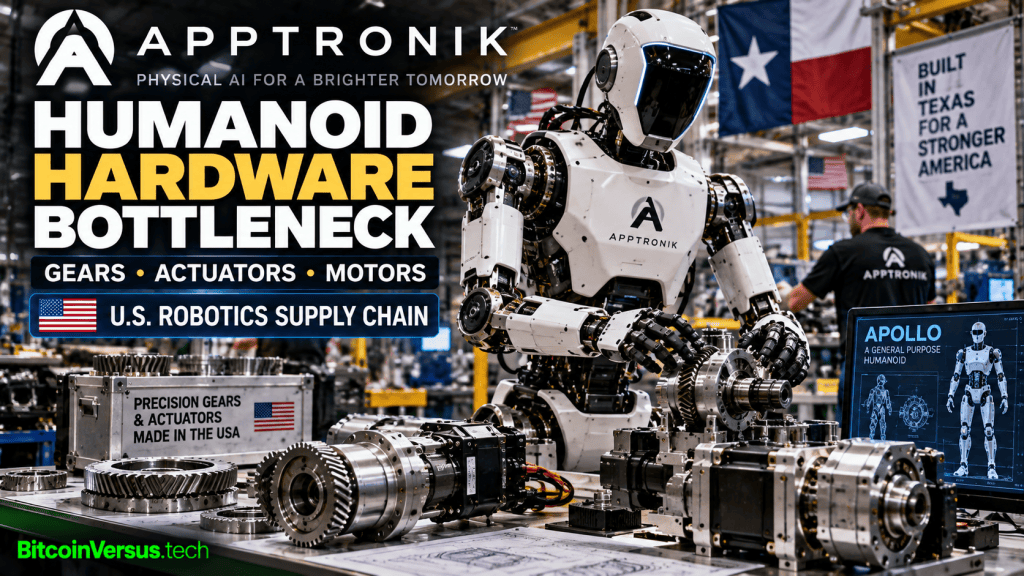
Apptronik CEO Jeff Cardenas says the United States has a hardware problem to solve if it wants to scale humanoid robots: the domestic supply base is short on critical components including precision gears.
Cardenas made the comments during a September 22 television interview about the global robotics race. The Austin, Texas company is developing Apollo 2 for manufacturing and logistics while building a broader U.S. physical-AI ecosystem.
Apptronik CEO Jeff Cardenas discusses the hardware and manufacturing foundation required to scale U.S. humanoid robotics.
The bottleneck is inside the joints
Cardenas described actuators as the muscles of a humanoid. These assemblies combine motors, gearboxes and electronics to convert electrical power and software commands into controlled physical motion.
According to Cardenas, actuators can represent as much as 60% of a humanoid robot’s bill of materials. He specifically identified gears as an area where the U.S. lacks the supply base it needs. Recent reporting on the interview also notes Apptronik has designed more than 80 distinct electric actuators since its founding.
The issue connects directly with BitcoinVersus.tech’s coverage of more than five million industrial robots working in factories, MISUMI’s $50 million physical-AI fund, and NEURA and SECO’s European physical-AI hardware.
Software leadership still needs metal, motors and gears
Cardenas’ central argument is that AI software alone cannot create a competitive robotics industry. Humanoids require precision mechanical parts, power electronics, sensors, batteries, compute and reliable high-volume manufacturing.
That hardware reality is also visible in QBit’s robot-control silicon, Cognex’s RealSense acquisition and Qualcomm’s expansion into robotics.
Jabil is already part of Apptronik’s manufacturing plan
The supply-chain comments build on an existing manufacturing strategy. In February 2025, the company announced Jabil as its worldwide manufacturing partner for Apollo.
Under that collaboration, newly manufactured Apollo robots are intended to perform inspection, sorting, kitting, lineside delivery, fixture placement and sub-assembly in Jabil facilities. The striking long-term idea is a feedback loop in which humanoids participate in the factories that manufacture humanoids.
Apptronik and Jabil’s manufacturing arrangement turns factory deployment into both a customer use case and a real-world validation environment for Apollo.
Apollo 2 starts with industrial work
Apptronik is currently focusing Apollo 2 on relatively straightforward material-moving and sorting tasks in manufacturing and logistics. The company has relationships with Mercedes-Benz and GXO and is working with Google DeepMind on AI.
The approach fits a wider industry pattern: robots first enter structured environments where tasks, pathways and safety zones can be controlled. BitcoinVersus.tech recently covered Skild AI’s sim-to-real humanoid training, another example of developers trying to bridge AI models and reliable physical behavior.
The U.S. robotics race is becoming a supply-chain race
The newest Apptronik comments highlight a less glamorous side of physical AI. Scaling humanoids requires factories capable of producing precision components repeatedly, at high quality and at costs that can support commercial deployment.
Apptronik’s challenge is therefore two-sided. Its software and control stack must improve, but the machines also need a manufacturing ecosystem capable of supplying the gears, motors and actuator components that turn code into motion.
Advertisement:
Support BitcoinVersus.tech’s independent technology reporting and research.
BitcoinVersus.Tech Editor’s Note & Disclaimer:
We volunteer daily to ensure the credibility of the information on this platform is Verifiably True. BitcoinVersus.tech provides news, technical analysis and educational information and does not provide financial or investment advice. Verify technical specifications and operational requirements with the manufacturer before making purchasing, deployment or investment decisions. If you would like to support to help further secure the integrity of our research initiatives, please donate here: 3C9o19EH5HSiwEPyCTmEKzxhNCbo2X6TTb


Leave a Reply