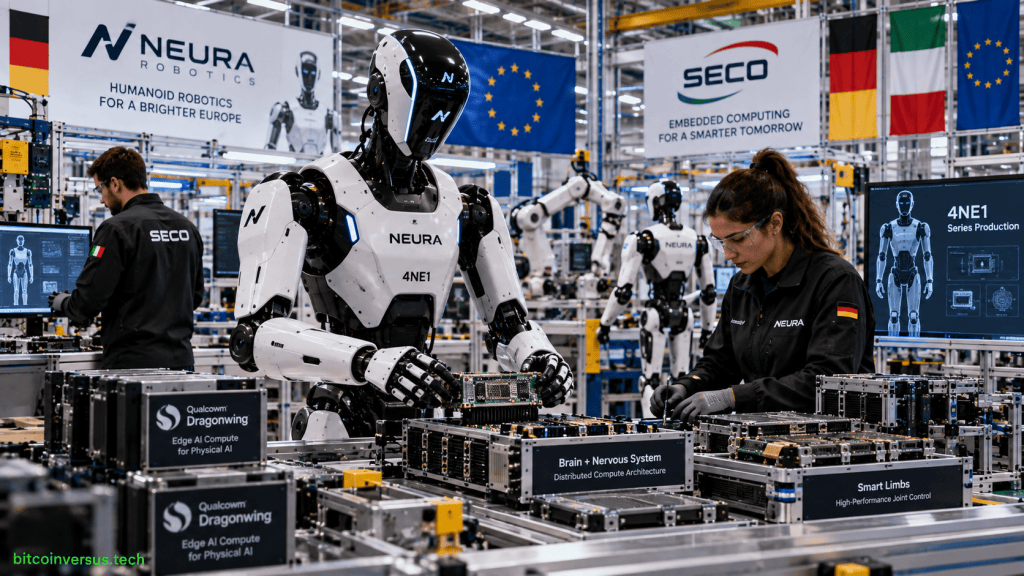
NEURA Robotics and SECO are joining forces to industrialize European physical AI hardware, including compute modules intended to help move NEURA’s 4NE1 humanoid robot toward series production.
The partnership, announced September 7, combines Germany-based NEURA’s cognitive robotics architecture with Italian technology company SECO’s embedded engineering and manufacturing capabilities. The companies say they will jointly develop electronic compute modules for NEURA robots and collaborate on physical-AI solutions for semiconductor and electronics manufacturing.
The hardware strategy is built around what NEURA calls a Brain and Nervous System architecture. Instead of sending every sensor event back to one central computer, processing can be distributed closer to joints, sensors and other points where the robot needs to react. In its announcement, NEURA says these Smart Limbs use Qualcomm Technologies’ Dragonwing processors to provide on-device AI performance, low latency and power efficiency.
That approach connects directly with the broader physical-AI hardware race BitcoinVersus.tech has been tracking. Agility’s Digit 5 is pushing industrial humanoids toward safer production work, while NVIDIA Isaac ROS 5.0 is expanding the software and AI-agent layer used by robot developers.
SECO’s role is particularly important because moving from prototype robots to repeatable manufacturing requires more than AI models. Compute boards have to be engineered, sourced, tested and produced consistently at volume. The companies say SECO will engineer the modules and provide the manufacturing capacity required for NEURA’s scale-up.
The partnership also extends into semiconductor and electronics production itself. NEURA and SECO plan to work on real-world industrial data and automation systems that could ultimately be deployed globally. That puts the collaboration alongside AMD’s physical-AI push and the wider expansion of intelligent machines into factories.
The market is already moving beyond isolated demonstrations. BitcoinVersus.tech recently reported that more than five million industrial robots now operate in factories. It has also followed Amazon’s Vulcan robot and PAL Robotics’ TIAGo Pro hardware as robot sensing, manipulation and autonomy move deeper into production environments.
NEURA and SECO have not disclosed production volumes, unit economics or a binding 4NE1 shipment schedule in the announcement. The partnership therefore represents an industrialization step rather than proof that mass production has already been achieved. The key test will be whether the distributed compute architecture can be manufactured reliably and deployed at the scale envisioned by the partners.
Follow BitcoinVersus.tech on X
Editorial note and disclaimer: BitcoinVersus.tech covers the intersection of Bitcoin, technology, computing, energy and emerging infrastructure. Partnership plans, production targets and performance descriptions attributed to companies remain company statements unless independently demonstrated. This article is for informational purposes and is not financial or investment advice.


Leave a Reply