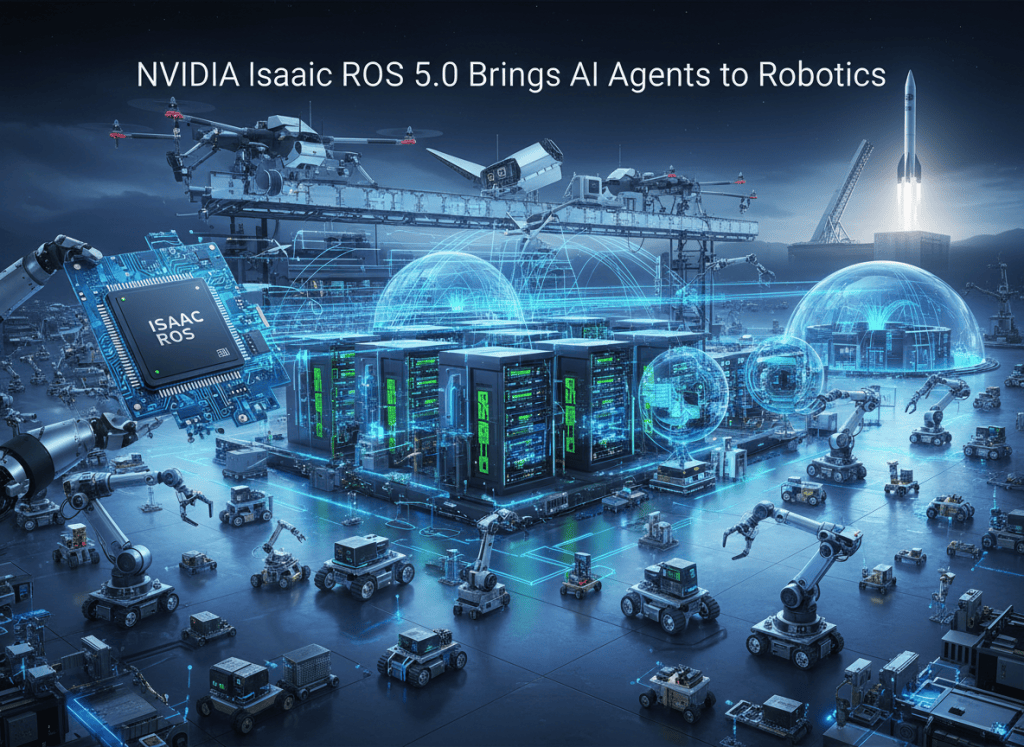
NVIDIA released Isaac ROS 5.0 on September 22 at ROSCon 2026 in Toronto, adding agent-ready development workflows, support for ROS 2 Lyrical and Ubuntu 24.04, and expanded GPU-accelerated robotics libraries. The release matters because it brings AI agents closer to the practical work of configuring, testing and deploying physical robots rather than limiting agents to ordinary software projects. NVIDIA’s release announcement says Isaac ROS serves the broader ROS community with accelerated perception and production-oriented libraries.
AI agents move into the robot workflow
Isaac ROS 5.0 introduces reusable Isaac Skills for setup and manipulation tasks, plus documentation structured so software agents can understand the tools and workflows. One new FoundationStereo skill can help fine-tune stereo perception for a developer’s cameras and operating environment. FoundationPose also gains an agent-ready inference library that NVIDIA says can estimate and track object pose up to 5.5 times faster. Those changes connect AI-assisted coding with perception work that ultimately runs on real machines.
ROS 2 gets a faster path for large sensor data
A major infrastructure change is support for accelerated memory transports in ROS 2 Lyrical. NVIDIA worked with the Open Source Robotics Alliance on a standard data-handling interface intended to move large data such as tensors and point clouds efficiently across different computing hardware. NVIDIA’s ROSCon 2026 program describes the feature as enabling near-zero-overhead transfer for hardware-accelerated physical-AI pipelines, with CUDA serving as one implementation.
Why edge hardware still matters
Robotics software can only react as quickly as the sensor, memory and compute path allows. Cameras, depth sensors and lidar can generate large streams that must be moved, interpreted and turned into motion commands with low latency. Isaac ROS 5.0 supports NVIDIA Jetson hardware from Orin Nano through Jetson Thor, creating a common development path from smaller edge systems to more demanding physical-AI machines.
A practical example: collision-aware robot motion
The embedded ROBOTIS demonstration shows Isaac ROS cuMotion working with the AI Worker platform for collision-aware planning around fixed and changing obstacles, including carried objects. NVIDIA also highlighted ROBOTIS among the ecosystem integrations around the Isaac ROS 5.0 launch. Examples like pick-and-place and obstacle-aware manipulation are useful because they show where accelerated perception and planning leave the software stack and become physical behavior.
What developers should watch next
The important question is whether agent-ready robotics tools reduce integration time without weakening validation. Physical systems require stricter testing than ordinary software because a bad parameter or incorrect perception result can move hardware. The strongest gains will come when AI agents automate repetitive setup and tuning while simulation, hardware-in-the-loop testing and human review continue to guard deployment.
BitcoinVersus.Tech Editor’s Note:
We volunteer daily to ensure the credibility of the information on this platform is Verifiably True. If you would like to support to help further secure the integrity of our research initiatives, please donate here: 3C9o19EH5HSiwEPyCTmEKzxhNCbo2X6TTb


Leave a Reply