Alibaba has unveiled the Zhenwu V900, a new AI accelerator from its T-Head semiconductor unit, as the company expands its computing stack from chips and models to enormous data-center infrastructure. The processor was announced September 22 at the Apsara Conference in Hangzhou and is expected to enter mass production in the first quarter of 2027.
A chip built for large AI clusters
Alibaba says the V900 delivers about three times the performance of its Zhenwu M890 predecessor. Published technical details list 216 GB of memory and 1,200 GB/s of inter-chip interconnect bandwidth. The architecture supports numerical formats from FP32 through FP4, including lower-precision modes increasingly important for AI inference and training efficiency.
Alibaba also says V900 systems can scale to clusters containing as many as 500,000 accelerator cards. A cluster at that scale is not simply a chip story. Networking, memory bandwidth, electrical distribution, cooling, storage and software orchestration become system-level constraints. Those supporting systems often determine how much of an accelerator’s theoretical performance can actually be used.
Alibaba targets more than 20 GW
The chip announcement arrived alongside an unusually large infrastructure target. Alibaba Cloud plans to operate more than 20 gigawatts of global data-center capacity by 2032, according to Reuters reporting from the conference. CEO Eddie Wu tied the expansion to expectations that demand for machine intelligence will continue growing as models become larger and AI moves into more industries.
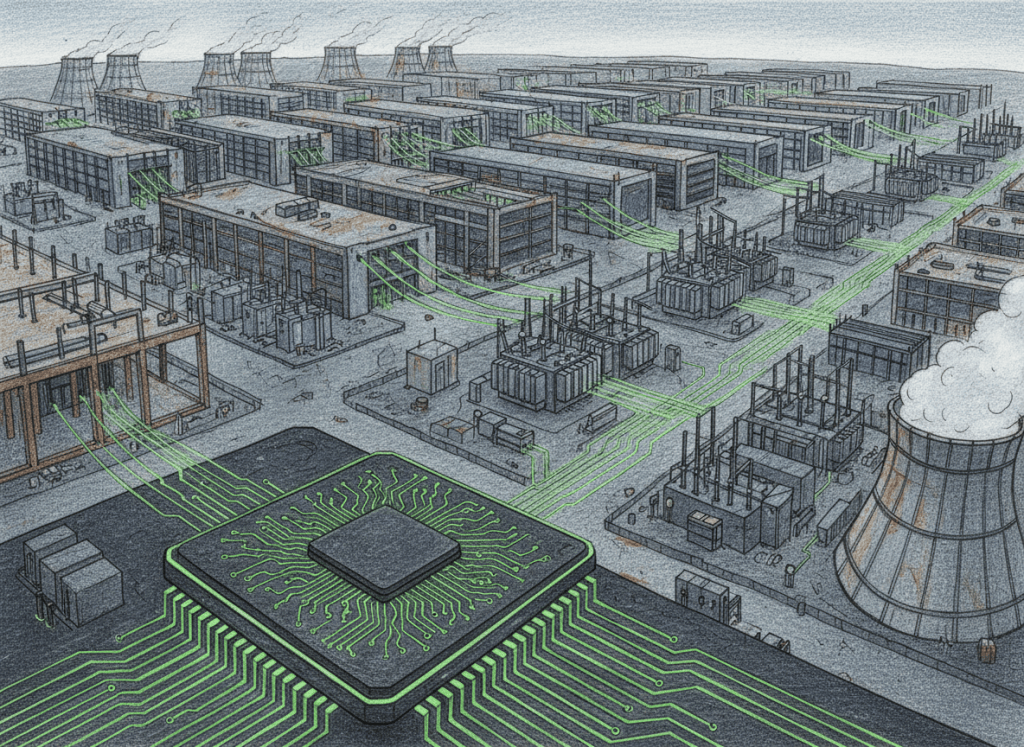
Twenty gigawatts illustrates how quickly AI has become an electrical-engineering problem as well as a computing problem. At multi-gigawatt scale, utility interconnections, transformers, substations, switchgear, backup generation, cooling plants and transmission availability can become as strategically important as accelerator supply. The V900 therefore matters partly because Alibaba is trying to coordinate silicon development with the physical infrastructure needed to operate it.
Models are growing with the infrastructure
Alibaba is also planning future Qwen models with roughly 5 trillion to 10 trillion parameters. The company has not demonstrated that parameter count alone guarantees better models, but the roadmap helps explain the emphasis on cluster scale, memory capacity and interconnect bandwidth. Larger training systems require moving enormous amounts of data among accelerators without allowing communication delays to overwhelm useful compute time.
What to watch next
The most important next checkpoints are production volume, independent performance measurements, power consumption, cluster efficiency and software support. Alibaba’s three-times-performance claim compares the V900 with its own previous accelerator, not with an independently tested NVIDIA or AMD system. Real-world comparisons will require matched workloads, precision formats, memory configurations and power measurements.
The broader development is easier to see. AI infrastructure competition is expanding beyond individual GPUs. Companies increasingly need control over accelerators, memory, networking, software, power and data-center capacity as one coordinated system. Alibaba’s V900 and 20 GW roadmap are a particularly large example of that shift.
BitcoinVersus.Tech Editor’s Note:
We volunteer daily to ensure the credibility of the information on this platform is Verifiably True. If you would like to support to help further secure the integrity of our research initiatives, please donate here: 3C9o19EH5HSiwEPyCTmEKzxhNCbo2X6TTb


Leave a Reply