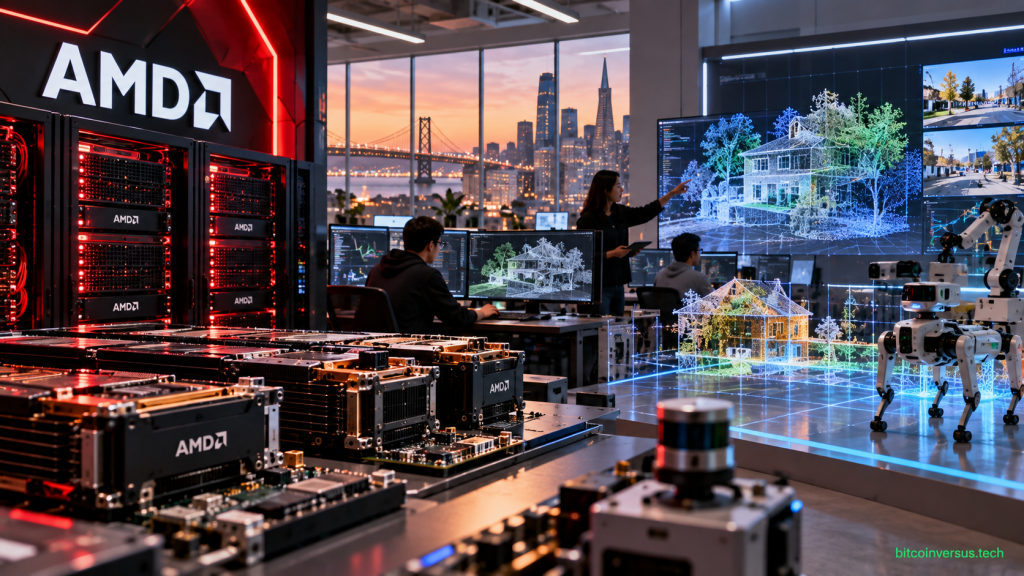
AMD is making one of its largest bets yet on the software side of artificial intelligence, agreeing to acquire Fei-Fei Li’s World Labs in an all-stock transaction valued at approximately $8.2 billion.
According to the chipmaker, World Labs will bring model researchers and spatial-intelligence expertise directly into AMD as the company develops future AI hardware, software and systems. The transaction is expected to close by the end of 2026, subject to regulatory approvals and customary conditions.
AMD is buying insight into the workloads its chips will run
World Labs develops AI models that generate, reconstruct and simulate interactive three-dimensional environments from text, images and video. Those capabilities extend beyond conventional chatbot workloads into robotics, simulation, design and other forms of physical AI.
That distinction matters for a chip company. Future accelerators will be shaped not only by model size, but by how models move data, represent 3D space, simulate physics and interact with real-world sensors. AMD says World Labs’ research will help it understand those emerging workloads while shaping future technology roadmaps.
World Labs cofounder Justin Johnson introduced the company’s Atlas model earlier this month in a social post that demonstrates the type of spatial AI AMD is acquiring. Atlas combines generation and reconstruction, letting the model create new camera views while maintaining a three-dimensional representation of a scene.
World Labs already trained on AMD GPUs
The acquisition is not a cold start. World Labs says the two companies began a technical partnership last year around model training and inference optimization on AMD GPUs. AMD also participated in World Labs’ $1 billion funding round earlier in 2026.
Reporting on the agreement says the deal is valued at $8.2 billion in stock. After closing, Li will become AMD executive vice president and chief scientist and report to CEO Lisa Su.
BitcoinVersus.Tech has been tracking the same convergence from the hardware side. Recent coverage examined XDOF’s robot-training data expansion, NEURA and SECO’s physical-AI hardware stack, and Delos Data’s work on AI interconnect bottlenecks. World models add another layer: the models and simulations that increasingly determine what compute infrastructure must do.
Spatial intelligence moves closer to the silicon roadmap
World Labs’ Atlas can work across text, images, video and 3D data. The company says the model can generate controlled camera views, reconstruct scenes from sparse images and create simulated sensor observations for robots. Those workloads combine graphics, AI inference, memory bandwidth and large-scale training in ways that can influence accelerator and system design.
AMD’s acquisition therefore reaches beyond buying an AI application. If completed, the transaction will put a frontier model laboratory inside a company designing CPUs, GPUs, networking and rack-scale AI infrastructure. The researchers building future workloads and the engineers building the machines that run them will sit inside the same organization.
BitcoinVersus.Tech
Advertisement: Follow BitcoinVersus.Tech for independent coverage of Bitcoin, mining hardware, artificial intelligence, robotics, semiconductors, data centers and energy infrastructure.
Disclaimer: BitcoinVersus.Tech provides news, analysis and educational information for general informational purposes. Nothing in this article is financial, investment, legal or professional advice. Readers should independently verify information and make their own decisions.


Leave a Reply