Delos Data has raised more than $100 million to attack a problem that becomes more expensive every time an AI accelerator sits idle: the network between compute, memory and storage.
Announced September 15, the funding backs Delos Nonstop AI, a workload-first architecture built for agentic inference across mixtures of GPUs, XPUs, CPUs, accelerators, memory and flash. The company says the round includes Matrix, Playground, Socratic Partners, Capricorn’s Technology Impact Fund, Matter Venture Partners and IAG, alongside industry investors.
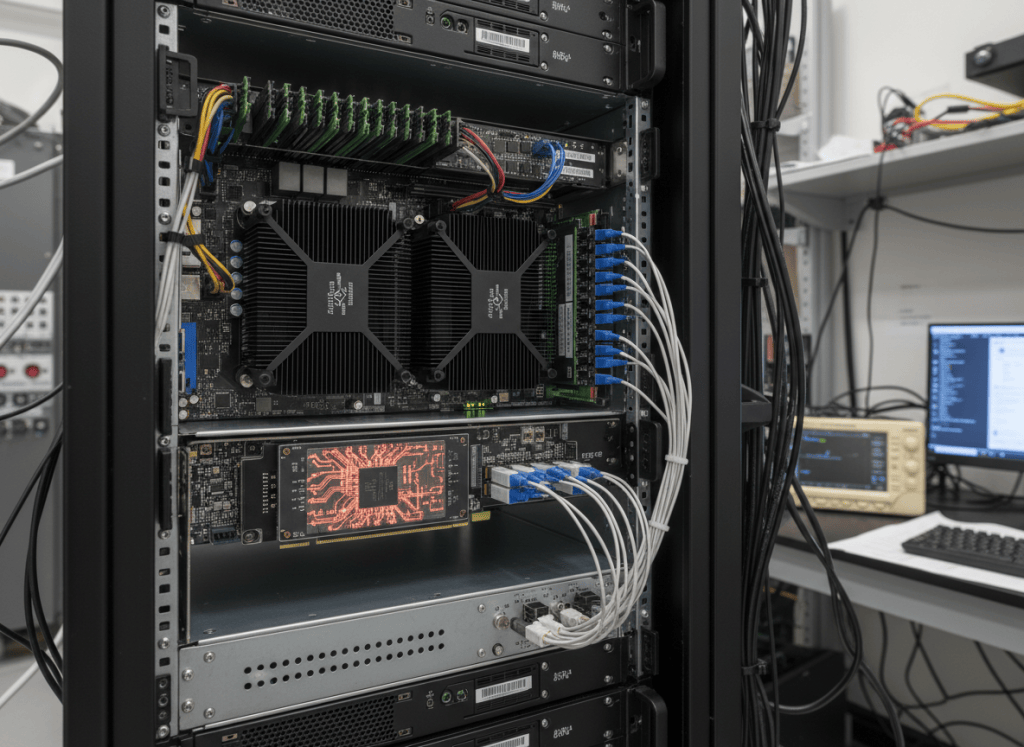
Illustration: Delos Data’s pitch is that AI inference performance increasingly depends on how quickly and reliably data moves between heterogeneous processors—not simply how many accelerators are installed.
The Data Interface Becomes Part of the AI Computer
The newly announced Nonstop AI Data Interface is planned in three forms: an I/O chiplet, near-packaged optics and a card. Delos says the interface targets 10× lower latency and 10× higher efficiency, while its broader portfolio targets stronger resiliency and scale. Those are company claims and should be treated as targets until independently benchmarked.
The architecture is notable because the same physical problem is appearing throughout the AI stack. BitcoinVersus.tech has tracked Ciena’s move from 1.6T coherent optics toward 6.4T CPO, Marvell’s 2 nm 3.2T optical roadmap and PicoJool’s 200G-per-lane VCSEL work. Delos is approaching the bottleneck from a different angle: make the data interface and network behave as part of the inference computer itself.
That matters as clusters become less homogeneous. d-Matrix’s rack-scale AI work and custom AI silicon paired with 1.6T optics show why future infrastructure cannot assume every endpoint is the same GPU connected through one proprietary fabric.
Intel Veterans Take on the Networking Layer
Delos was founded by CEO Ed Doe and CTO Dan Daly, both veterans of Intel networking organizations. Reuters reported that the startup is developing chips and software intended to move data faster inside increasingly heterogeneous AI data centers. Sources say the changing mix of NVIDIA, AMD, Cerebras and other compute architectures is creating an opening for networking systems that are less tightly coupled to one accelerator family.
Delos calls that heterogeneous environment a Mixture of “X” Infrastructure, or MoXI: different hardware, models, switches, links and topologies serving one workload. Its reference architecture is designed to compose those pieces into one data domain while keeping workloads alive through component failures.
The timing also overlaps with a broader race around scale-up fabrics. A technical report from The Register described Delos and Cornelis Networks as part of a group challenging the assumptions behind proprietary GPU interconnects as standards such as UALink and Ultra Ethernet mature.
At the physical layer, all of that software still lands on racks, cables and optics. Recent BitcoinVersus.tech reporting on 3,456 fibers packed into 1RU and 136 Tbps distributed GPU connectivity shows the scale of the plumbing required once AI compute stops fitting inside a single rack—or even a single building.
Presentation note: Delos’s core engineering argument is simple—an expensive accelerator waiting for data is stranded capital. The startup wants its interface silicon, software and reference architecture to keep that data moving continuously.
BitcoinVersus.Tech
Advertisement: Use promo code bitcoinversus at checkout to get 5% off participating Bitaxe mining products.
BitcoinVersus.Tech advertisement: participating Bitaxe mining products, using promo code bitcoinversus.
BitcoinVersus.Tech Editor’s Note & Disclaimer:
We volunteer daily to ensure the credibility of the information on this platform is Verifiably True. BitcoinVersus.tech provides news, technical analysis and educational information and does not provide financial or investment advice. Vendor specifications, performance targets and efficiency claims should be independently verified before purchasing, deploying or investing in hardware. If you would like to support to help further secure the integrity of our research initiatives, please donate here: 3C9o19EH5HSiwEPyCTmEKzxhNCbo2X6TTb


Leave a Reply