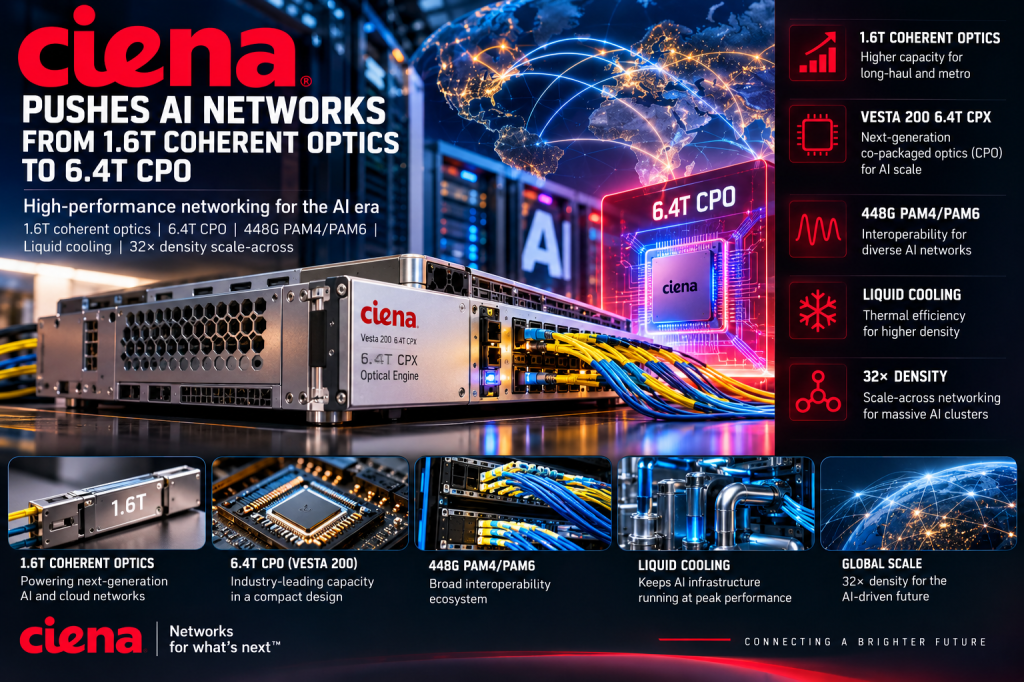
Ciena used ECOC 2026 in Málaga to show how quickly AI networking is moving beyond today’s 400G and 800G links toward 1.6T coherent optics, 6.4T optical engines and much denser scale-across architectures.
In a new showcase announced September 16 and demonstrated during the September 20–23 conference, Ciena brought together copper, coherent optics, co-packaged optics and liquid cooling rather than presenting one isolated transceiver. That matters because modern AI clusters increasingly hit limits in bandwidth, rack-face density and power before operators run out of demand for compute.
The physical layer starts inside the data center. Ciena’s Nitro 2004 linear redriver is designed to extend high-speed copper reach, while its Vesta 200 6.4T CPX optical engine moves optics much closer to the switching silicon. The Open CPX-compliant engine is aimed at co-packaged and near-packaged optical architectures for scale-up and scale-out AI networks.
At ECOC, the story was not “fiber replaces copper.” It was that copper and optics are being pushed into different jobs according to distance, density, power and serviceability.
1.6T Between Data Centers
For longer links, distributed GPU superclusters are already making inter-data-center bandwidth part of the compute architecture. Ciena demonstrated a roadmap spanning WaveLogic 6 Nano 800G pluggables through 1600ZR+, liquid-cooled XPO optics and full-spectrum transport.
The same transition is visible in BitcoinVersus.tech’s coverage of Marvell’s 3.2T optical roadmap, PicoJool’s 200G-per-lane VCSEL work, and 1.6T optical engines moving toward 6.4T links. Those technologies attack different layers of the same problem: getting more bits through a constrained amount of power, fiber and rack space.
448G Electrical I/O Enters the Demonstration Floor
One of the more technically interesting demonstrations involved live 448 Gb/s PAM4 and PAM6 multivendor electrical transmission through the Optical Internetworking Forum’s interoperability program. The work is significant because future 1.6T-and-beyond optical modules still depend on electrical interfaces capable of feeding those optics efficiently.
Ciena also showed its RLS Hyper-Rail scale-across architecture, which the company says can deliver a 32× density improvement. As with all vendor performance claims, deployment results depend on topology and configuration, but the direction is clear: AI networking is being redesigned simultaneously at the electrical, optical, rack and inter-data-center layers.
That density race is also changing passive infrastructure. BitcoinVersus.tech recently examined 3,456 fibers packed into 1RU and 2,304 fibers in 2RU. More bandwidth at the silicon is useful only if the physical network can actually route it.
For technical context, the ECOC exhibition program confirms the Vesta 200 live demonstration and its Open CPX focus. Ciena’s own event material describes the broader system as a combination of 1.6T coherent optics, multi-rail photonics and electrical/optical interconnects for AI scale-up, scale-out and scale-across networks.
BitcoinVersus.Tech
Advertisement: Use promo code bitcoinversus at checkout to get 5% off participating Bitaxe mining products.
Advertisement: BitcoinVersus.Tech promotional post for participating Bitaxe mining products.
BitcoinVersus.Tech Editor’s Note & Disclaimer:
We volunteer daily to ensure the credibility of the information on this platform is Verifiably True. BitcoinVersus.tech provides news, technical analysis and educational information and does not provide financial or investment advice. Vendor specifications and performance claims should be independently verified before purchasing or deploying hardware. If you would like to support to help further secure the integrity of our research initiatives, please donate here: 3C9o19EH5HSiwEPyCTmEKzxhNCbo2X6TTb


Leave a Reply