Dutch deep-tech company Morphotonics has raised more than €40 million in Series B funding as it scales its large-area nanoimprint lithography platform beyond augmented-reality displays and into optical components for AI data centers.
The company says the financing will accelerate manufacturing technology for AR waveguides, co-packaged optics and other next-generation photonic applications. Independent reporting says the round includes 3M Ventures, Innovation Industries, BOM, Invest-NL, the European Innovation Council Fund, Ernij Next and the European Investment Bank.
From Display Manufacturing to AI Interconnects
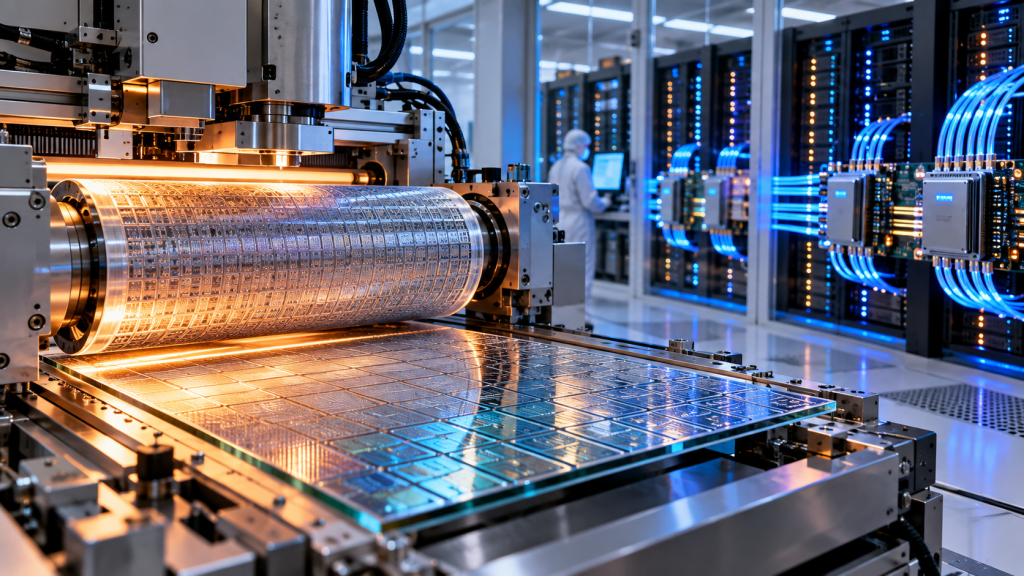
Morphotonics has spent more than a decade developing roll-to-plate nanoimprint lithography, a manufacturing process that stamps extremely small optical patterns across large surfaces. The technology is already aimed at high-volume waveguide production for smart glasses, but the new funding gives the Eindhoven company room to pursue a second market: co-packaged optics for data centers.
That expansion arrives as optical interconnects become increasingly important to AI infrastructure. BitcoinVersus.tech recently covered Ciena’s push from 1.6T coherent optics toward 6.4T CPO, Marvell’s 2 nm optical platform for 3.2T AI networks, and Tower Semiconductor’s plan to expand optical-chip capacity in Japan.
Why Nanoimprint Lithography Matters
Instead of writing every optical structure individually, nanoimprint lithography can replicate a master pattern across a much larger surface. That manufacturing logic can make sense when an industry needs large volumes of precisely patterned optical components.
Morphotonics’ Erhan Ercan recently explained its panel-based approach to scalable waveguide manufacturing in an English-language technical presentation. The YouTube page exposes a standard external embed player, so the presentation can be watched directly below.
The data-center opportunity is different from an AR display, but the underlying manufacturing problem has a familiar shape: photonic structures have to be produced repeatedly, accurately and at high volume. Co-packaged optics moves optical communication closer to the compute and switching silicon, potentially reducing the electrical distance that high-bandwidth data must travel.
The Next Machine Targets More Than Six Million Waveguides a Year
Morphotonics CEO Hugo da Silva told TechCrunch that the company’s next machine is being built now and is expected to begin shipping in early 2027. He said it will be capable of producing more than six million waveguides annually.
The company currently has roughly 10 to 15 systems deployed globally and expects to reach around 50 deployments during the next two to three years. About 90% of current revenue comes from hardware sales, according to the report, while the company also supplies process expertise and consumables.
Co-Packaged Optics Is Still an Expansion Market
The data-center angle should not be mistaken for a mature shipping business. Morphotonics has not yet shipped machines into this segment, although it says customers have validated the technology. That makes the new funding partly a scale-up bet: the company must translate a manufacturing platform proven in other optical applications into the reliability, throughput and economics demanded by data-center photonics.
But the timing is notable. AI clusters are forcing networking suppliers to move more bits across shorter distances while controlling power and thermal costs. If co-packaged optics reaches broad deployment, the industry will need not only photonic chips but manufacturing equipment capable of producing optical structures consistently at scale.
Morphotonics is betting that its large-area imprinting technology can become one of those manufacturing layers. The €40 million-plus Series B gives it fresh capital to test that proposition while its established waveguide business continues to scale.
BitcoinVersus.Tech Editor’s Note
Support independent technology reporting: BTC donations may be sent to 3C9o19EH5HSiwEPyCTmEKzxhNCbo2X6TTb.
Follow BitcoinVersus.tech on X/Twitter for AI hardware, photonics, semiconductors, Bitcoin mining and data-center reporting.
Disclaimer: BitcoinVersus.tech is not a financial advisor. This media platform reports on financial subjects purely for informational purposes.


Leave a Reply