xAI’s Memphis AI buildout is becoming an energy-storage project on the scale of a power plant. Satellite imagery reviewed by Canary Media shows 720 Tesla Megapack containers at the Colossus 2 campus, while xAI and local utility officials have described a multi-gigawatt-hour battery system designed to let the supercomputer shed grid load when electricity is constrained.
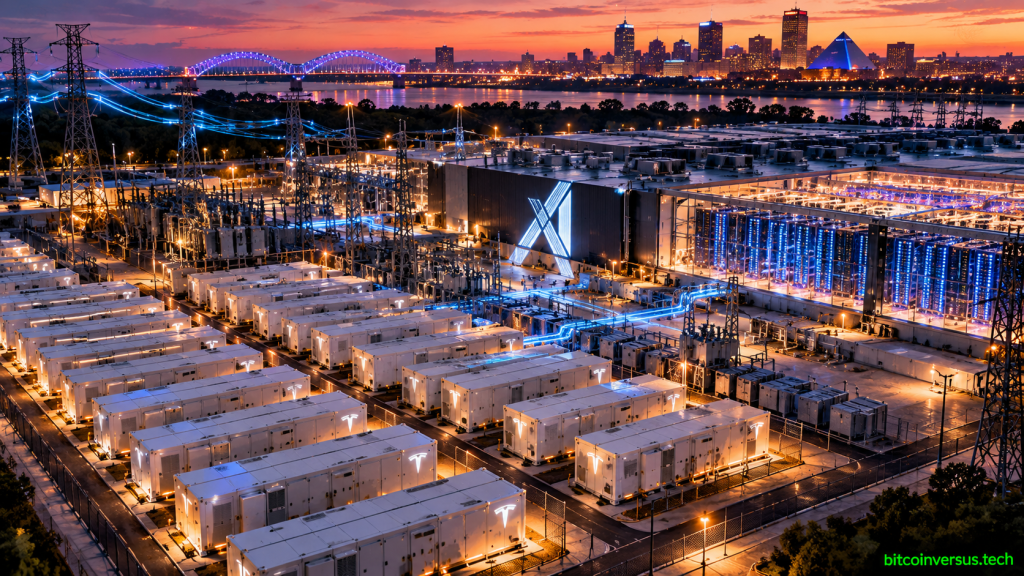
720 Megapacks visible from orbit
Reporting based on July 11 satellite imagery counted 720 Tesla Megapack containers at Colossus 2. Depending on which Megapack version is installed, that equipment would represent roughly 2.8 GWh of storage and somewhere between 720 MW and 1.4 GW of discharge power.
An xAI energy developer gave the Tennessee Valley Authority a still larger energy figure, saying the battery holds 3.3 GWh. Memphis Light, Gas and Water CEO Doug McGowen separately described roughly 2,000 MW of batteries behind the meter. Those numbers use different units and have not been reconciled publicly, so BitcoinVersus.tech is treating the precise rating as unconfirmed.
The batteries turn an AI data center into an interruptible load
The company says more than 200 Megapacks have been integrated into Colossus and that onsite generation and batteries allow it to disconnect from the grid during emergencies or periods of grid strain under arrangements with TVA and MLGW.
That operating model matters because an AI supercomputer is normally viewed as a huge, inflexible electrical load. Storage changes the equation: batteries can absorb energy at one time and support the computing campus later, allowing grid draw to fall rapidly without necessarily shutting every GPU down at once.
BitcoinVersus.tech has been tracking the same power-first trend through grid-interactive AI data centers and new firm-power projects serving data-center growth.
Colossus is scaling the compute side too
The battery field is arriving alongside an extraordinary GPU expansion. BitcoinVersus.tech recently reported xAI’s plans for hundreds of thousands of additional Blackwell-generation GPUs. Power delivery, substations, cooling and stored energy increasingly determine how quickly those accelerators can actually be commissioned.
The following English-language video provides visual context for the Colossus campus and its infrastructure scale. It is embedded here because the energy story is easier to understand when the physical size of the GPU facility is visible.
Four hours off-grid changes the utility conversation
MLGW has said the campus participates in a power-interruption program and can reduce grid demand sharply during curtailment. Separate September reporting says onsite generation and storage can support the campus away from the grid for up to four hours when required.
That does not make a multi-gigawatt AI campus electrically independent. It does, however, create a buffer between compute demand and instantaneous grid demand. As AI campuses move toward gigawatt scale, that buffer may become as important as the servers themselves.
BitcoinVersus.Tech Editor’s Note: Public estimates for the Memphis battery differ. Satellite imagery supports a count of 720 Megapack containers, while xAI and utility representatives have cited different energy and power ratings. We therefore distinguish the observed unit count from the still-unconfirmed final system rating.
Support independent AI hardware, data-center and energy reporting: 3C9o19EH5HSiwEPyCTmEKzxhNCbo2X6TTb
BitcoinVersus.tech is not a financial advisor. This media platform reports on financial subjects purely for informational purposes.


Leave a Reply