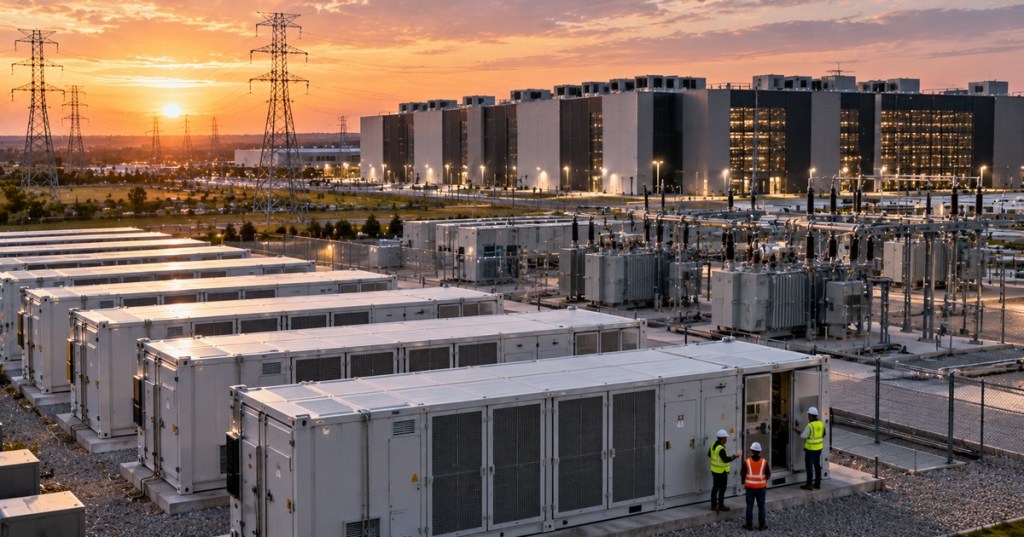
Four-hour battery storage is now cheaper than open-cycle gas turbines in every one of the 43 markets modeled by Wood Mackenzie. That is a meaningful shift for data centers, utilities, and grid planners because open-cycle gas turbines have long been one of the standard answers for short bursts of peak power.
According to Wood Mackenzie, expanding battery manufacturing is pushing storage costs down while gas-turbine shortages and fuel volatility are driving peaking costs higher. In North America, the consultancy says rapid data-center load growth is contributing to a gas-generation supply deficit expected to keep thermal capital costs elevated through the late 2030s.
The important qualifier is that the comparison is specific. It is four-hour battery storage versus open-cycle gas peakers. It does not mean batteries are cheaper than every gas plant, and it does not mean four hours of storage can cover multi-day shortages of wind, solar, or grid supply.
Why gas peakers are getting more expensive
Open-cycle gas turbines are built to start quickly and run during short periods of high electricity demand. Their strength is dispatchability: operators can turn them on when the grid suddenly needs more power.
But they are less efficient than combined-cycle plants and are becoming more expensive to buy. Utility Dive reports that, for U.S. projects targeting 2026 commercial operation, four-hour battery storage can be roughly 65% to 75% cheaper than new open-cycle gas turbines on a levelized-cost basis.
Procurement time matters too. Turbine order books have stretched out as utilities and AI infrastructure developers compete for equipment. A battery project can often be ordered, installed, and interconnected faster than a new gas peaker can be manufactured and delivered.
Data centers make the comparison more important
Large AI campuses can add hundreds of megawatts of new load in one location. Their power demand can also change quickly, which makes fast-response resources valuable. Batteries can react in milliseconds, absorb excess electricity, shave short peaks, and provide backup or grid-support services without waiting for a combustion turbine to ramp.
That does not make batteries a complete replacement for the grid. BitcoinVersus previously explained why data centers are building behind-the-meter power: operators increasingly want several layers of generation, storage, and grid access rather than one energy source doing everything.
At the facility level, batteries already play a familiar role. A data-center UPS uses batteries to bridge the gap between a grid failure and longer-duration backup power. Grid-scale storage applies the same basic idea at a much larger energy scale and for a wider range of grid services.
The global numbers are moving quickly
Wood Mackenzie says China remains the global cost floor for grid-scale batteries, with four-hour storage more than 55% cheaper than the rest of the Asia-Pacific average. In the Middle East and Africa, four-hour storage is modeled at about $120 per MWh in 2026 and is forecast to fall to roughly $80 per MWh by 2035.
That matters because peaking economics are particularly sensitive to capital cost and utilization. A gas peaker may sit idle for long stretches and then operate during only the most expensive hours. A battery can participate in several markets—peak shaving, frequency response, capacity, arbitrage, backup, and renewable integration—depending on the local rules.
But four hours is still four hours
The biggest limitation is duration. A four-hour battery can be excellent for the evening peak, a sudden data-center load spike, or a short grid emergency. It is not designed to supply a city through several days of low renewable output.
- Batteries are strongest at: fast response, short peaks, frequency control, backup, and shifting cheap electricity into expensive hours.
- Gas remains stronger at: long-duration generation when fuel is available and the event lasts longer than the battery’s stored energy.
- The grid solution: combinations of transmission, generation, batteries, demand response, and longer-duration resources.
That is why BitcoinVersus has also covered projects such as xAI’s large Megapack battery installation behind Colossus 2. The battery is not the data center’s only power source. It is one layer in a broader power system designed to improve flexibility and reliability.
What changes now
The biggest near-term change may be in planning. If a utility or data-center developer only needs a few hours of fast, dispatchable capacity, the default question can no longer be “Which gas turbine should we buy?” Battery storage now deserves to be priced against that turbine first.
That does not end natural gas generation. It narrows one of gas power’s most valuable historical markets: short-duration peaking. As batteries keep getting cheaper and turbine delivery times stay long, that pressure is likely to increase.
Editor’s Note: The cost comparison discussed here is based on Wood Mackenzie’s modeled levelized-cost analysis for four-hour battery storage and open-cycle gas turbines. It should not be interpreted as a claim that batteries replace every gas plant or solve every long-duration reliability requirement.
Support independent technology reporting: Bitcoin donations help fund BitcoinVersus.Tech research and publishing.
Disclaimer: BitcoinVersus.Tech provides technology news and analysis for informational purposes only.


Leave a Reply