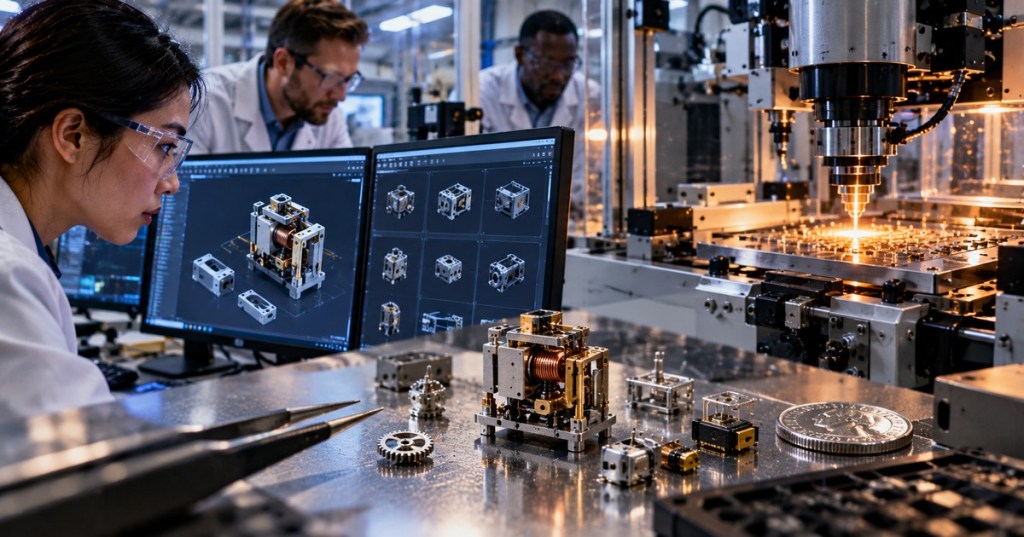
Atomic Machines wants to do for physical hardware what software compilers did for code: take a digital description and turn it into something that actually works. Its new Matter Compiler is designed to accept digital instructions and produce working micro-machines with moving parts, multiple materials, and three-dimensional structures.
CEO Jeffrey Holden described the system in a Bloomberg interview on The Close, saying the factory takes digital code as input and outputs micro-machines. Atomic Machines emerged from six years in stealth this week after raising $250 million to date, according to the company’s Matter Compiler documentation.
This is not just a smaller 3D printer
A conventional 3D printer can turn a digital file into a different shape. Atomic Machines is making a much larger claim: different code can instruct the same manufacturing system to build different machines, not simply different geometries.
Holden calls that a “combinatorial constructor.” The factory is meant to combine processes and materials under software control, then measure what it built and feed those measurements back into the manufacturing loop. The long-term goal is a foundry where one system can manufacture very different micro-devices without building a dedicated production line for each one.
That is a major step beyond the basic additive-manufacturing model BitcoinVersus explained in how 3D printing turns a digital file into a physical part. Atomic Machines is trying to make the manufacturing process itself programmable.
PrimeSwitch is the first proof point
The first product out of the Matter Compiler is PrimeSwitch PS-150, an electromechanical relay aimed at high-power electrical systems. Atomic Machines says it can carry 150 amps continuously, open in 50 microseconds, provide 1,500 volts of galvanic isolation, and hold its state with zero power.
The company is targeting one of the fastest-moving power problems in computing: AI racks shifting toward 800-volt DC distribution. BitcoinVersus has already covered how 800-volt DC is moving deeper into next-generation AI rack power systems. At those voltages and power densities, fault protection has to react quickly while wasting as little electricity as possible as heat.
Traditional semiconductor switches can react quickly but introduce conduction losses. Mechanical contactors conduct efficiently but are much slower. Atomic Machines’ pitch is that PrimeSwitch can sit beside a semiconductor in a hybrid breaker: the metal contact carries current efficiently during normal operation, while the semiconductor handles the brief transition when the relay opens.
The bigger bet is manufacturing without retooling
Most hardware manufacturing is optimized around repetition. Once a process is tuned for one product, changing the design can mean new masks, fixtures, molds, recipes, tooling, qualification work, and months or years of engineering.
Atomic Machines says the Matter Compiler removes much of that per-product process development. A new device is supposed to be represented by a different digital instruction set rather than a different factory. Holden’s analogy is deliberately extreme: imagine a factory where a car comes off the line, then a laptop, then a bicycle, all because the digital input changed. Atomic Machines is applying that concept only at the micro-scale today.
Why semiconductor fabs are the comparison point
Chip fabs already manufacture structures at astonishingly small scales, but they are optimized for planar semiconductor processes and a constrained set of materials. Atomic Machines is targeting devices that need metal parts, moving mechanisms, three-dimensional assembly, fluid channels, thermal structures, magnets, optics, or combinations of those domains.
That contrast is easier to understand beside conventional wafer manufacturing. BitcoinVersus previously explained why advanced chip fabs organize production around 300 mm silicon wafers. Atomic Machines is not trying to replace that semiconductor model; it is going after micro-machines that do not fit comfortably inside it.
The vision is much broader than one relay
Holden says future devices could include micro-pumps, cooling systems that bond directly to chips, miniature manipulators, optical systems, energy harvesters, and eventually tiny machines for medical applications. The company’s own roadmap spans electrical, mechanical, fluidic, thermal, optical, charged-particle, and chemical devices.
The idea is especially interesting when combined with generative AI. Instead of an engineer manually designing every geometry and every manufacturing sequence, Atomic Machines wants AI systems to generate the device design, simulate it, write the manufacturing instructions, and learn from measurements taken during the build.
That “prompt-to-product” vision is not fully realized yet. The company says it still has work ahead before customers can simply describe an arbitrary micro-machine and receive a finished device. PrimeSwitch is therefore the first test of whether the underlying manufacturing architecture works economically and reliably outside a laboratory.
The next device may matter more than the first
A single successful relay proves that Atomic Machines can manufacture one useful product with its system. The bigger claim—that the same Matter Compiler can build a broad family of fundamentally different micro-machines—will become much more convincing when the company ships a second and third device from different physical domains.
The Next Web reports that PrimeSwitch is already shipping to early-access customers for evaluation. That gives Atomic Machines a near-term test: independent customers can measure whether the relay meets its claimed electrical performance while the company prepares the broader foundry model.
The manufacturing idea is ambitious, but the benchmark is refreshingly concrete. If different code can repeatedly produce genuinely different working machines on the same platform, the Matter Compiler could become a new category of factory. If every new device still requires extensive custom engineering, it will look more like an unusually flexible manufacturing line.
Editor’s Note: Performance figures and manufacturing capabilities described here are company claims unless otherwise stated. PrimeSwitch is currently being evaluated by early-access customers; broad third-party validation of the Matter Compiler’s multi-device manufacturing range has not yet been published.
Support independent technology reporting: Bitcoin donations help fund BitcoinVersus.Tech research and publishing.
Disclaimer: BitcoinVersus.Tech provides technology news and analysis for informational purposes only.


Leave a Reply