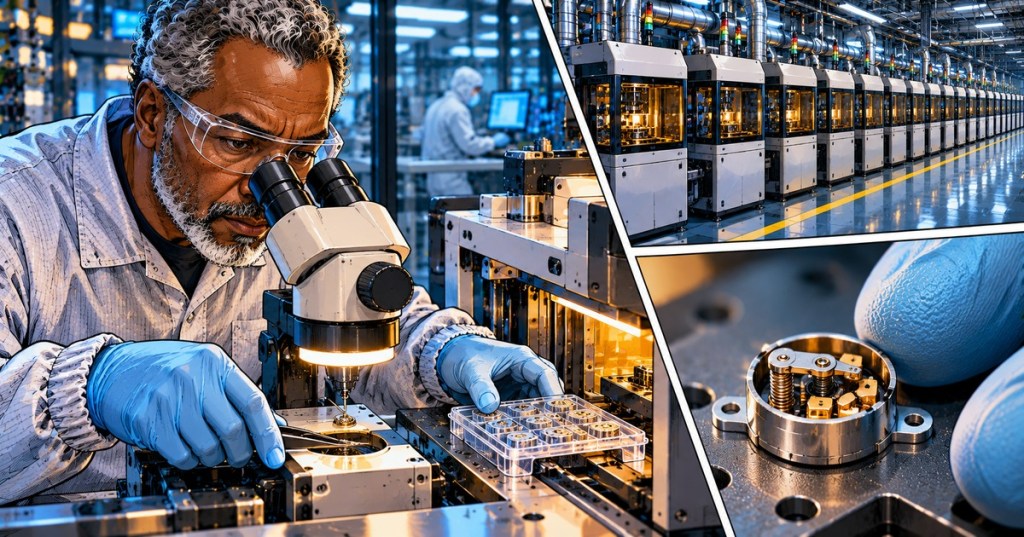
EMERYVILLE, Calif. — Atomic Machines is still using human assistance to build micro-machines across a chain of 13 manufacturing tools, even as it develops a system intended to turn digital designs into functioning hardware. In an October 13 TBPN interview, founder Jeff Holden explained the software architecture and future open-foundry model behind its Matter Compiler.
That adds an engineering reality check to BitcoinVersus.Tech’s earlier report on code-driven micro-machines: company software coordinates manufacturing, but engineers still transfer parts between equipment and assist final assembly, according to independent reporting. Fully autonomous, one-prompt production is a goal, not a demonstrated commercial service.
Atomic Machines founder Jeffrey Holden discusses the Matter Compiler’s process language and prospective foundry in the October 13 TBPN interview; the relevant discussion begins around 2:18:00.
The Difference Between CAD and a Machine Compiler
Conventional CAD describes geometry and dimensions. A manufacturer still must determine materials, tooling, processing steps, assembly and quality checks. Holden describes a formal process graph that links digital device instructions to manufacturing operations. Atomic Machines says its system measures builds and uses the results to inform subsequent iterations.
Its company roadmap depicts prompt-driven design, CAD validation, process-graph validation and manufacturing. But that webpage describes the intended end state; it does not establish that all steps already run without people.
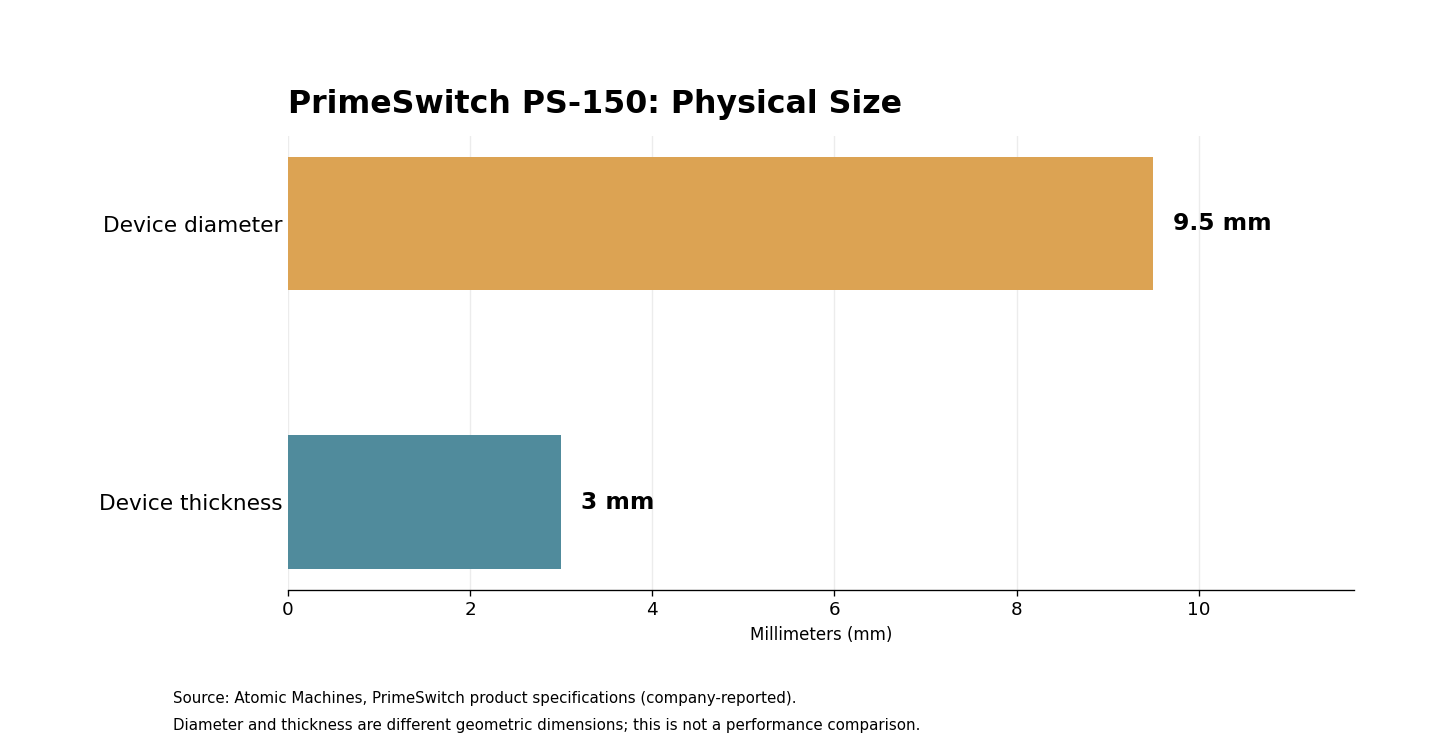
Atomic Machines product specifications: PrimeSwitch PS-150 measures 9.5 mm in diameter and 3 mm thick. The chart shows physical dimensions, not a manufacturing-speed comparison.
PrimeSwitch Remains the Test Device
Atomic Machines’ PrimeSwitch PS-150 is the first publicly identified device. The company claims 150-amp continuous current, 200-micro-ohm resistance and 50-microsecond opening with 1,500-volt isolation. Its product page lists sampling availability, not high-volume shipments or independently published endurance tests.
Holden describes a future open foundry for other microscale devices, including tiny medical robots and pumps. Such applications remain proposals. They would require design validation, fabrication yield, clinical or industrial testing and customer qualification.
Holden’s October 8 explanation distinguishes building differently functioning machines from simply printing different passive shapes. It is a company claim, not independent validation.
The Second Device Is the Real Benchmark
BitcoinVersus.Tech previously compared specialized chipmaking machines and AI-assisted PCB design. Atomic Machines is attempting to bridge those workflows: moving from a digital description to a multi-material working mechanism.
The next meaningful evidence will be an independently tested second device class, disclosed manufacturing yields and fewer manual handoffs. Until then, the Matter Compiler is an ambitious, partially automated manufacturing platform rather than a universal machine-making factory.
Support BitcoinVersus.Tech
We volunteer daily to ensure the credibility of the information on this platform is Verifiably True. Please scan the original QR code below to donate 5,000 sats if you would like to support our independent reporting. For best results, open this page on a laptop or larger screen.

On mobile, display the QR code on another screen to scan it with a Bitcoin wallet; alternatively, use a wallet’s saved-image QR-scanning feature if available. Bitcoin donation address: 3C9o19EH5HSiwEPyCTmEKzxhNCbo2X6TTb.
BitcoinVersus.tech is not a financial advisor. This media platform reports on financial subjects purely for informational purposes.


Leave a Reply