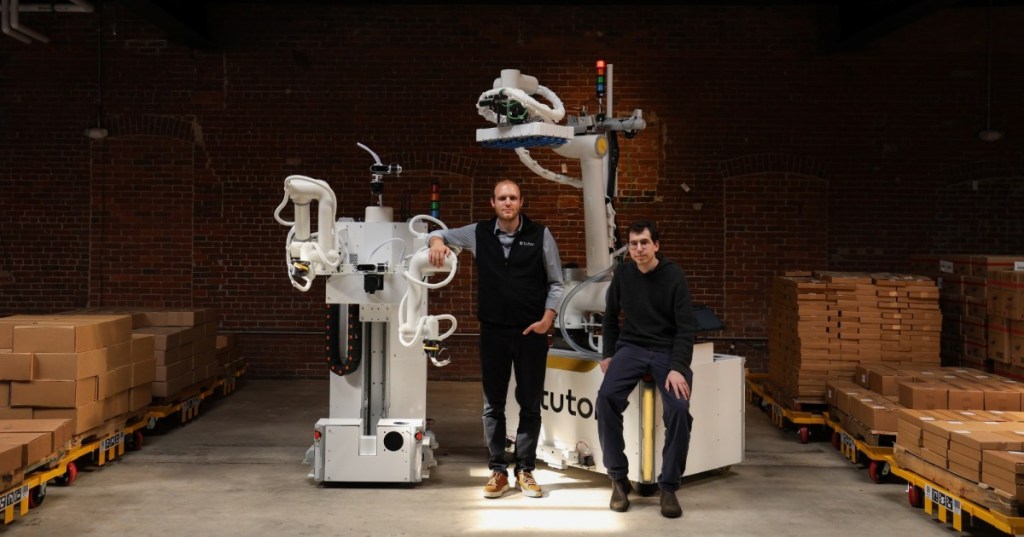
November 3, 2026 — Tutor Intelligence, a robotics company based in Watertown, Massachusetts, announced a $75 million Series B on November 2, taking its cumulative funding to $117 million. Andreessen Horowitz led the round, with Union Square Ventures and Neo participating. According to the company-issued release, proceeds will train robot foundation models and expand manufacturing and deployments of its Cassie and Sonny machines.
Tutor’s business model shifts automation from buying an industrial robot to purchasing completed work by the hour or by the pick. The company says customers avoid upfront machine purchases and long-term contracts while Tutor provides equipment, maintenance and software updates. Lower entry costs could open warehouse automation to smaller firms, although recurring service charges can eventually exceed the cost of owning equipment when utilization remains high.
Tutor Intelligence’s Sonny robot demonstration, linked by co-founder Josh Gruenstein in September 2026. A product clip establishes the demonstrated task, not fleet-wide productivity or unattended reliability.
Robots With Humans Still in the Loop
Cassie uses one arm for case picking, palletizing and depalletizing; Sonny uses two arms for more dexterous individual-item handling. Both run Tutor-developed models, according to the lead investor’s announcement. Unlike fully autonomous robot marketing, Tutor openly describes remote operators, called tutors, guiding connected machines through tasks that their models cannot complete independently.
The strategy is commercially useful when human interventions are infrequent and fast. It could also offer a data advantage: real warehouse actions, including corrected mistakes, feed subsequent training. However, the public release does not report intervention minutes per robot-hour, autonomous task-completion rates, remote operator staffing ratios, disconnections or median recovery times. Without those measurements, claims of improving autonomy remain difficult to quantify.
Tutor says its robots work in nearly four times as many facilities as one year earlier and that almost one-third of organizations receiving machines during the last 12 months were returning customers. The company has not disclosed the prior facility count or an independently audited active fleet count. Its projection of more than 1,000 robots under contract by the end of 2027 is a future commercial target, not 1,000 robots already installed.
The Real Cost of an Automated Pick
A buyer needs a comparable cost per accurate, on-time pick, including service fees, human intervention, downtime, missed picks, workflow integration and supervisory labor. For hourly billing, paid idle time matters. For per-pick billing, the contract must define exceptions, rejected items and minimum throughput. Even a low advertised hourly rate is not proof of a lower fully loaded cost than the existing workflow.
On the supplier side, Tutor must cover robot manufacturing, repairs, communications, remote operators, model training and deployment staff. Investor enthusiasm does not establish a profitable service margin. Tutor disclosed neither a valuation nor revenue in the November announcement, and its service economics have not been independently audited.
Andreessen Horowitz’s November 2026 discussion with Tutor CEO Josh Gruenstein addresses human-assisted robotics, customer deployments and pricing. The investor interview expresses management and investor views rather than independent customer audits.
Reliability, Jobs and the Next Evidence
Remote assistance can help machines recover from unpredictable warehouse conditions, but it introduces network dependence, access-control requirements and potential exposure of workplace video to off-site operators. Worker retraining, job redesign and the location of supervisory labor also deserve disclosure before claiming a broad employment benefit.
Related BitcoinVersus.Tech reporting includes Opentrons’ $40 million laboratory-robotics financing, a review of humanoid robots doing commercial work, physical-AI training facilities and human involvement in advanced manufacturing automation. Each offers a different benchmark for claims about productive autonomy.
The funding validates investor interest, not an autonomous-labor breakthrough. Future reporting should prioritize customer-verified picks per hour, failure rates, the share of tasks requiring human assistance, equipment uptime and contract economics. Those disclosures would establish whether Tutor’s deployment-first strategy can scale reliably beyond demonstrations and initial adopters.
BitcoinVersus.Tech Editor’s Note: We volunteer daily to ensure the credibility of the information on this platform is Verifiably True. If you would like to support our work and help further secure the integrity of our research initiatives, please scan the QR code below to donate 5,000 sats. For best results, scan the QR code from a laptop or larger screen.

On mobile, display the QR code on another screen to scan it with a Bitcoin wallet; alternatively, use a wallet’s saved-image QR-scanning feature if available. Bitcoin donation address: 3C9o19EH5HSiwEPyCTmEKzxhNCbo2X6TTb.
BitcoinVersus.tech is not a financial advisor. This media platform reports on financial subjects purely for informational purposes.


Leave a Reply