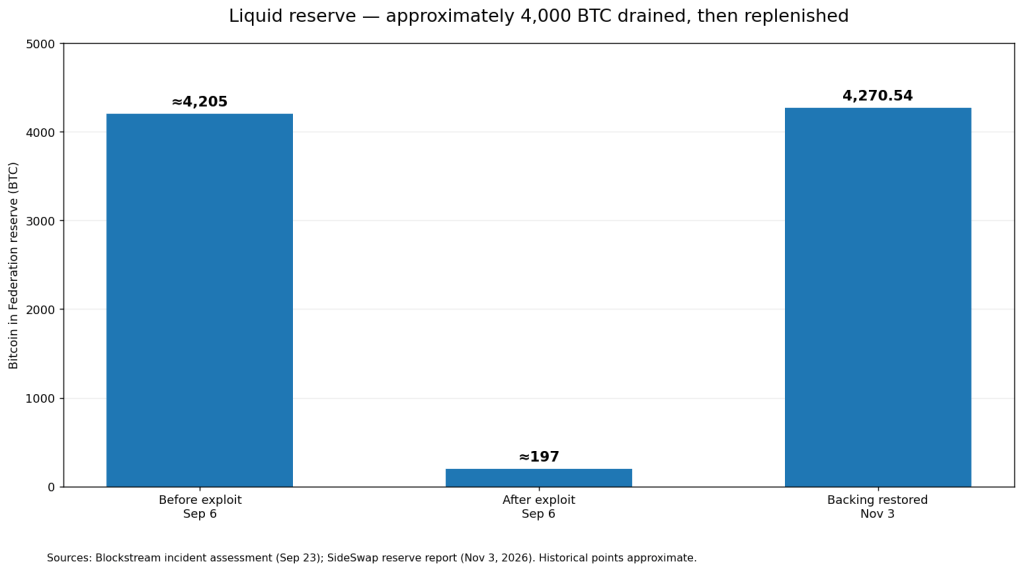
The Liquid Federation said on November 3, 2026, that Bitcoin reserves backing every Liquid Bitcoin (L-BTC) had returned to a one-for-one ratio, nearly two months after a software exploit drained approximately 4,000 BTC, valued at about $320 million at the time. The restored backing is a major financial recovery, but direct Federation withdrawals remain restricted, according to swap provider SideSwap.
Liquid Network’s November 3 statement announces full backing and upcoming security improvements. Source: Liquid Federation on X.
The Federation said users can independently compare Bitcoin reserves with circulating L-BTC through the public Liquid Network dashboard or operate nodes to verify proof of reserves. SideSwap reported 4,270.54 BTC held against 4,270.54 L-BTC in circulation on the morning of November 3. Those balances are a dated snapshot, not a promise of immediate redemption for every holder.
How the September Exploit Created Unbacked Bitcoin
The September 6 failure arose in a cached rangeproof-verification path in Elements, the Bitcoin-derived software used by Liquid. Blockstream’s September 23 incident assessment found that an invalid transaction created roughly 4,000 L-BTC without a corresponding Bitcoin deposit. The attacker passed those tokens through SideSwap’s authorized peg-out service, withdrawing real Bitcoin from the Federation reserve. The assessed reserve balance fell from approximately 4,205 BTC to 197 BTC.
BTC Sessions’ March 2021 video demonstrates ordinary Liquid wallet transfers and swaps. The tutorial predates the September 2026 exploit.
An attacker returned 3,400 BTC on September 7, leaving roughly 602 BTC outstanding. The latest recovery involved deposits of 2.5 BTC on October 27, 50 BTC on October 28, then 300 BTC and 250 BTC on November 2, SideSwap reported. The deposits collectively restored the accounting match. Liquid Federation board member Samson Mow attributed the replacement Bitcoin to Blockstream, but the Federation has not published a complete independent funding reconciliation.
Full Reserves Do Not Mean Normal Peg-Outs
Restoring reserves resolves a critical backing deficit, not every operational consequence of the exploit. SideSwap says its own BTC-to-L-BTC and L-BTC-to-BTC conversions reopened, with a standard 0.1% service fee. Yet Federation peg-outs are still restricted. SideSwap currently pays customers using its own Bitcoin inventory, replenished manually; customers may encounter queues when that balance runs low.
The distinction exposes how sidechain architecture differs from Bitcoin mainnet settlement. Liquid relies on a group of functionaries to secure pegged funds and authorize withdrawals. The earlier Blockstream growth investment reflected ambitions for Bitcoin settlement infrastructure; the exploit now makes software validation, reserve transparency and governance central to evaluating those ambitions.
Security Safeguards and Governance Still Matter
Other Bitcoin payment systems present different trade-offs. BitcoinVersus.Tech has examined Lightning withdrawals for miners, which use a separate payment-channel model. Recent coverage of the Binance wallet incident also illustrates why custody, exploit type and recovery mechanism should not be conflated. A proof-of-reserves dashboard establishes a balance at an observed time, not immunity from future validation bugs.
Blockstream released Elements v23.3.4 in September to correct the affected validation behavior. The Federation now says it will overhaul governance roles, strengthen oversight and add technical safeguards. The software failure was separate from the longer-term cryptographic risks considered in our Bitcoin quantum-security report. Independent audit findings, unrestricted Federation peg-outs and documented funding provenance remain important tests of the recovery. Until those steps are confirmed, the reserve repair is a substantive milestone rather than a declaration that normal operations have entirely returned.
BitcoinVersus.Tech Editor’s Note
We volunteer daily to strengthen the credibility of our reporting through verifiable sources. To support independent research, you may donate 5,000 sats using the original QR code below. Verify the receiving address before sending.

Donation address: 3C9o19EH5HSiwEPyCTmEKzxhNCbo2X6TTb.
Disclaimer: BitcoinVersus.Tech provides financial and technology reporting for information and education. This report does not constitute investment advice.


Leave a Reply