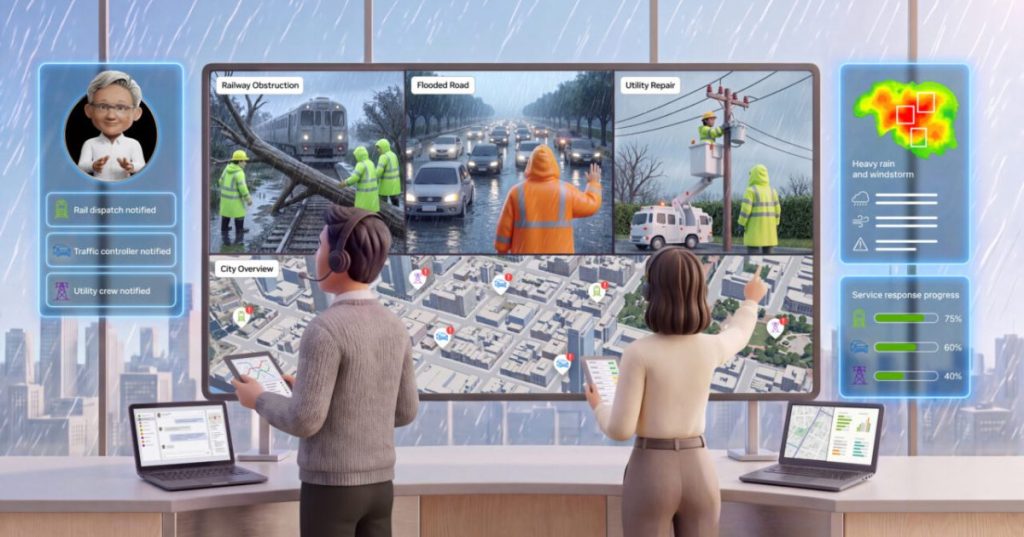
November 3, 2026 — NVIDIA outlined a wider set of municipal artificial-intelligence deployments on November 2, describing resident-service agents, camera-assisted traffic management and digital twins across Europe, Asia, Africa and North America. The company’s announcement identifies named partners and projects, but offers limited independently verified evidence of operating savings, privacy protections or sustained improvements for residents.
The commercial argument is straightforward: shared computing can support multiple city departments without requiring each office to purchase an independent GPU cluster. NVIDIA says some smaller workloads can begin on RTX workstations. Yet a small initial server is not the entire cost of a service that must also fund integration, cybersecurity, model monitoring, staff training and ongoing maintenance.
NVIDIA’s official video, “How NVIDIA AI Is Transforming Cities, Ports, and Communities Worldwide,” linked in its November 2 announcement. Promotional demonstrations are not independent operating audits.
Resident Services and Traffic Systems
Spain’s 1MillionBot combines Barcelona Supercomputing Center ALIA models with NVIDIA Nemotron and other systems to assist with appointments, city procedures, planning incidents and inquiries. NVIDIA reports more than 150 deployments across Spain, including customers such as Madrid Digital and Administració Oberta de Catalunya. A deployment count does not disclose how many requests were completed accurately, escalated to public employees or resolved on first contact.
In Malaysia, ITMAX is expanding SamurAI V2 vision agents using RTX PRO 6000 GPUs, with an aim to support more than 17,000 cameras by 2027. The camera figure is a future target, not a verified present installation. ITMAX also employs Laplace Intelligence’s TeraSim traffic platform; NVIDIA cites peak-hour corridor travel-time reductions of up to 26% from signal-timing tests. Without a disclosed baseline, methodology and independent live-road evaluation, the reported upper-end reduction cannot be treated as a typical citywide result.
Wrocław, Poland, meanwhile, is developing shared vision infrastructure through K2K for mobility, safety and event response. Cameras capable of finding operational incidents can also reveal personally sensitive movement patterns. Officials would need public retention limits, access controls, audit logs, procurement transparency and clear procedures for contesting AI-influenced decisions.
Digital Twins Are Planning Tools, Not Physical Results
In Taiwan, Linker Vision and architectural firm MVRDV are developing urban-planning agents that reportedly simulate 15-year tree-canopy outcomes in about ten minutes. NVIDIA says design iteration can move from two weeks to under an hour. Those are vendor-reported workflow comparisons, not measured proof of environmental improvement. In Nigeria, a proposed Omniverse digital twin for the Lekki refinery is still described as planned, even while Honeywell’s Forge Plant Cognition uses operational data.
NVIDIA’s earlier smart-city digital-twin demonstration, published November 2025, explains the underlying simulation approach. Footage predates the November 2026 deployment summary.
The Public-Sector Test
City procurement needs more than a demo. An informative contract would disclose capital spending, annual cloud or power costs, incident-detection precision, false alarms, accessibility performance, human appeals and benchmark results measured before and after deployment. GPU and camera spending should be compared against simpler software or staffing alternatives, not only against manual processes.
BitcoinVersus.Tech previously examined AI-assisted government procedures in Abu Dhabi, where auditability and human review face related tests. Technical context also comes from Hitachi’s NVIDIA-based engineering digital twin and an explanation of retrieval-augmented AI, which helps distinguish sourced answers from ungrounded responses. Concerns about independently tested systems echo earlier reporting on AI oversight and outside audits.
NVIDIA’s roster indicates broad interest in municipal AI, not a uniform record of verified cost reductions. The next meaningful milestones are published procurement terms, privacy-impact assessments and reproducible performance measurements from the actual cities and service operators.
BitcoinVersus.Tech Editor’s Note: We volunteer daily to ensure the credibility of the information on this platform is Verifiably True. If you would like to support our work and help further secure the integrity of our research initiatives, please scan the QR code below to donate 5,000 sats. For best results, scan the QR code from a laptop or larger screen.

On mobile, display the QR code on another screen to scan it with a Bitcoin wallet; alternatively, use a wallet’s saved-image QR-scanning feature if available. Bitcoin donation address: 3C9o19EH5HSiwEPyCTmEKzxhNCbo2X6TTb.
BitcoinVersus.tech is not a financial advisor. This media platform reports on financial subjects purely for informational purposes.


Leave a Reply