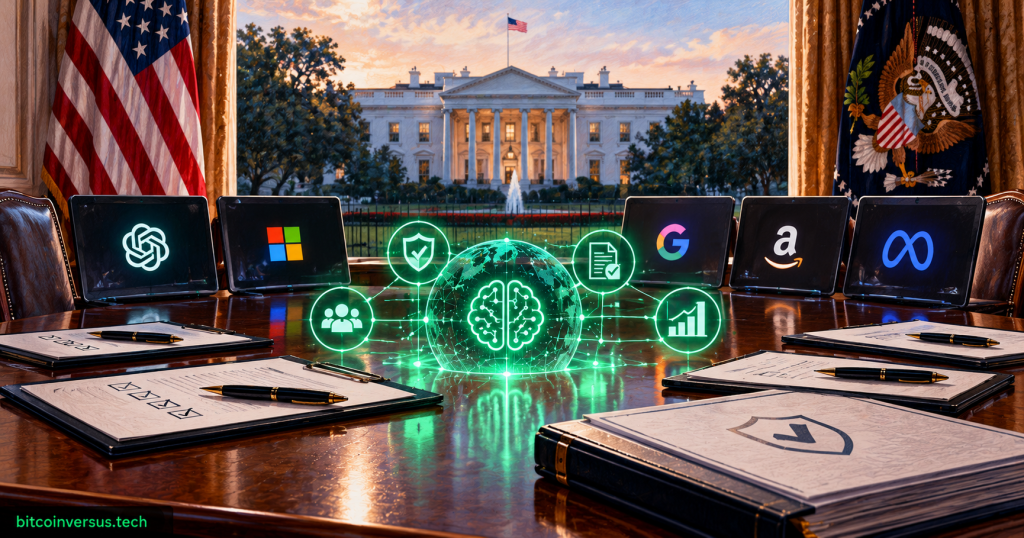
The White House is testing a political middle ground on artificial-intelligence safety: ask the companies building frontier systems to police themselves, require internal controls and outside audits, and leave the framework voluntary rather than turning it into new binding regulation.
The approach emerged from President Donald Trump’s September 29 Super Intelligence summit, documented in the White House’s official event gallery. A fresh Reuters report published October 3 says the agreement relies on voluntary compliance and includes no stated penalty if a participating company chooses not to follow it.
The accord moves AI oversight inside the companies
The central idea is not that Washington will preapprove models before release. Instead, participating companies are expected to build internal safety controls, submit those controls to independent external review and elevate findings to board-level oversight.
That structure shifts the first line of accountability toward corporate governance rather than a new federal licensing regime. BitcoinVersus.Tech recently covered the administration’s parallel decision to rename AI “Super Intelligence” across the executive branch, which came out of the same September 29 policy push.
The White House published the accord itself in an official X post, making the document directly visible alongside the administration’s broader Super Intelligence messaging.
Independent audits are the accord’s strongest enforcement mechanism
External evaluation matters because self-policing can become meaningless if the same team that ships a model is also the only team judging whether its safeguards work. The accord attempts to separate those roles by adding independent auditors and board-level review.
White House AI and crypto adviser David Sacks described that structure in his own X post about the agreement, emphasizing internal controls, independent external audits and responsibility at the company level.
Voluntary does not mean consequence-free — but it is not a law
The political argument for the accord is speed. A voluntary framework can be signed and implemented faster than legislation, while public commitments and audit reports can create reputational, board and potentially existing-law consequences if companies misrepresent what they are doing.
The criticism is just as straightforward: without a statutory penalty or independent regulator with direct enforcement authority, the system still depends heavily on companies reporting problems and acting on them. That tension has been central to the wider debate over whether advanced AI should be governed through law, markets, corporate boards or some combination of all three.
The accord fits a broader U.S. push to manage AI risk without stopping development
The administration’s policy line has repeatedly favored continued AI deployment while adding targeted safeguards around specific risks. BitcoinVersus.Tech previously tracked the proposed U.S.-China AI incident notification channel, another attempt to manage high-consequence failures without slowing the entire sector.
The private sector is moving in the same direction at the infrastructure layer. NVIDIA’s work on a hardware watchdog for autonomous AI agents shows how technical controls can sit alongside policy controls when software is given more authority to act.
The real test is what happens when an audit finds something serious
The White House accord is easiest to evaluate at the moment of failure. If an independent audit finds that a frontier system is behaving dangerously, will a company delay deployment, narrow access or accept a competitive disadvantage to fix it?
If the answer is yes, the voluntary model could become a meaningful governance layer even without a new law. If the answer is no, the absence of direct penalties will become the central weakness. That makes the accord less a final settlement over AI regulation than a live experiment in whether corporate controls and outside audits can carry political weight before Congress writes harder rules.
BitcoinVersus.Tech
Advertisement
Editor’s Note
If you value independent technology reporting, consider supporting BitcoinVersus.Tech with a Bitcoin donation: 3C9o19EH5HSiwEPyCTmEKzxhNCbo2X6TTb
BitcoinVersus.tech is not a financial advisor. This media platform reports on financial subjects purely for informational purposes.


Leave a Reply