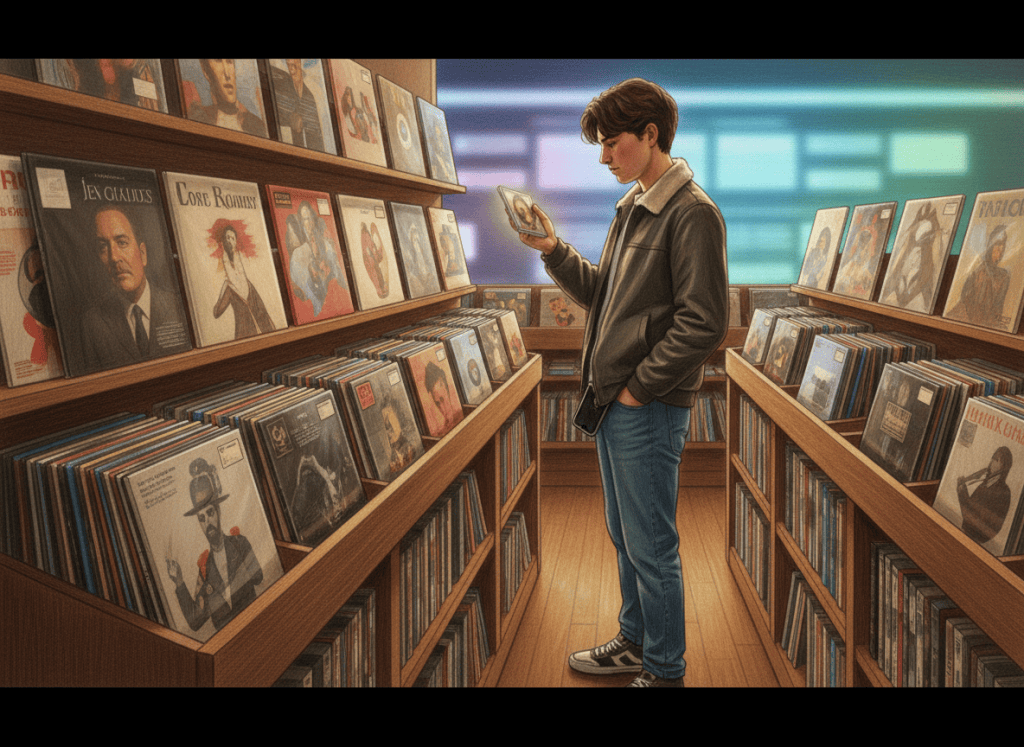
Physical media is doing something streaming was supposed to make unnecessary: growing again. In 2026, CDs, vinyl records and even older movie formats are finding new buyers who increasingly describe the appeal in terms of ownership, control and escaping recommendation algorithms—not simply nostalgia.
The numbers make the comeback harder to dismiss. California State University, Northridge’s review of 2026 industry data reports that 17.5 million CDs were sold in the United States during the first half of 2026, up from 12 million during the same period in 2025, while vinyl units climbed nearly 21% to 26.5 million. The Guardian’s October 2 reporting found collectors explicitly turning to CDs, DVDs and records to reduce dependence on algorithms and subscription libraries.
The physical-media comeback is becoming an ownership story
Streaming remains overwhelmingly convenient, but convenience and ownership are not the same product. A subscription gives access to a catalog whose licensing, availability, interface and recommendation system can change without the listener or viewer controlling any of them.
A CD, record, DVD or Blu-ray behaves differently. Once purchased, the copy can remain on a shelf, play without an active subscription and survive a platform changing its catalog. That difference is becoming culturally important as more entertainment moves through services that optimize what users see next.
CD sales jumped while streaming still dominated
The comeback does not mean streaming is collapsing. U.S. streaming music still generated billions of dollars during the first half of 2026 and remains the dominant way people listen. What changed is that physical formats grew at the same time.
That creates a more interesting market than a simple digital-versus-analog fight. Consumers can use streaming for discovery and convenience while buying physical editions of the albums, films or artists they care most about. Physical media becomes the permanent library; streaming becomes the enormous temporary one.
Algorithms created convenience—and a reason to escape them
Modern entertainment platforms are built around recommendation. That can surface music or video a person would never discover alone, but it can also turn listening and watching into a continuous feed shaped by engagement systems.
Physical collections reverse that relationship. A shelf has no autoplay queue. It does not reorder itself around a prediction model. Choosing an album or movie requires a deliberate decision, which is exactly the friction some collectors now appear to value.
That tension sits beside another cultural shift BitcoinVersus.Tech has been following. YouTube is adding AI feedback and testing tools for creators, making digital media production increasingly algorithm-aware even before a video is published.
Music technology is moving in two directions at once
At the same moment listeners are rediscovering discs and records, music creation is becoming more computational. Suno V6 is rebuilding generative music around licensed catalogs, while Universal Music and ElevenLabs are developing licensed AI remix tools for fans.
Those developments are not necessarily contradictory. The same person can want AI-assisted discovery or creation and still want a permanent object representing the finished work. In that sense, the physical-media rebound may be less anti-technology than anti-dependence.
Gen Z can make old hardware culturally new again
One reason CDs are especially interesting is price. Used discs can often be found cheaply, while the hardware needed to play them is abundant on the secondhand market. Younger buyers can build a tangible music library without entering the premium collector economics that surround some vinyl releases.
Physical formats also turn media taste into something visible. A streaming library lives behind a login. A shelf of records, discs or movies becomes part archive, part decoration and part personal history. That quality matters in a culture where so much entertainment consumption otherwise disappears into identical glass screens.
Streaming won distribution, but it may not own the whole future
No serious reading of the 2026 numbers suggests CDs or DVDs are about to replace streaming. The stronger conclusion is that digital convenience did not eliminate the demand for permanent ownership.
That may be the real lesson of the comeback. The more entertainment becomes personalized, licensed, subscription-based and algorithmically sorted, the more valuable a simple physical object can feel. A disc does less than a streaming platform—but the few things it does, it does without asking permission from an algorithm.
BitcoinVersus.Tech
Advertisement
Editor’s Note
BitcoinVersus.Tech covers culture, entertainment and the technologies changing how media is created, distributed and owned.
If you value independent technology reporting, consider supporting BitcoinVersus.Tech with a Bitcoin donation: 3C9o19EH5HSiwEPyCTmEKzxhNCbo2X6TTb
BitcoinVersus.tech is not a financial advisor. This media platform reports on financial subjects purely for informational purposes.


Leave a Reply