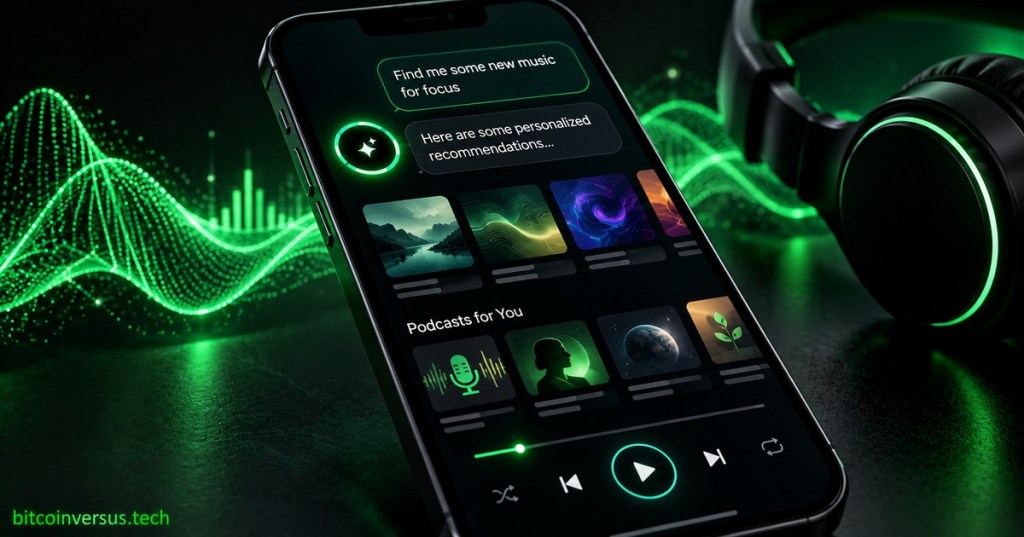
YouTube Music is expanding Ask Music from an AI-radio experiment into a broader conversational layer across more than 300 million songs and podcasts, while adding a weekly AI-audio guide called Your Podcast Lineup. The shift moves music discovery closer to a chat interface: listeners can describe what they want, refine a queue, and ask for more context without starting from a traditional search box.
YouTube’s September 23 product announcement says Ask Music now works across official studio recordings, remixes, live performances, covers and DJ sets. The company also says YouTube Music users discovered an artist new to them more than 450 million times in July 2026, framing conversational discovery as a way to push that behavior further.
YouTube highlighted the update on X, saying listeners can use Ask Music to customize a queue and explore artist lore across its 300M-plus-song catalog.
Music discovery is becoming a conversation
Ask Music is designed for natural-language requests rather than exact artist or track searches. A listener can describe a mood, activity or style, then refine what comes next instead of manually rebuilding a playlist every time the intent changes.
TechCrunch’s coverage of the launch notes that the expanded experience also lets listeners explore artists and music history, while Your Podcast Lineup creates a personalized spoken preview of recommended shows. Both features are slated to come to YouTube Music and Premium subscribers worldwide.
Why 300 million songs changes the AI-music question
The most important difference between Ask Music and an AI music generator is that Ask Music is selecting from an existing catalog rather than synthesizing a new song from scratch. That puts YouTube on a different path from systems that generate original audio and instead turns AI into a navigation layer for a huge library of human-made and user-uploaded recordings.
That contrast matters because Suno V6 is rebuilding generative AI music around licensed catalogs, while YouTube Music is using AI to help people traverse music that already exists. Both approaches put machine learning between the listener and the catalog, but they solve different problems.
The recommendation algorithm now has a chat box
Streaming platforms have always depended on recommendation systems, but conversational discovery makes the listener’s intent more explicit. Instead of inferring everything from skips, likes and history, a service can receive a direct request such as a specific mood, era, pace or listening context and use that as an additional signal.
That creates an interesting counterpoint to the physical-media revival BitcoinVersus covered in the rise of CDs and vinyl among listeners pushing back on streaming algorithms. Ask Music doubles down on algorithmic discovery, but makes the system more steerable by giving the listener a direct conversational control surface.
Podcasts are moving into the same AI layer
Your Podcast Lineup extends the same idea beyond songs. YouTube says the feature will provide a short weekly spoken preview of recommended shows, explain why a listener may like them, and then move into the suggested episodes, making discovery more hands-free.
The broader strategy fits YouTube’s effort to make premium video and audio feel like one continuous media system. LISA’s “Always Lalisa” IMAX-to-YouTube Premium release showed how YouTube is already positioning Premium as a distribution layer for major entertainment, and conversational music discovery adds another reason to keep users inside that ecosystem.
What changes for artists and listeners
For listeners, the obvious benefit is less menu navigation. For artists, the more consequential change may be how discovery queries are phrased: descriptive context such as mood, instrumentation, influences, era or activity can become more important when fans ask for music the way they would describe it to another person.
The unresolved question is transparency. YouTube has described what Ask Music can do, but it has not publicly detailed every ranking signal behind a conversational response or how much weight is given to listening history, metadata, popularity, freshness and the words in the prompt. As AI becomes the front door to a 300-million-song catalog, those ranking choices become part of music culture itself.
BitcoinVersus.Tech
Advertisement
Editor’s Note:
We volunteer daily to ensure the credibility of the information on this platform is Verifiably True. If you would like to support our research initiatives, please donate here: 3C9o19EH5HSiwEPyCTmEKzxhNCbo2X6TTb
BitcoinVersus.tech is not a financial advisor. This media platform reports on financial subjects purely for informational purposes.


Leave a Reply