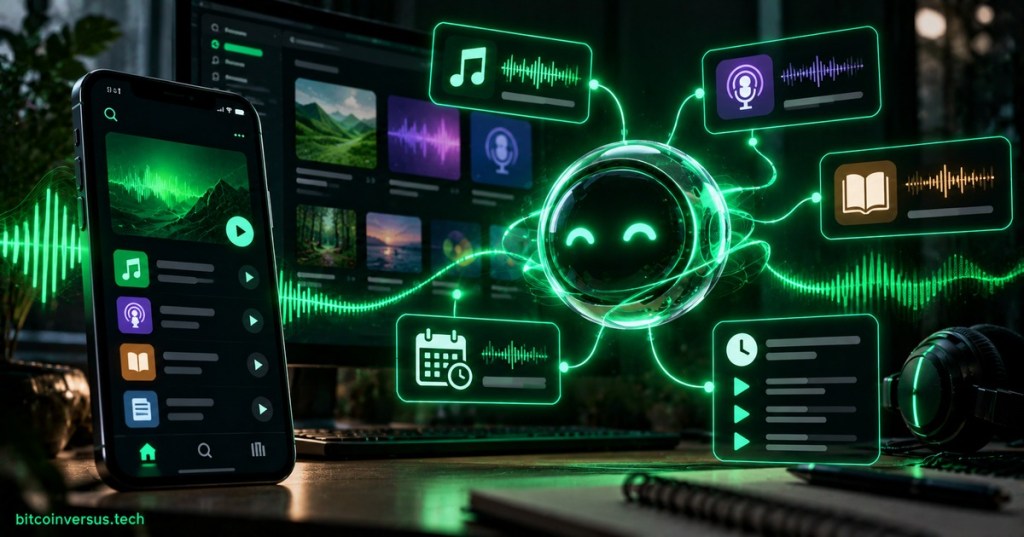
Spotify is moving music discovery and playback into the AI-agent layer through an integration with Meta’s Muse. Instead of opening Spotify and manually searching, listeners can ask the agent to play audio, save songs, build playlists, find podcasts or audiobooks, and schedule listening from a conversation.
In its September 23 integration announcement, Spotify said Muse can control playback, create and name playlists, add newly discovered music, resume podcasts and even turn a user’s notes or daily briefing into a Personal Podcast saved to the Spotify Library.
The playlist is becoming an agent task
The biggest change is not that AI can recommend songs. Spotify already uses recommendation systems throughout its product. The new step is that an outside agent can execute a sequence of listening actions on the user’s behalf: search, choose, save, organize and start playback.
That means a prompt such as “build a road-trip playlist for tomorrow and start it when I leave” can become a workflow instead of a suggestion. Spotify says Muse can also schedule music for routines such as morning runs or focus blocks on a calendar.
When Meta launched Muse on September 8, chief AI officer Alexandr Wang listed Spotify among the initial connectors available to the agent.
Music discovery is shifting from feed to conversation
Streaming platforms traditionally control discovery through home-screen recommendations, editorial playlists, search and autoplay. Agentic interfaces create a different model: the listener describes a goal in natural language and lets software assemble the listening experience.
That shift is already showing up across creator platforms. BitcoinVersus.Tech recently covered YouTube letting viewers build custom recommendation feeds with AI, another move toward users directly steering the algorithm rather than passively accepting a default feed.
Music Business Worldwide’s coverage notes that Spotify was already one of Muse’s named connectors at launch and that the September 23 update clarified what the integration can actually do inside a listener’s account.
Podcasts and audiobooks make this bigger than music
Spotify’s integration reaches beyond songs. Muse can search podcasts and audiobooks, continue something the listener started earlier, and place new finds into the user’s library. That makes the agent a media controller across several content formats rather than just a playlist generator.
The Personal Podcast feature pushes that idea further by turning a user’s own notes, briefings and ideas into audio. The distinction between “content discovery” and “content creation” starts to blur when the same conversational agent can find a podcast, build a playlist and generate a new personalized audio item.
That kind of automation also changes the cultural role of recommendation systems. BitcoinVersus.Tech recently examined the renewed demand for CDs and vinyl as some listeners push back against algorithmic streaming. Muse points in the opposite direction: not less algorithmic mediation, but more direct control over it.
The agent becomes another distribution surface
Spotify says its service is already available across more than 2,000 device types and integrations. Muse adds a new kind of surface: a general-purpose AI agent that can sit between the listener and the streaming app.
For artists and creators, that raises a new discovery question. If listeners increasingly ask an agent for “something new for the gym” or “a podcast about semiconductors for my commute,” the agent’s search and ranking behavior may become another layer influencing who gets heard.
That matters as platforms give creators more AI-assisted tools of their own. BitcoinVersus.Tech recently covered Instagram’s AI assistant using creator performance data to recommend what to post next. Together, these systems point toward a media environment where agents increasingly shape both sides of the marketplace: what creators make and what audiences consume.
Culture is moving from apps to agents
The broader change is interface-level. People are used to opening one app for music, another for calendars and another for messaging. Agentic systems try to collapse those steps into a conversation that can coordinate actions across services.
Spotify’s Muse integration is a small but concrete example of that transition. The music app still owns the library, playback and catalog, but the user no longer has to begin every interaction inside Spotify itself. Increasingly, the front door to culture may be the agent.
BitcoinVersus.Tech
Advertisement
Editor’s Note
We volunteer daily to ensure the credibility of the information on this platform is Verifiably True. If you would like to support to help further secure the integrity of our research initiatives, please donate here: 3C9o19EH5HSiwEPyCTmEKzxhNCbo2X6TTb
BitcoinVersus.tech is not a financial advisor. This media platform reports on financial subjects purely for informational purposes.


Leave a Reply