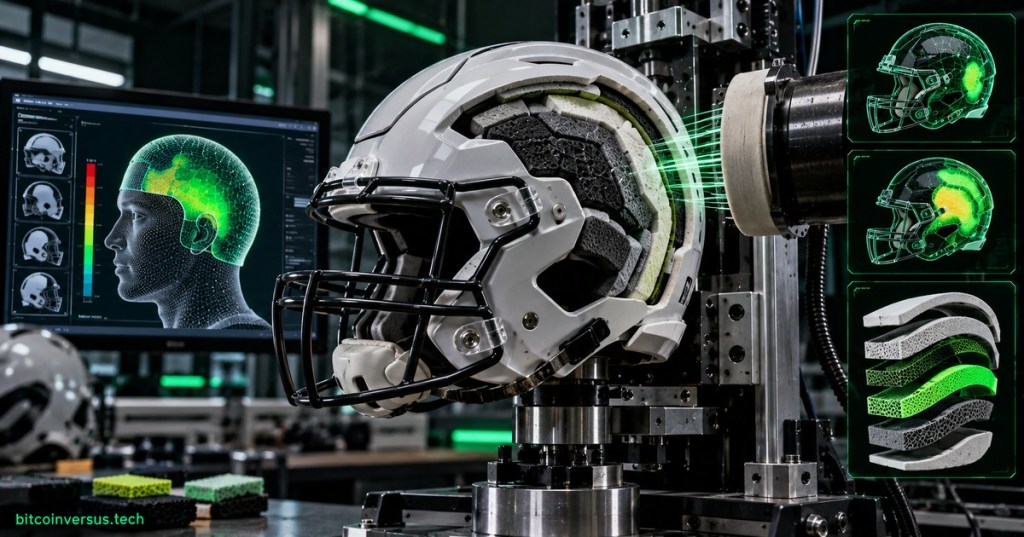
The NFL’s latest helmet-safety update puts a measurable number on equipment performance: players wearing top-performing helmet models have shown nearly 30% lower on-field concussion rates than players wearing models the league classifies as Not Recommended.
In a September 21 engineering update, the league said the annual NFL-NFLPA laboratory rankings are increasingly matching what it sees on the field. The same data showed that 97% of NFL players wore custom-fit helmets during the 2025 season, while 35% of players at positions with position-specific helmets available used those specialized designs.
The helmet ranking is becoming an on-field performance signal
The league and NFL Players Association test helmet models every year and publish the results for clubs and players. For 2026, every model outside the Top-Performing group is now labeled Not Recommended, increasing the pressure on players and equipment staffs to move toward the strongest-performing options.
LIGHT Helmets’ September breakdown of the 2026 results points to the same trend: nearly 60% of returning players moved into a higher-performing helmet, while the gap between the top and lower-ranked equipment is now backed by both laboratory testing and NFL injury data.
The NFL has been emphasizing that annual testing program publicly for years. In an official NFL Football Operations post, the league described how the rankings identify helmets that best reduce head-impact severity and help players choose by position.
Custom fit is now almost universal
The 97% custom-fit figure may be just as important as the helmet-model ranking. Modern fitting can use head scans, adjustable padding and position-specific shell or liner designs so the helmet better matches the player instead of relying on a small set of generic sizes.
That is part of a wider shift toward measuring football equipment instead of treating it as passive gear. BitcoinVersus.Tech recently covered shoulder-pad sensors that quantify contact forces, another example of sports hardware becoming a data source.
Position-specific helmets are the next layer
Quarterbacks, offensive linemen and defensive linemen do not experience the same impact patterns. Position-specific helmets are designed around those different exposure profiles, which is why the NFL tracks adoption separately from general custom fitting.
The same specialization is happening in the league’s software layer. BitcoinVersus.Tech recently examined NFL AI models that identify run schemes and blocking assignments, showing how player safety, strategy and performance are increasingly being measured with role-specific data.
Sports technology is moving from observation to intervention
The significance of the NFL’s helmet data is that the technology is no longer being judged only by laboratory scores. The league is now connecting equipment rankings to on-field concussion outcomes, then using those results to influence what players actually wear.
That feedback loop mirrors what is happening elsewhere in sports technology. BitcoinVersus.Tech’s coverage of Sony’s optical tracking for 3D sprint-finish reconstruction showed how measurement systems are becoming part of officiating and performance infrastructure rather than remaining behind-the-scenes analytics tools.
For football equipment, the direction is increasingly clear: scan the player, measure the impact environment, test the hardware, compare it with real-world outcomes and update the recommendation every season. The helmet is becoming an engineered, data-driven system rather than a static piece of protective equipment.
BitcoinVersus.Tech
Advertisement
Editor’s Note
We volunteer daily to ensure the credibility of the information on this platform is Verifiably True. If you would like to support to help further secure the integrity of our research initiatives, please donate here: 3C9o19EH5HSiwEPyCTmEKzxhNCbo2X6TTb
BitcoinVersus.tech is not a financial advisor. This media platform reports on financial subjects purely for informational purposes.


Leave a Reply