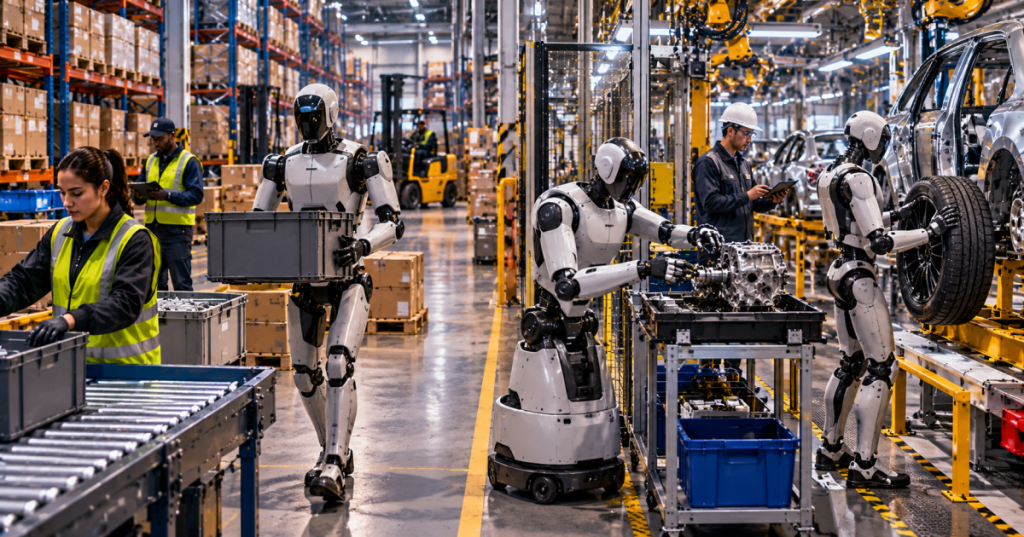
A humanoid robot carrying a storage tote at a warehouse is less spectacular than one doing a backflip, but the tote is a better test of the technology. As of October 27, 2026, several humanoids have completed real workplace tasks involving logistics, vehicle assembly, guest assistance and material handling. Yet paid production service, customer-confirmed pilots, and manufacturer-reported deployments are not equivalent. This countdown separates them and prioritizes evidence from operators over spectacular promotional footage.
The seven examples below are ranked editorially by the strength and scale of documented real-world work, not theoretical intelligence or promised sales. All seven have a named workplace and an actual task described by a source; some have since finished their trials. A robot seen at a customer site does not prove full autonomy, a positive return on investment, or deployment at thousands of locations. Each entry includes one distinct relevant video or image.
7. UBTECH Walker S2 — Factory Material Handling in China
Status: manufacturer-reported industrial work; customer-level shift metrics not disclosed. UBTECH says its Walker S2 has entered real production-line and data-collection environments through industrial partners including Geely, BYD and Foxconn. A first batch of several hundred units began delivery in November 2025, but a delivery target is not the same as a verified number working on any one shift. Some footage also shows Walker S2 in factory-like wind-energy workflows; those clips do not independently establish plant throughput or autonomy.
The hardest missing evidence is mundane: how many robots are independently operating at a named customer site, how many cycles they complete, how frequently employees intervene and how often equipment needs service. UBTECH’s manufacturing expansion answers the scale-up question, but not all of those operational questions.
6. AGIBOT Humanoids — Guest Services at Chimelong Spaceship Park
Status: launched guest-facing deployment, with manufacturer-reported fleet totals. In September 2026, AGIBOT and Chimelong announced more than 300 robots across a mixed fleet at the Zhuhai amusement and tourism complex. Humanoid models participate in performance, tours, visitor guidance and interactive educational activities; the group also includes other robot types. AGIBOT’s 20,000th manufactured robot, an A3 Ultra according to subsequent reporting, was delivered to the park. The 300-unit headline must not be presented as 300 identical humanoid employees, and independent staff-hour and intervention statistics have not been published.
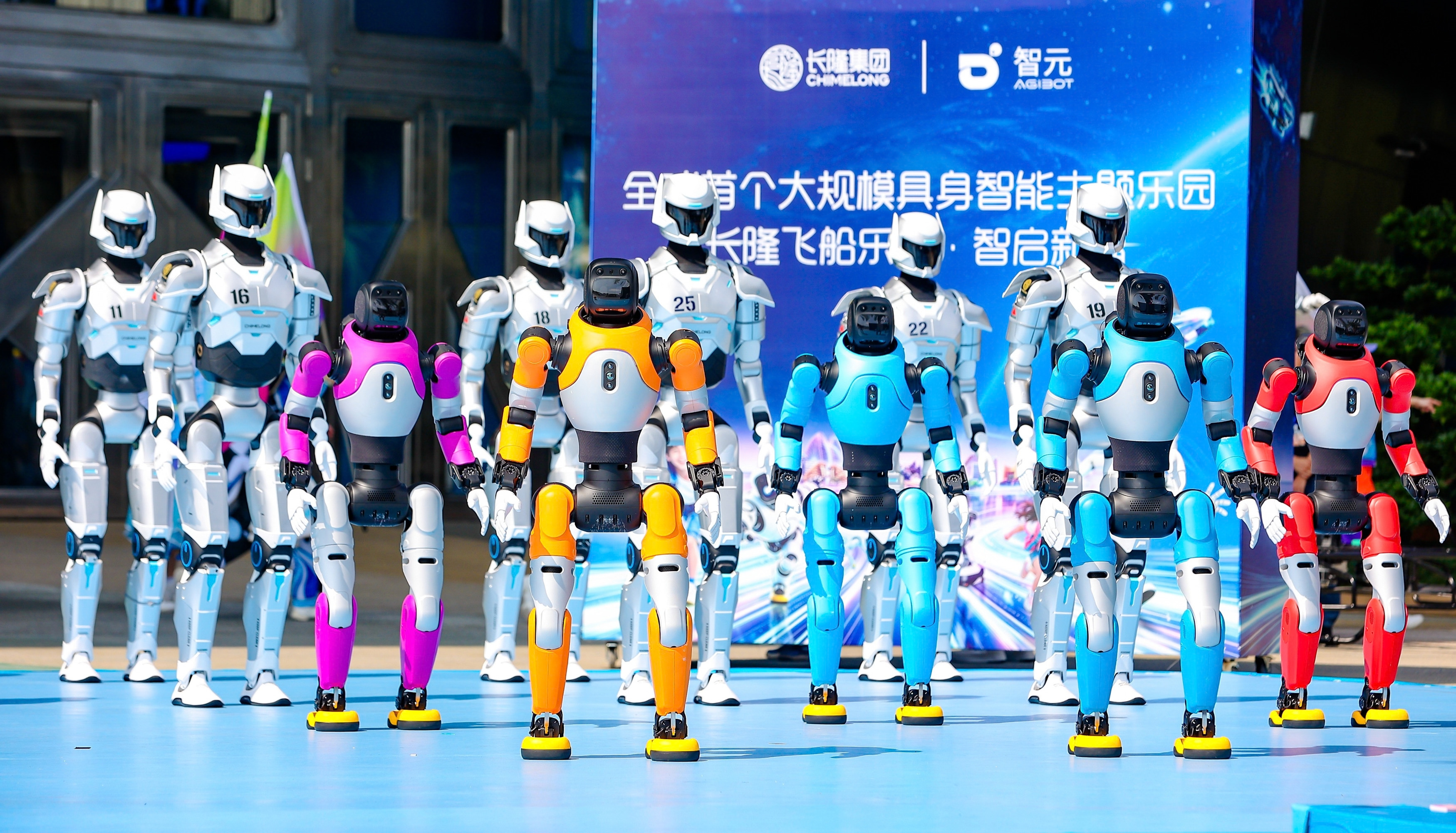
A public-facing resort has more variable conversations and human interactions than a warehouse conveyor. That makes safety zones, customer handoff procedures, networking and human supervision particularly important. The park’s announced 5G-A coordination system is infrastructure context, not a substitute for disclosed reliability figures.
5. Hexagon AEON — BMW Battery-Assembly Pilot in Leipzig
Status: customer-confirmed German factory pilot. BMW’s September 21 update documents AEON, a wheeled humanoid from Hexagon Robotics, operating in a BMW Leipzig project focused on high-voltage battery assembly and component manufacturing. The configuration supports different grippers, tools and inspection tasks. BMW explicitly calls the effort a pilot, so its real-world task performance should not be exaggerated into a permanent plant-wide robot workforce.
AEON demonstrates why a robot can have a humanoid upper body without needing walking legs. Wheels can improve movement on flat industrial floors, while arm reach, dexterity and task flexibility remain the areas being tested. Safety engineering and physical-AI safeguards will determine whether pilots become routine operations.
4. Wandercraft Calvin — Tire Handling at Renault Douai
Status: customer-confirmed working factory trial. Renault’s June 26 report describes the Calvin humanoid, developed with Wandercraft, being tested in the wheel workshop at Douai. Its task is lifting and moving two tires at once, approximately 30 kg combined, reducing physically demanding handling steps for employees. Renault projects about ten robots at its plants by the end of 2026 and 350 across French and Spanish sites by the end of 2027; those numbers are plans, not existing deployed fleet counts.
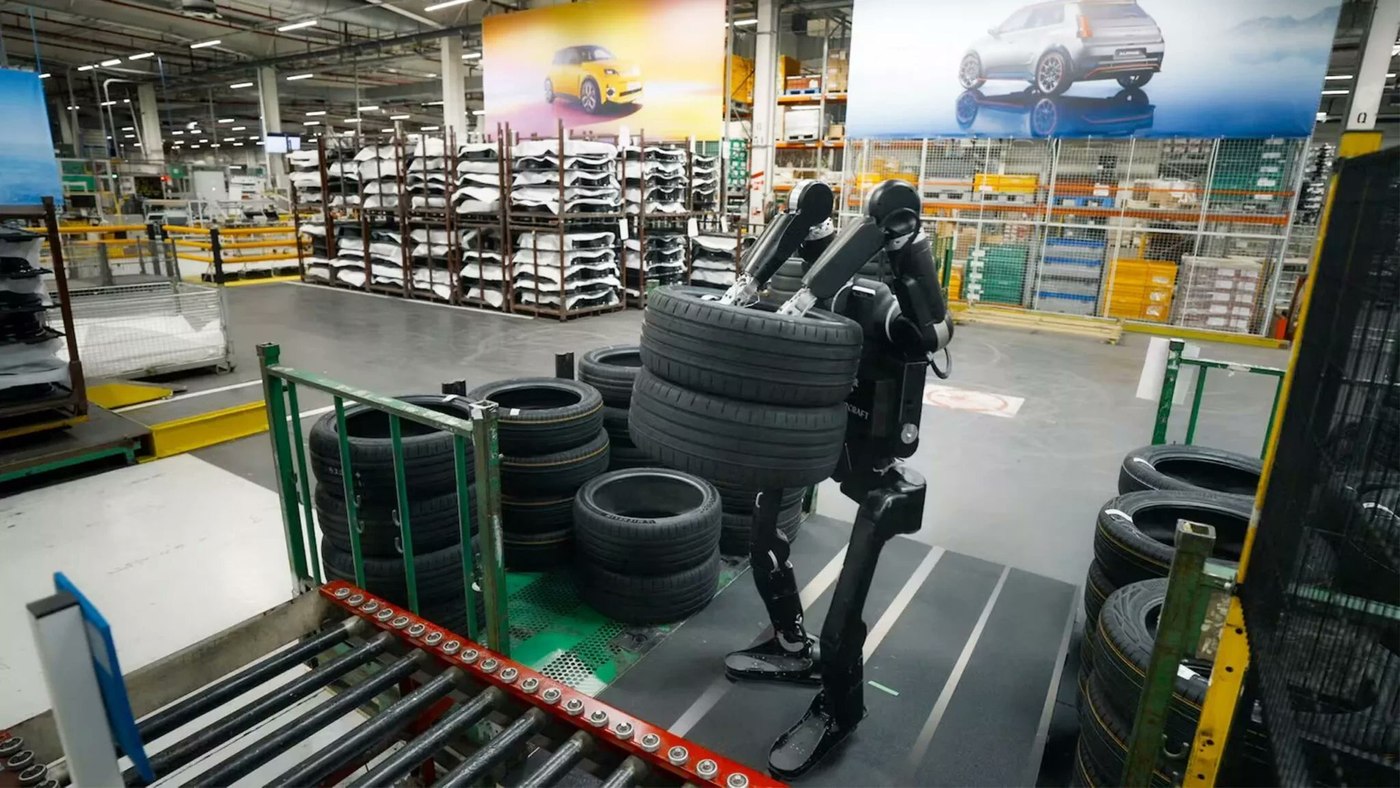
The engineering question is whether the robot can keep moving irregular, heavy loads safely for an entire production shift, not merely execute an isolated lift. Floor traction, grasp reliability and collision prevention matter more than choreography. A single active trial can teach a manufacturer a great deal without proving that hundreds of units already exist.
3. Figure 03 — Sequencing Parts at BMW Spartanburg
Status: live workplace testing, not a published mass-production performance contract. Figure’s June 30 demonstration and BMW’s customer statement document the successor to Figure 02 working through a material-sequencing workflow. Figure 03 picks components from unsorted containers, places them in designated positions on trolleys, and maneuvers a heavy rolling cart. Its Helix 02 system coordinates perception, manipulation and walking within the same workflow.
The important qualifier is time: Figure 02’s 90,000-plus parts and 1,250-plus hours belonged to a completed 2025 program, not a 2026 Figure 03 fleet. The new model has a new task and has not yet disclosed an equivalent output record. Earlier Figure 02 hardware testing offers context for the redesigned system, but does not certify Figure 03’s workplace uptime.
2. Humanoid HMND 01 Alpha — 60 Totes per Hour at Siemens
Status: customer-measured, completed two-week industrial proof of concept. At the Siemens Electronics Factory in Erlangen, Germany, the wheeled HMND 01 Alpha autonomously picked stacked storage totes, transported them and placed them on a conveyor for workers. Siemens reported a throughput of 60 tote moves per hour, more than eight hours of total uptime, and a greater than 90% autonomous pick-and-place success rate. These are specific published trial metrics—but the trial has ended, and uptime does not mean eight hours of uninterrupted operation.
This real-world trial is valuable because it has clearly defined throughput and task-success measures. Siemens also evaluated simulation-to-factory training, its production IT environment and NVIDIA-based controls. That makes it a stronger engineering comparison than a clip of a humanoid simply walking around a showroom.
1. Agility Robotics Digit — Paid Warehouse Work at GXO
Status: ongoing commercial logistics deployment. Digit is the clearest operational example because logistics customer GXO has a multi-year Robots-as-a-Service agreement dating from June 2024. At its Flowery Branch, Georgia, site, Digit lifts storage totes from autonomous mobile robots and places them onto conveyors. The partners confirmed more than 100,000 totes moved in their October 26, 2026 expansion announcement. Agility reports more than 65,000 operating hours across its commercial operations and customer programs, not at GXO alone.
The expanded GXO agreement names North Carolina and Tennessee sites, but deployments are expected to begin in 2027; neither site should be counted as an additional active warehouse in October 2026. Agility’s new Digit 5 generation is also separate from the existing Digit 4 operations. The company continues to work on protective separation, reliability and safe coexistence with people as commercial demand grows.
Why the workplace evidence matters
Most robotics marketing focuses on degrees of freedom, speed and AI models. But buyers ultimately need completed work per hour, uptime, recoveries per thousand cycles, safety incidents, site integration costs and human intervention time. A two-week factory trial can validate a workflow. A paid contract with six-figure handled-item totals goes further. Neither proves generalized intelligence or that every demonstration is autonomous.
The shift from a polished demo to a dependable industrial product is why robot integration software, optical sensing and the accelerators used to train vision-action models matter. It is also why occupational safety cannot be reduced to a single video: even capable robot systems must be evaluated for force limits, safety-rated stops, emergency access, workspace design and employee training.
Excluded from this list: Boston Dynamics Atlas is training at Hyundai’s Robotics Metaplant Application Center in Georgia, but Hyundai targets parts-sequencing line work from 2028. Tesla has described Optimus development and early production without comparable verified external workplace throughput. Apptronik Apollo 2 has active robot-training tasks and customer pilots, but this list favors customer or site evidence of specific task outputs. Those distinctions may change when operators publish results.
Editor’s Note: Rankings are editorial judgments based on public evidence available October 27, 2026. A customer trial, an active commercial contract, and a manufacturer assertion are labeled separately; vendor-reported numbers are not treated as independently audited results. If you value detailed technology coverage, consider donating 5,000 sats by scanning the QR code below with your Bitcoin wallet.

Scan the donation QR from another screen to send 5,000 sats and support independent reporting.


Leave a Reply