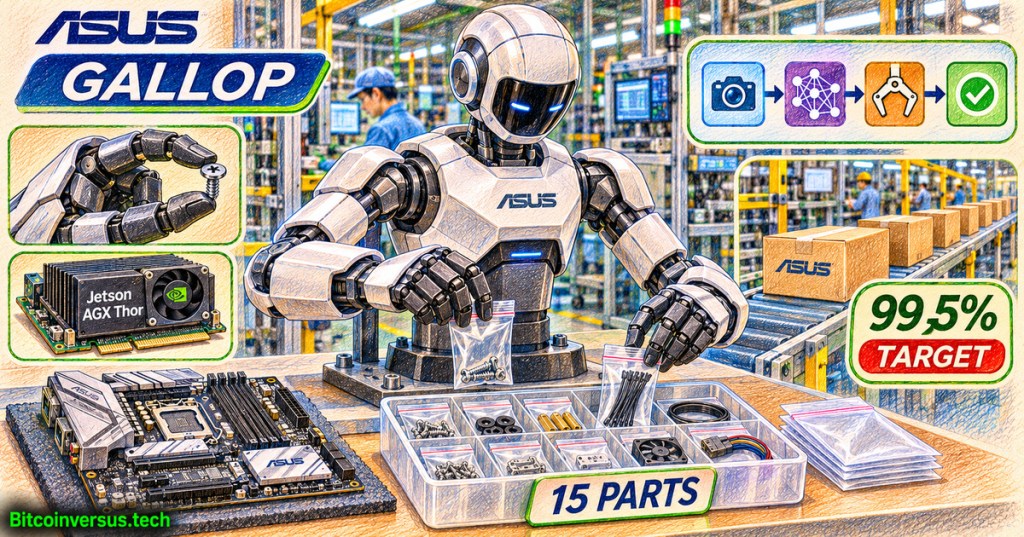
ASUS is testing its first humanoid robot, Gallop, at a motherboard-accessory packing station in one of the company’s electronics factories. The job involves 15 small parts per board, many sealed in thin plastic bags. ASUS is targeting 99.5% successful packing within 20 seconds per board, according to its November 13, 2026 official engineering account. Crucially, ASUS has not published Gallop’s achieved success rate or evidence of full-shift operation.
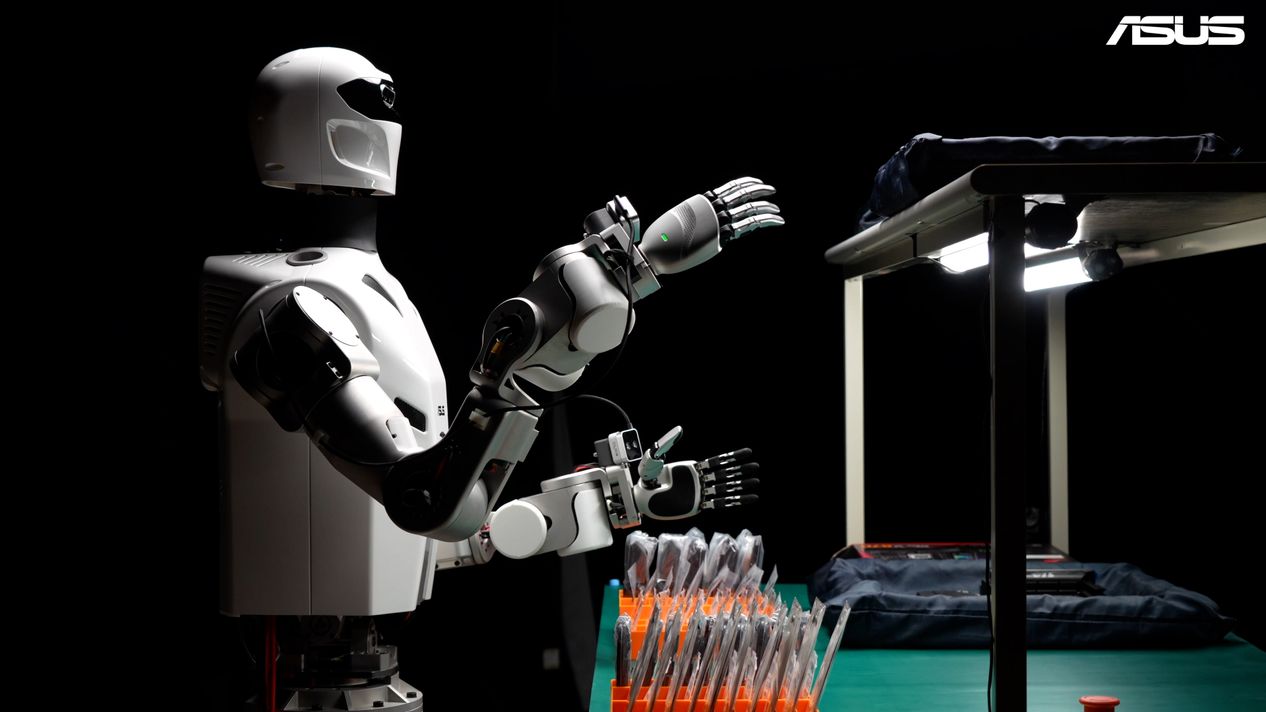
Gallop is a two-arm unit currently mounted on a fixed base, rather than a walking humanoid. ASUS says a wheeled platform is planned. Its goal is to work at existing human-sized stations where parts, packaging and production runs change often, potentially limiting the need to rebuild entire manufacturing lines around traditional automation.
A target, not a factory-wide performance result
At the stated target pace, a continuously operating station would process 180 boards per hour (3,600 seconds divided by 20). At a 99.5% target success rate, that would translate to approximately 179 correctly packed boards per theoretical hour before downtime, changes, rework or inspection. Those figures are arithmetic illustrations, not measured Gallop output, and ASUS has disclosed neither a current robot failure rate nor the number of working units.
ASUS co-CEO S.Y. Hsu’s November 13, 2026 social post, featured on the official ASUS Pressroom page. The post shows the factory task; announced milestones and targets are attributed separately to ASUS.
How Gallop learns from factory workers
ASUS describes a staged learning pipeline: consenting experienced workers record the job through head cameras; simulation creates variations; operators guide the robot through difficult actions using VR headsets and gloves; and task recordings feed further training. The robot’s software separates planning, supervisory checking, grasping skills and low-level motion control into four layers so models can be replaced without rebuilding the mechanical platform.
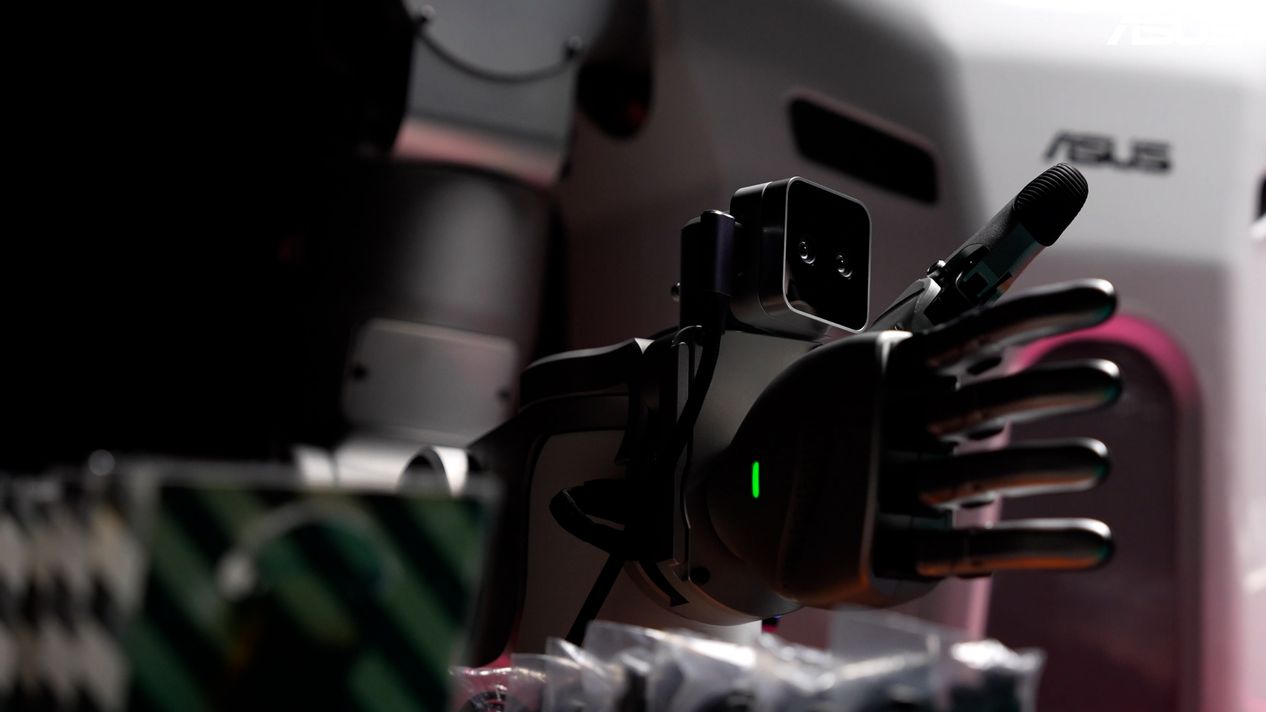
All four layers run on a single NVIDIA Jetson AGX Thor onboard computer, according to ASUS. The company designs Gallop’s body and is developing a touch-sensitive dexterous hand in-house, while motors and other components come from suppliers. Related robotic touch-sensor engineering and Jetson Thor planning-latency research show why perception, hand control and computation must work together when handling flexible packaging.
Pilots in 2027, market target in 2028
ASUS plans to show Gallop to customers at Computex 2027 and start external customer pilots during 2027, with commercial availability targeted for the second half of 2028. A pilot or planned sales date is not evidence of existing third-party deliveries. The firm has not disclosed a selling price, payload, fleet size, uptime or independently verified production savings.
The competitive comparison is broader than picking up accessories. Separate NVIDIA robot-learning benchmarks are not directly comparable because tasks and test conditions differ. Other humanoid programs at factories and warehouses likewise vary from demonstrations to contracted or operating deployments; actuator cost and hardware availability remain important constraints.
For Gallop, the decisive evidence will be repeatable quality, intervention rates, safe coexistence with workers, maintenance cost and throughput over complete production shifts—not a target printed on a launch slide. For now, the November factory trial is a technical development with measurable goals but unverified commercial economics.
Editor’s Note: ASUS’s November 13, 2026 Pressroom report is the primary source for Gallop’s factory task, 15 accessories, 20-second cycle target, 99.5% target, onboard computing and timeline. The 180-board theoretical hourly figure is independent arithmetic, not a company-reported result. The colored-pencil featured cover is original conceptual art, not an authentic Gallop photograph or engineering drawing. The two in-body photographs originate from ASUS’s pressroom and remain credited to ASUS. The embedded social post comes from ASUS co-CEO S.Y. Hsu and appears on the ASUS Pressroom page; rendered content and actual playback are separately audited. No independent factory visit, robot benchmark, safety certification or live playback check was performed.

For mobile scanning, display the QR on a separate screen and scan it with a compatible Bitcoin wallet camera. Some wallets also support scanning an image saved on the same phone. Verify the destination before donating 5,000 sats: 3C9o19EH5HSiwEPyCTmEKzxhNCbo2X6TTb.
We volunteer daily to ensure the credibility of the information on this platform is Verifiably True. If you would like to support our work and help further secure the integrity of our research initiatives, please scan the original QR code above to donate 5,000 sats.
BitcoinVersus.tech is not a financial advisor. This media platform reports on financial subjects purely for informational purposes.

