
Georgia’s low statutory wage floor offers an argument for a new kind of income policy: a Universal Basic Workers Bonus (UBWorkers), a recurring public supplement paid to people with earned income. Rather than give every adult the same unconditional payment, the proposal would make employment more financially rewarding while retaining separate support for people unable to work. UBWorkers is an editorial proposal, not an enacted benefit.
Official IRS video explaining the existing federal Earned Income Tax Credit, published January 2022. Historical educational material, not an endorsement of the proposed UBWorkers policy or a guide to every 2026 tax rule. Credit: IRSvideos / YouTube.
Why Georgia makes a useful starting point
Georgia’s statutory minimum wage is $5.15 per hour, although the federal $7.25 rate applies to most covered workers. Georgia’s Department of Revenue confirms the state has no state Earned Income Tax Credit. House Bill 316 proposed a state credit equal to 20% of the federal EITC, but the official legislative record lists the measure at House second reading, not as an enacted benefit. Low statutory wage protections do not establish what every Georgia employer actually pays.
An earlier BitcoinVersus.Tech argument for universal basic income as artificial intelligence advances focused on an unconditional safety net. A workers’ bonus addresses a different question: how to make a paycheck go further. Our report on widening wage disparities provides broader context.
A recurring supplement rather than an annual refund
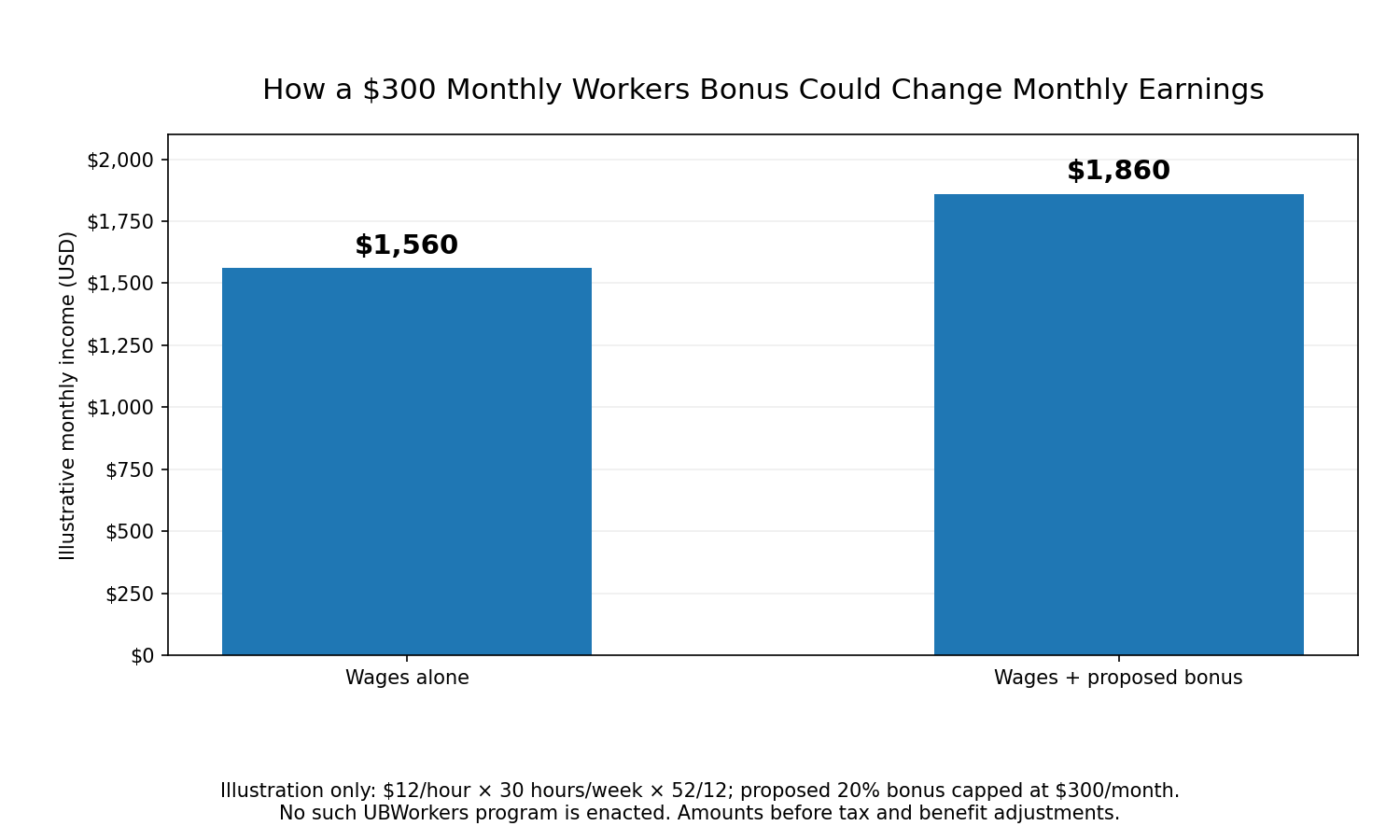
A Georgia pilot could pay 20% of verified monthly earned wages, capped at $300 per month, with payments delivered monthly or as biweekly advances. For example, someone earning $12 per hour for 30 hours weekly would average $1,560 in monthly gross wages using 52 weeks divided by 12 months. A 20% supplement equals $312, reduced to the $300 cap. Total modeled earnings become $1,860 before taxes. The percentage, cap and eligibility thresholds are proposed design choices, not official program figures.
The bonus should reach workers directly, not become a reason for employers to reduce wages. Payroll records could support advances, with annual reconciliation for changing hours and self-employment income. Direct deposit is one option; BitcoinVersus.Tech previously explained how ACH paycheck transfers operate. Policymakers would need strong privacy safeguards and straightforward corrections for overpayments.
The existing precedent and the trade-offs
The federal Earned Income Tax Credit already supplements eligible workers’ incomes through a refundable tax credit, with benefits depending on earnings and household circumstances. UBWorkers would differ mainly through frequent payments and a potentially simpler, more visible bonus. A gradual income phaseout would be necessary to prevent sudden losses when workers accept raises or additional shifts.
Critics could reasonably argue that public wage subsidies allow low-paying employers to avoid raising compensation, shift costs to taxpayers, or create fraud and benefit-cliff problems. Supporters could argue that additional earnings improve the immediate reward for working without placing the entire burden on small businesses. Neither argument establishes the size of any actual employment effect; evaluation would be essential.
Cost matters. A hypothetical 500,000 recipients receiving an average $200 monthly would cost $1.2 billion annually before administration. A time-limited Georgia pilot should publish its funding plan and measure employment, hours, retention, employer wages, household income and administrative errors. Earlier analysis of wages and homebuying power illustrates why purchasing power cannot be judged from nominal pay alone.
A national program could follow only after credible results and an explicit funding debate. A workers’ bonus should not displace disability benefits, unemployment protection, caregiving support or minimum-wage enforcement. The governing principle is straightforward: paid work should provide a clearer financial gain, while economic security must remain available to people who cannot work.
Primary sources: Georgia Department of Labor, minimum wage; U.S. Department of Labor, 2026 wage table; Georgia Department of Revenue, credit FAQ; Georgia HB 316 legislative record; IRS, EITC eligibility; Congressional Research Service, September 2026 EITC report; official IRS educational video. Calculations: $12 × 30 × 52 ÷ 12 = $1,560; 20% × $1,560 = $312, capped at $300; $1,560 + $300 = $1,860; 500,000 × $200 × 12 = $1.2 billion.
Editor’s Note: UBWorkers is an editorial policy proposal and is not an enacted Georgia or federal payment program. Figures, eligibility design and fiscal illustrations are hypothetical. Georgia’s $5.15 state minimum is generally superseded by the $7.25 federal minimum for covered employees. The IRS video predates 2026 changes and explains the existing EITC, not UBWorkers. The 1200 × 630 original colored-pencil cover is conceptual illustration, not a documentary photograph; the chart uses a zero baseline. Source links and saved WordPress markup were checked, but mobile layout and actual video playback require independent testing. The proposal is not a claim that people unable to work should lose benefits.

BitcoinVersus.Tech is volunteer-run and publishes independent educational technology reporting. An optional 5,000-satoshi donation supports ongoing research. Scan the original QR from a second screen with a compatible Bitcoin wallet; on mobile, use a wallet that supports scanning a saved image. Independently verify the recipient address 3C9o19EH5HSiwEPyCTmEKzxhNCbo2X6TTb and the payment amount before sending. Bitcoin transfers are generally irreversible.
We volunteer daily to ensure information on the BitcoinVersus.Tech platform is Verifiably True. Coverage is educational and informational and does not constitute financial or investment advice.


Leave a Reply