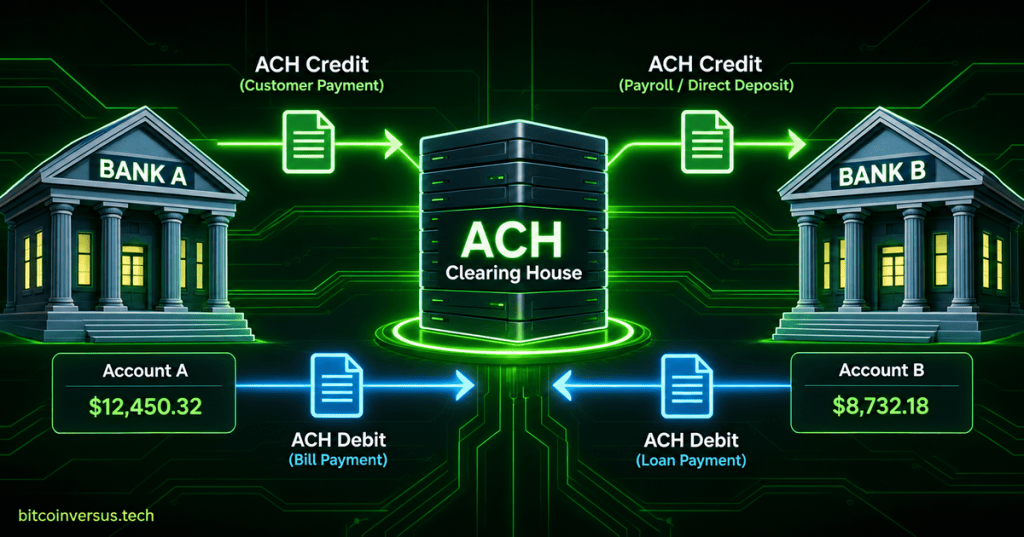
ACH, short for Automated Clearing House, is one of the main systems banks use to move money electronically between U.S. accounts. If your paycheck arrives by direct deposit, your mortgage or utility bill is pulled automatically, or you transfer money from one bank account to another, there is a good chance ACH is working in the background.
Unlike a card payment, ACH does not depend on a card network at the point of sale. Unlike a traditional wire, it is built to move large numbers of payments efficiently in batches. And unlike an instant-payment rail such as FedNow, ACH was designed around scheduled clearing and settlement rather than always-on instant finality.
The easiest way to remember ACH is this: it is a standardized bank-to-bank messaging and settlement system for electronic credits and debits.
ACH Is the Rail Behind Direct Deposit and Autopay
Nacha, the organization that administers the ACH operating rules, describes the ACH Network as a batch-oriented electronic funds-transfer system. It moves money between financial-institution accounts for consumers, businesses and governments.
Common examples include payroll direct deposit, Social Security payments, tax refunds, mortgage payments, utility bills, insurance premiums, tuition, loan payments and account-to-account bank transfers.
The Five Main Players in an ACH Payment
Most ACH transactions can be understood by following five roles from the payment instruction to the destination account.
1. Originator
The Originator starts the ACH instruction. It might be an employer sending payroll, a utility collecting an authorized bill payment, a consumer initiating a bank transfer, or a business paying a supplier.
2. ODFI
The Originator sends payment instructions to an Originating Depository Financial Institution, or ODFI. This is the bank or credit union that introduces the ACH entry into the network.
3. ACH Operator
The ACH Operator receives batches of entries, sorts them by destination and routes them toward the correct receiving institutions. The U.S. has two interoperable ACH operators: the Federal Reserve and the Electronic Payments Network, operated by The Clearing House.
4. RDFI
The Receiving Depository Financial Institution, or RDFI, is the bank or credit union that receives the entry and posts it to the destination account.
5. Receiver
The Receiver is the consumer, business or other entity whose account is ultimately credited or debited.
An ACH Credit Pushes Money
An ACH credit pushes money toward another account. Payroll direct deposit is the classic example. Your employer originates instructions telling its bank to send the appropriate amount to your bank. The ACH operator sorts the entries, your bank receives the payment instruction, and your account is credited.
Other examples include tax refunds, business-to-business payments and many bank-to-bank transfers that you initiate from the sending side.
An ACH Debit Pulls Money
An ACH debit lets an authorized Originator collect money from the Receiver’s account. A monthly electricity bill is a familiar example: you authorize the utility to collect the amount due, the utility originates the debit, and your bank receives an instruction to remove the funds from your account.
The word debit describes the direction of the entry from the Receiver’s perspective. The utility is receiving money, but the Receiver’s bank account is being debited.
ACH Is Batch Processing
ACH became powerful because banks do not have to process every ordinary electronic payment as an isolated real-time event. Financial institutions can group many entries into files and transmit those batches through scheduled processing windows.
The ACH operator sorts the file, distributes the entries to the correct RDFIs and supports settlement between participating financial institutions. This store-and-forward model is one reason ACH can handle enormous volumes of relatively low-cost transfers.
Federal Reserve Financial Services describes FedACH as a low-cost batched payment service for exchanging ACH debit and credit transactions between financial institutions.
The Federal Reserve continues to treat payment-system modernization as an active infrastructure topic; this official post announced its payments-innovation conference.
How Long Does ACH Take?
ACH is not automatically a multi-day process. Nacha says the substantial majority of ACH credits settle in one banking day or less, while debits generally settle either the same day or the next banking day. Same Day ACH provides multiple processing opportunities during a banking day for eligible entries.
What a customer sees in an app can differ from the underlying settlement schedule. A bank may make payroll funds available early, hold a transfer for risk reasons, or show a transaction as pending before final posting. That is why two services that both say “ACH transfer” can appear to move at different speeds.
Routing Number + Account Number Tell the Network Where to Go
Consumer ACH transfers commonly rely on a bank routing number and account number. The routing number identifies the financial institution, while the account number identifies the customer’s account inside that institution.
Those identifiers are instructions, not a magic transfer by themselves. The bank or payment service still has to create an authorized ACH entry, format it correctly, submit it through an ODFI and follow the applicable network rules.
ACH Is Not the Same as a Wire Transfer
A wire transfer is generally designed for individual, higher-value transfers that move through wire systems rather than ACH batches. Wires are often used when speed, certainty and transaction-specific handling matter more than minimizing cost.
ACH is optimized for high-volume everyday payments. That is why payroll, recurring bills and ordinary account transfers fit ACH so naturally.
ACH Is Not a Card Network Either
When you tap or insert a payment card, the transaction follows a card-authorization and settlement system involving issuers, acquirers, card networks and merchant processors. That infrastructure is different from an ACH file sent between bank accounts.
BitcoinVersus.Tech’s coverage of Visa Direct and Coinbase shows another payment architecture: Visa’s card-linked infrastructure can fund an account rapidly, while ACH operates as a bank-account transfer rail.
ACH Is Also Different From FedNow
FedNow is an instant-payment service operated by the Federal Reserve Banks. Participating institutions can use it to send and receive payments around the clock with immediate clearing and settlement characteristics.
ACH remains useful because not every payment needs instant settlement. Payroll files, subscription billing, large batches of vendor payments and scheduled transfers often benefit from ACH’s mature rules, broad reach and batch economics.
Returns Are Part of the System
An ACH entry can be returned for reasons such as an invalid account, insufficient funds, a closed account or an authorization problem. ACH therefore should not be confused with an irreversible final cash handoff.
The exact return rights and deadlines depend on the type of entry, account and reason. Banks, businesses and processors use Nacha rules and applicable banking regulations to determine how exceptions are handled.
ACH Has Been Evolving Since the 1970s
The ACH Network emerged in the 1970s as banks looked for an electronic alternative to moving enormous volumes of paper checks. The core idea—standardized electronic payment files exchanged among financial institutions—proved durable enough to become part of everyday U.S. financial infrastructure.
The network has continued evolving with Same Day ACH, expanded processing windows, stronger fraud controls and modern bank and fintech interfaces. The user experience may now look like a phone app, but the payment underneath can still be a structured ACH entry moving through decades-old banking infrastructure.
ACH Still Matters in a World of New Payment Rails
Modern finance now includes cards, wires, FedNow, RTP, mobile wallets, stablecoins and cryptocurrency networks. BitcoinVersus.Tech has covered that expansion through stories ranging from the dollar’s role in global payments to stablecoin payment infrastructure.
ACH remains important because a payment rail does not need to be the newest technology to be useful. It needs broad reach, predictable rules, operational reliability and economics that fit the job.
The Simple Way to Remember ACH
ACH is the U.S. batch bank-transfer network behind direct deposit and many automatic bank payments. An Originator sends instructions through an ODFI, an ACH Operator sorts and routes those entries, an RDFI receives them, and the Receiver’s account is credited or debited.
An ACH credit pushes funds. An ACH debit pulls authorized funds. The network is not a card system, not a wire system and not the same thing as an instant-payment rail—even though all of them ultimately exist to solve the same basic problem: moving value from one account to another.
References
- Nacha — How ACH Payments Work
- Nacha — ACH Guide for Developers: How ACH Works
- Federal Reserve Financial Services — FedACH Services
BitcoinVersus.Tech
BitcoinVersus.Tech covers payments, banking infrastructure, Bitcoin, software, hardware, energy and the systems connecting modern technology.
Editor’s Note
ACH processing schedules, limits, bank availability policies and operating rules can change. For a specific payment, use the current rules and disclosures of the financial institutions and payment providers involved.
We volunteer daily to help keep the information on this platform verifiably accurate. Support our independent research through the support options available on BitcoinVersus.Tech.
BitcoinVersus.tech is not a financial advisor. Content is provided for informational purposes.


Leave a comment