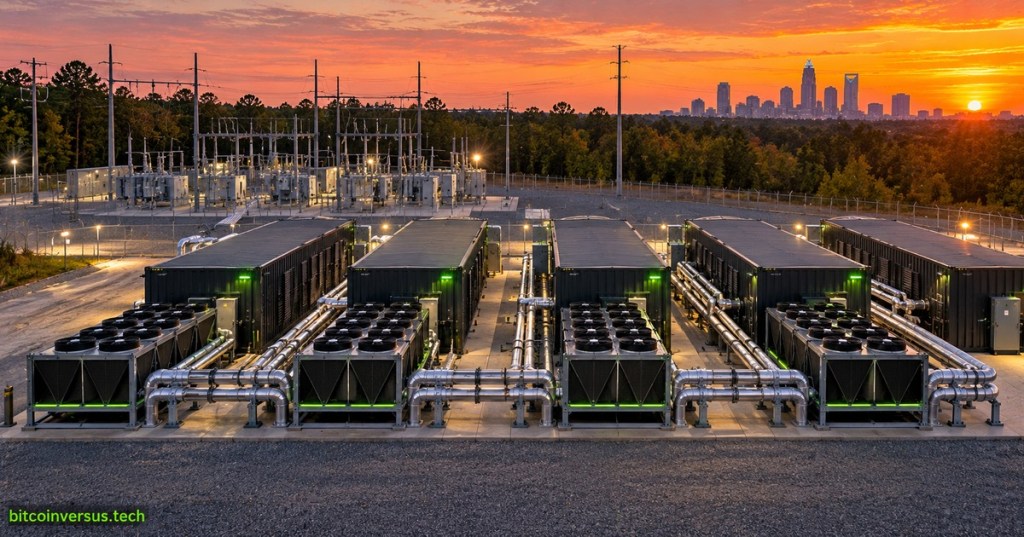
A newly published mining-infrastructure case study shows what high-density hydro Bitcoin mining looks like when the cooling system, container layout, and serviceability are designed together from the start. Apexto Mining says an operational Charlotte, North Carolina, site uses eight 40-foot hydro containers to support 832 server-grade 3U mining slots across 10 MW of utility capacity.
The project is a positive example of the mining industry moving beyond rows of standalone air-cooled boxes. Instead, the facility treats miners, coolant loops, dry coolers, electrical distribution, structural support, and maintenance access as one integrated system.
Eight Containers, 832 Slots, 10 MW
According to Apexto’s published deployment portfolio, the Charlotte project uses eight Antminer 3U hydro containers. Each 40-foot enclosure provides 104 slots in a dual-row layout, bringing the site total to 832 miner positions.
Each container combines sliding 3U rails, electrical distribution, closed-loop coolant piping, and dedicated dry coolers. Apexto says the site moved from transformer-pad work to final water-loop commissioning in about five weeks. The facility itself was energized in 2024; the detailed case study was published on October 8, 2026.
Why the Sliding Rails Matter
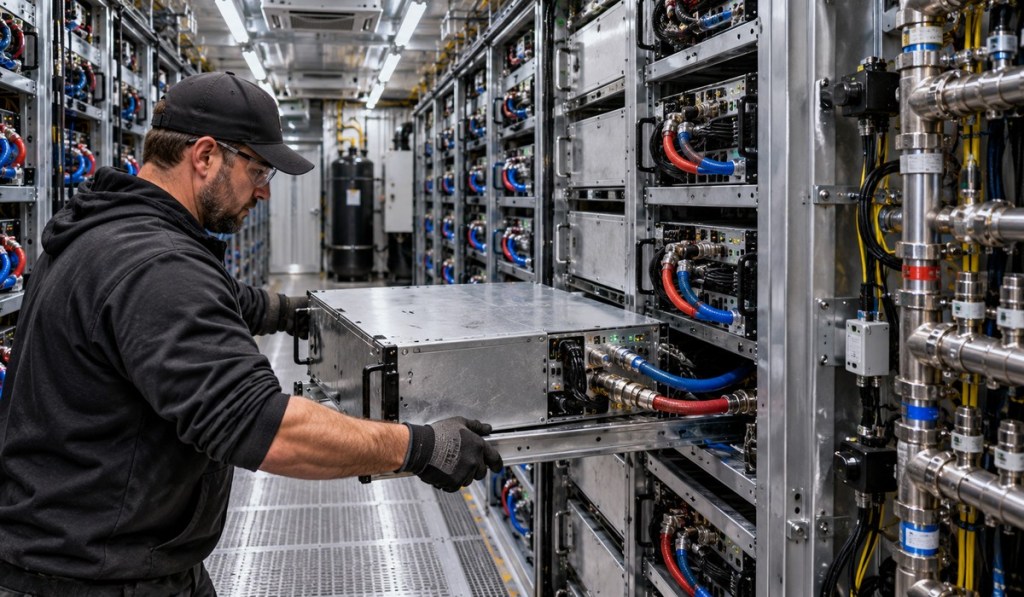
Large 3U hydro miners are much heavier and more awkward to service than familiar shelf-mounted air-cooled machines. That makes mechanical access part of uptime engineering. Apexto’s container uses sliding rails so technicians can pull a server outward instead of lifting a dense machine out of a packed rack by hand.
This is the same principle behind good rack-and-stack design: equipment density only helps if technicians can still isolate, remove, inspect, and replace hardware without turning routine maintenance into a major outage.
Hydro Changes Where the Engineering Work Happens
Air-cooled mining pushes enormous quantities of air through each machine. Hydro mining removes that fan-heavy airflow requirement from the miner itself and moves the thermal problem into coolant pumps, manifolds, hoses, heat exchangers, controls, and dry coolers.
That can support much denser equipment layouts, but it also creates new failure modes. Flow imbalance, pressure loss, air in the loop, leaks, clogged heat exchangers, pump faults, or poorly designed manifolds can reduce hashrate just as surely as bad airflow can in an air-cooled facility.
BitcoinVersus recently compared those tradeoffs across air, hydro, and immersion ASIC fleets. The Charlotte installation is a useful real-world example of why hydro is becoming an infrastructure category of its own rather than simply “an ASIC with water hoses.”
The Facility-Level Efficiency Question
The Charlotte case study is also a reminder that miner nameplate efficiency is only one part of a liquid-cooled facility. Pumps and dry coolers consume electricity outside the ASIC itself. Transformers, switchgear, networking, monitoring, and controls add additional load.
That is why ASIC J/TH and whole-site J/TH are not the same measurement. A dense hydro layout can improve thermal stability and eliminate onboard fans, but the correct comparison still has to include the entire electrical and cooling boundary.
Apexto Claims 30% Better Space Use
Apexto says its dual-row 104-slot layout improved site space efficiency by 30% compared with standard modular designs. That figure is vendor-reported and BitcoinVersus has not independently audited the site footprint or comparison baseline.
The basic direction is credible even without accepting the percentage at face value: rack-format hydro servers can pack substantially more compute into a container when the design no longer needs the same straight-through air path, hot-aisle spacing, and giant exhaust openings associated with traditional air cooling.
Bitmain is pursuing the same density trend at the machine level. BitcoinVersus recently covered the S23e U2H, which packs 865 TH/s into a 2U hydro form factor, and the smaller ANTRACK AR30 hydro cabinet. Charlotte shows what that rack-style hardware trend looks like when expanded to a multi-container site.
The Reported Savings Need Context
Apexto reports that the Charlotte project reduced ongoing energy costs by 22% and generated about $1.25 million in annual operational savings through balanced liquid circulation across the 832 slots.
Those figures are supplied by the vendor, and the case study does not publish the prior cooling configuration, utility tariff, miner fleet, load profile, or a third-party measurement report. BitcoinVersus therefore treats them as Apexto-reported project results, not independently verified facility KPIs.
What can be verified from the disclosed architecture is the engineering logic: eight modular containers, dedicated closed loops, external heat rejection, high-density 3U rails, and centralized infrastructure make it possible to operate large hydro fleets without constructing a conventional data-center building around every row.
Why This Is Good News for Mining Hardware
Bitcoin mining hardware is getting denser. The newest rack-format machines can deliver hundreds of terahashes from compact 2U and 3U chassis, but that only matters if operators can actually power, cool, network, and service them at scale.
Charlotte is a useful proof point because the story is not simply “a faster ASIC exists.” It shows the supporting infrastructure catching up to the hardware. Containers, rails, manifolds, dry coolers, pumps, controls, and maintenance workflows are evolving alongside the chips.
What Comes Next
The next generation of mining-site competition will increasingly be measured in more than TH/s per machine. Operators will care about TH/s per square foot, TH/s per site MW, coolant stability, service time, uptime, and how quickly new capacity can be commissioned.
A five-week containerized build with hundreds of serviceable hydro slots points toward that future: Bitcoin mining becoming less like a room full of appliances and more like purpose-built industrial compute infrastructure.
BitcoinVersus.Tech
Editor’s Note: Apexto is the equipment vendor and source for the Charlotte deployment figures. Claims regarding 30% improved space efficiency, 22% lower ongoing energy cost, and $1.25 million in annual operational savings are vendor-reported and have not been independently audited by BitcoinVersus.
We volunteer daily to improve the credibility of the information on this platform. If you would like to support the research, please donate here: 3C9o19EH5HSiwEPyCTmEKzxhNCbo2X6TTb
BitcoinVersus.tech is not a financial advisor. This media platform reports on technical and financial subjects purely for informational purposes.


Leave a comment