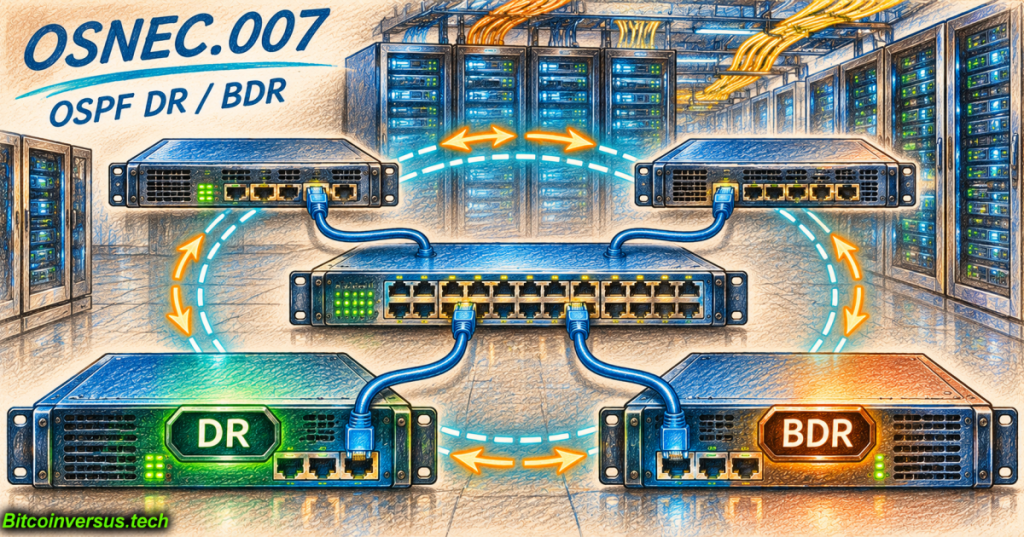
OSNEC.007 examines the Designated Router (DR) and Backup Designated Router (BDR) selected by Open Shortest Path First (OSPF) on shared Ethernet networks. Unlike a point-to-point link, one broadcast segment may contain several OSPF routers. DR and BDR roles coordinate link-state exchange, reducing the need for every pair of routers to maintain a full adjacency.
Practical Networking, “Designated Router / Backup Designated Router / DR BDR Election,” May 9, 2022. Independent instructional demonstration with packet captures. Credit: Practical Networking / YouTube.
Why OSPF elects leaders on Ethernet
Imagine four routers sharing a switch and the same VLAN. If every router synchronized independently with every other router, the segment would require six unique full-adjacency pairs: 4 × 3 ÷ 2 = 6. With one DR and one BDR, the two ordinary routers, called DROTHERs, normally remain at 2-Way with each other while becoming fully adjacent to the DR and BDR. They still exchange Hello packets and recognize one another as neighbors.
The mechanism follows RFC 2328, sections 7.3–7.4 and 9.4. Earlier lessons cover OSNEC.006 neighbor states and OSNEC.005 LSAs and shortest-path calculations.
Priority, Router ID and non-preemption
DR/BDR selection happens per OSPF network segment, not once for an entire routing domain. An interface priority of 0 makes a router ineligible for either elected role. Among eligible routers, higher priority wins the applicable election; a higher Router ID breaks equal-priority ties. However, an existing DR is generally not preempted when a new router with greater priority joins. The RFC election also considers existing DR/BDR declarations and network timing, making a simple priority ranking insufficient for every live situation.
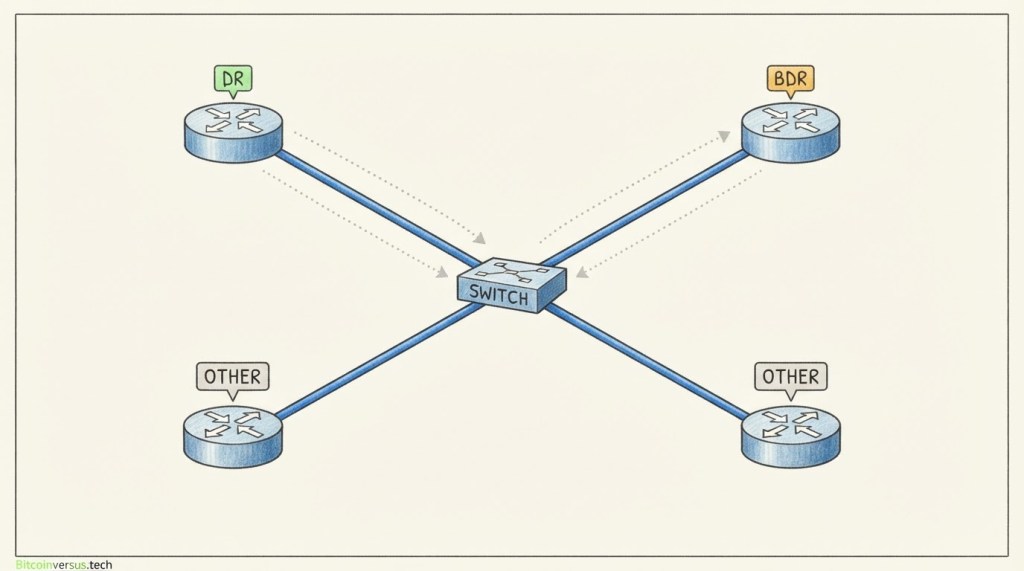
A hypothetical lab starts four eligible interfaces simultaneously with priorities 100, 50, 1 and 0. Given otherwise compatible settings and no incumbent DR, the 100-priority router would be expected to become DR and the 50-priority router BDR, while the remaining two cannot take either role under those conditions. If the DR fails, the BDR normally succeeds it. A returning router with priority 100 does not automatically displace the new DR.
Multicast and link-state flooding
On IPv4 OSPF broadcast networks, 224.0.0.5 represents AllSPFRouters and 224.0.0.6 represents AllDRouters. DROTHER routers commonly send link-state updates toward the DR and BDR using the latter address; the DR then floods updates to the wider segment. Such control traffic belongs to the routing protocol, not application-data load balancing. DR status does not make a router the default gateway for hosts.
IEE, “CCNA 200-301 Lab 034 — Verify & Influence OSPF DR and BDR Election,” October 1, 2024. Independent Cisco-style training lab; commands must be validated against the actual platform. Credit: IEE / YouTube.
Read-only checks before any network change
- On Cisco IOS or IOS XE, inspect
show ip ospf interfacefor interface network type, priority, current DR/BDR, and Hello/Dead timers. - Inspect
show ip ospf neighborfor neighbor IDs, priority and state, includingFULL/DR,FULL/BDRand2WAY/DROTHERwhere applicable. - Confirm the interfaces truly share one broadcast domain, matching area and compatible Hello/Dead timers. Look for authentication, MTU or neighbor-state issues before interpreting election results.
- In an isolated training environment only, an authorized engineer may alter a Cisco interface with
ip ospf priority. Do not reset production OSPF or force a re-election merely to test a priority hypothesis.
Cisco’s OSPF interface command guide and IOS XE routing configuration guide document the relevant fields. The earlier OSNEC.001 fundamentals lesson, OSNEC.004 area design and SPAN capture workflow provide additional background.
Knowledge check
Can priority 0 become DR? No. Will a higher-priority newcomer automatically take over? Generally no. Should two DROTHER neighbors always be FULL with each other? No; 2-Way is normal on a broadcast segment. Does DR mean default gateway? No. Election behavior must be evaluated per interface using observed state and protocol rules.
Editor’s Note: OSNEC.007 follows the published OSNEC.006 adjacency lesson. Explanations were checked against RFC 2328 and Cisco OSPF documentation. The four-router election and adjacency calculation is hypothetical; the topology images are original conceptual artwork, not evidence of a live network. The Practical Networking and IEE video identities were confirmed from public listings. WordPress player rendering and end-to-end playback are separate checks. No routing device was configured or reset and no traffic capture was conducted.

For mobile scanning, display the original QR on a second screen and scan it with a compatible Bitcoin wallet. Some wallets accept saved QR images on the same phone. Independently verify the Bitcoin destination 3C9o19EH5HSiwEPyCTmEKzxhNCbo2X6TTb and the intended 5,000 sats before sending; Bitcoin transfers are generally irreversible.
We volunteer daily to ensure the credibility of the information on BitcoinVersus.Tech is Verifiably True. Optional contributions support independent reporting and education. Educational content is not a substitute for approved network change management, certified engineering decisions, or individualized financial advice.


Leave a Reply