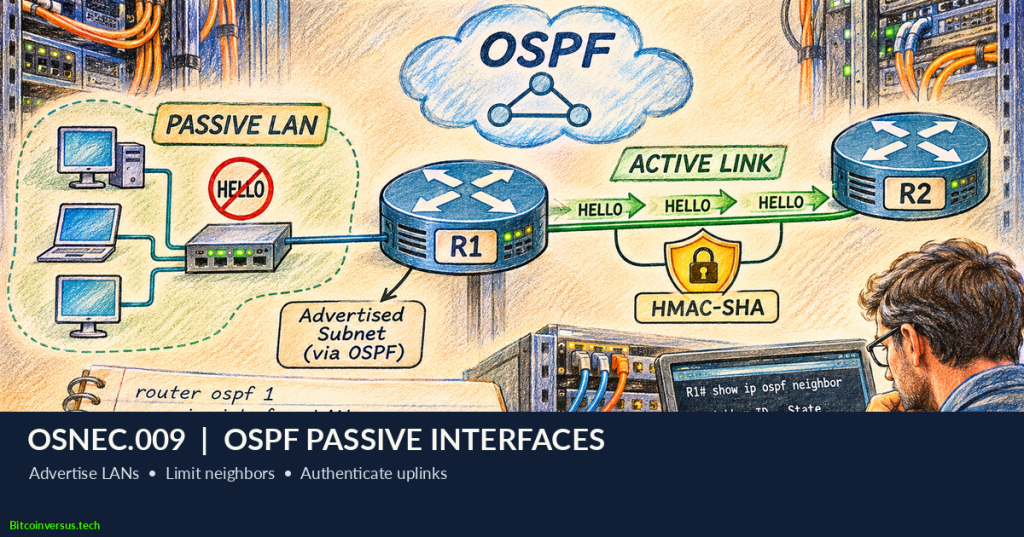
OSNEC.009 explores a useful OSPF security distinction: advertising a connected client network does not require forming router neighbors on the client-facing interface. An OSPF passive interface keeps the subnet reachable through the routing domain while suppressing the protocol exchanges that normally discover adjacent routers. Cryptographic authentication addresses a different problem: determining whether routing packets on active links come from peers possessing the configured secret.
Video: Practical Networking, “Passive Interfaces — WHAT are they? WHY do you need them? HOW do you configure them?” (August 29, 2022). The independent instructional demonstration covers the concept and verification on Cisco routers.
Why passive does not mean unreachable
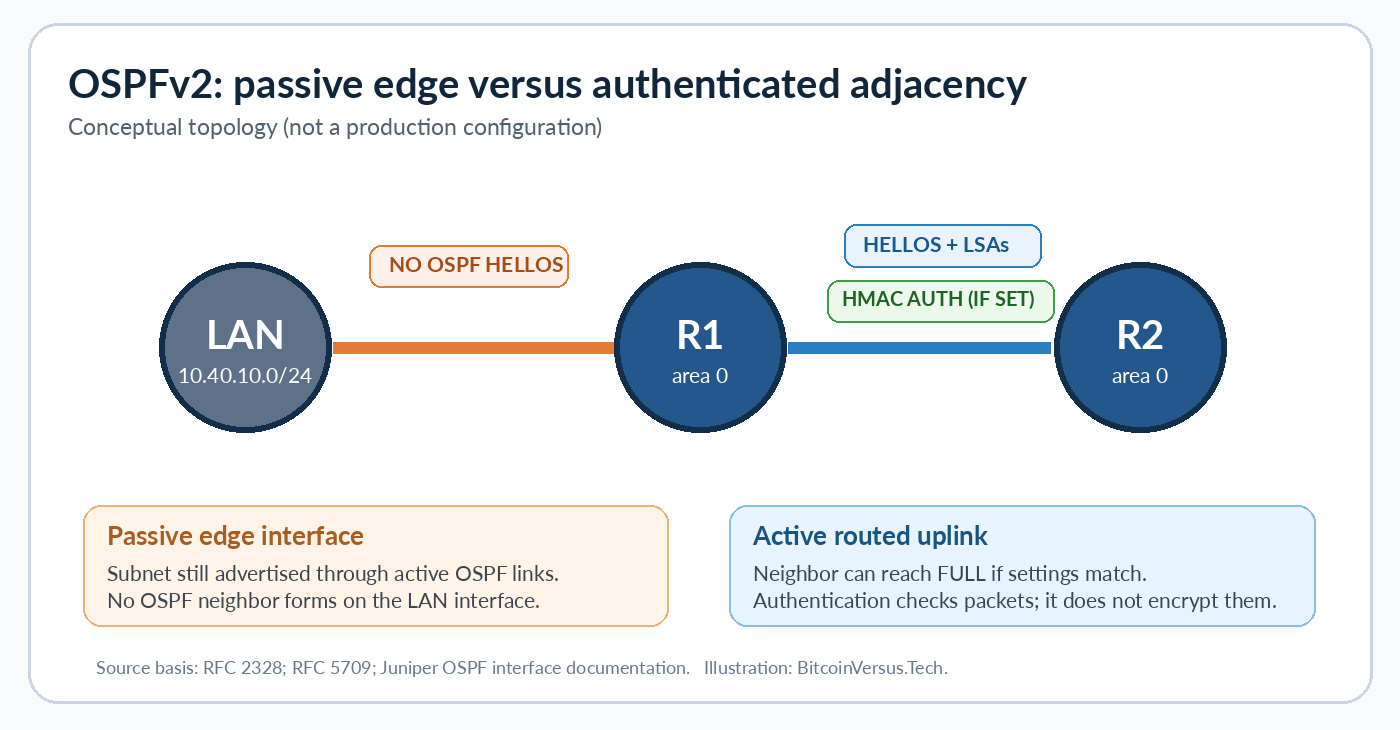
OSPFv2 uses periodic Hello packets to discover and maintain neighbors. On broadcast networks, Hello processing also participates in designated-router elections. A client LAN ordinarily needs IP forwarding, but has no reason to negotiate OSPF adjacency with a workstation. Passive mode disables OSPF protocol participation on the selected interface without necessarily withdrawing its connected network from OSPF advertisements. Juniper’s interface documentation explicitly separates the advertised address from Hello generation and adjacency formation.
Consider R1 with a client subnet 10.40.10.0/24 and a router-to-router uplink toward R2. Make the LAN interface passive while leaving the routed uplink active. R2 can learn the client prefix, but R1 does not form an OSPF neighbor on the client interface. The governing concepts extend OSNEC.008 on OSPF network types and OSNEC.007 on DR and BDR elections.
Protect the interfaces that must form neighbors
An active transit interface still needs OSPF Hello exchanges and database synchronization. RFC 2328 defines the original OSPFv2 authentication framework; RFC 5709 adds HMAC-SHA algorithms, including HMAC-SHA-256. A matching key and compatible authentication settings help reject packets lacking the required credentials. Modern platforms may support key chains and key lifetimes for controlled rotation; confirm the actual implementation and software version.
Authentication verifies shared-key possession and packet integrity; it does not encrypt routing information or establish the individual identity of a router when multiple peers share one secret. Neither authentication nor passive mode replaces interface ACLs, physical access controls or broader network segmentation. Cisco’s September 2026 OSPFv2 cryptographic-authentication guide describes supported HMAC-SHA configuration and key-chain behavior.
Video: Practical Networking, “Hash Based Authentication — OSPF Authentication” (October 3, 2022). The lab demonstrates older MD5 commands and packet inspection, then discusses SHA/HMAC key-chain alternatives. Treat the shown MD5 syntax as historical training, not a recommendation for new deployments.
Small, controlled lab and verification
A common Cisco IOS-style starting point is to make interfaces passive by default and explicitly enable the one required router-to-router link. The example below is illustrative; interface names, security commands and router platform support vary. Apply configuration only in an authorized test environment after establishing management access and a rollback plan.
router ospf 1
 passive-interface default
 no passive-interface GigabitEthernet0/0
Verify expected neighbors using read-only commands such as show ip ospf neighbor and inspect interface state with show ip ospf interface on supported Cisco systems. R2 should reach FULL adjacency over the active link, while no neighbor should appear on the passive LAN. Confirm advertised routes with the routing table and link-state database rather than assuming a silent interface has disappeared. OSNEC.006 explains neighbor states and timer or MTU mismatches; OSNEC.004 explains area membership and ABR verification.
Failure modes and operating limits
Accidentally marking the transit port passive prevents required Hellos and can drop its OSPF adjacency. Incorrect keys, algorithm disagreement or key-lifetime mismatches can produce a similar loss of neighbors, even when ordinary Ethernet connectivity remains healthy. Conversely, leaving a client port active invites unnecessary routing-protocol exposure. Changes demand a maintenance window, peer-side coordination and route verification before production rollout.
Primary references: IETF RFC 2328 (OSPFv2), RFC 5709 (OSPFv2 HMAC-SHA); Cisco IOS XE OSPFv2 Cryptographic Authentication (updated September 28, 2026); Juniper Networks, Configuring OSPF Interfaces. Educational examples were not executed against production devices.


Leave a Reply