Electronics factories installed 142,235 industrial robots worldwide in 2025, again surpassing automotive manufacturers, which installed 138,429. The International Federation of Robotics reported a record 603,307 global factory installations, up 11% from 2024. Its World Robotics 2026 findings, released September 24, reveal how electronics, automotive manufacturing and metalworking share the expanding automation market.
Electronics first reclaimed the industry’s leading customer position in 2024 and retained it during 2025. The annual difference reached 3,806 newly installed robots. The figures describe conventional industrial automation across production lines; they are not the number of new humanoid robots, nor a count of factory workers replaced by machines.
SmartChart #28: A record year divided by industry
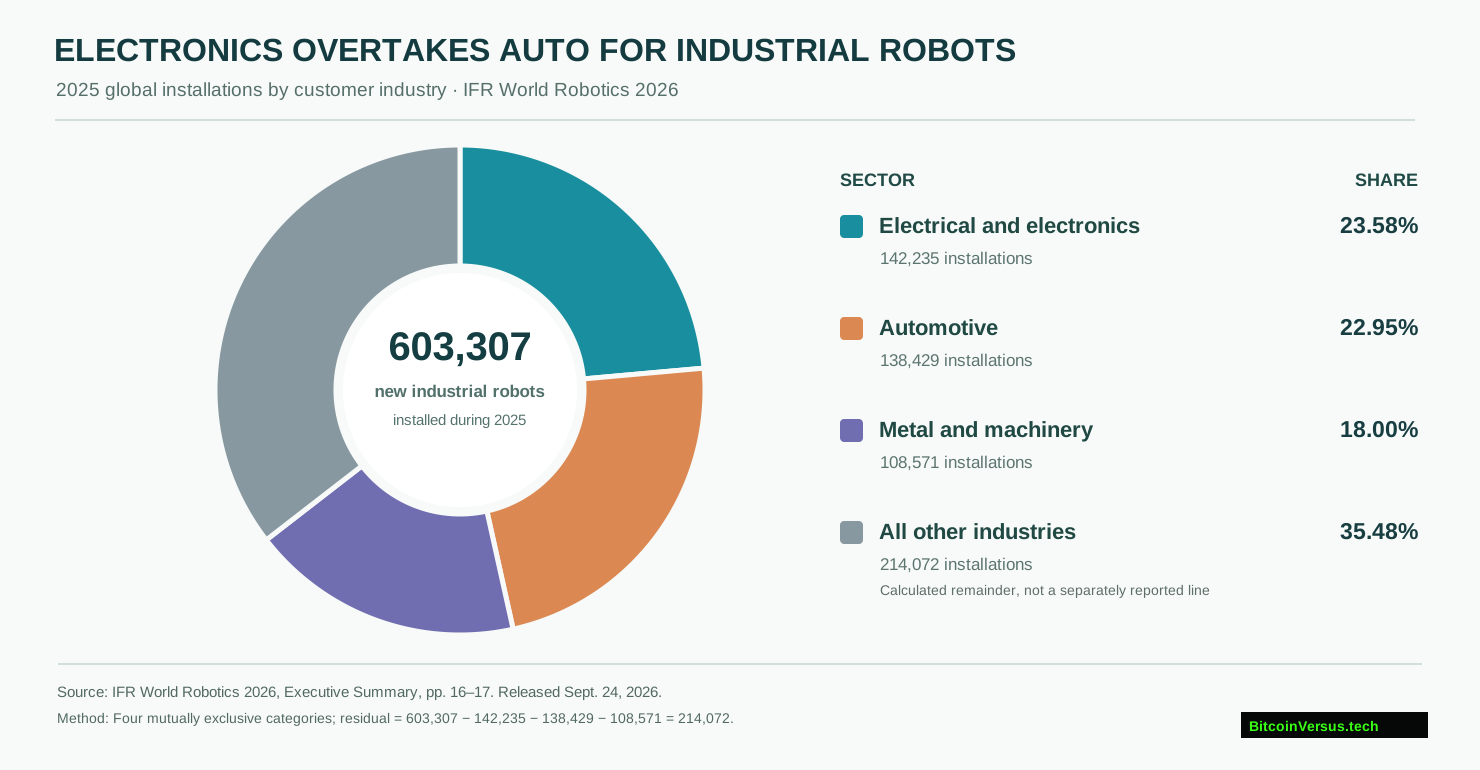
Electronics accounted for 23.58% of installations, automotive for 22.94% and metal and machinery for 18.00%. Metal and machinery also reached a record 108,571 units, up 22% year over year. Subtracting the three named industries from IFR’s global total leaves 214,072 robots, or 35.48%, across all remaining industry classifications. The residual is calculated rather than separately reported as one industry.
A donut accurately represents these four mutually exclusive shares of the same 603,307-unit annual total. Their percentages add to 100% before display rounding. IFR also counted 5,079,078 industrial robots operating worldwide at the end of 2025, a different stock measure. Adding that installed base to annual installations would double count machinery.
The original 1X robotic-hand demonstration above provides context for emerging humanoid manipulation. It does not establish IFR’s market totals. View the manufacturer’s post directly when browser restrictions prevent the social player from rendering.
China still dominates deployment
The regional breakdown highlights a separate dimension. Asia installed 457,315 industrial robots in 2025, Europe 73,054 and the Americas 57,044, with the balance elsewhere. China alone accounted for 354,226 installations, nearly 59% of the worldwide count, while the United States recorded 38,428 and overtook Japan for second place. Geographic totals cannot be appended as additional slices to the customer-industry donut because each robot already belongs to an industry.
The electronics lead reflects a wider market for industrial equipment, including high-speed handling, assembly, machine tending and inspection. Actual production gains depend on machine reliability, commissioning, workflow design, maintenance, guarding, energy use and staff skills. Neither the number of installed robots nor a supplier shipment implies independently measured productivity improvement.
IFR forecasts annual installations of approximately 655,000 in 2026 and 806,000 by 2029. Those numbers are projections, not completed deployments. Its executive summary also distinguishes proven machine vision and predictive maintenance from general-purpose physical AI and humanoids, which are not yet broadly industry-grade.
What factory operators should watch
Related reporting examines America’s factory-robot installation gap, Rockwell’s AGILOX acquisition, ASUS’s motherboard-packing robot trial and the most robot-dense manufacturing economies. Installations, announced acquisitions, test targets and robots per worker are distinct performance measures.
Sources and methodology
The underlying figures come from World Robotics 2026, Industrial Robots, executive summary and IFR’s September 24 release. Inspect the SmartChart #28 SVG and reproducible CSV. The four segments reconcile to 603,307 industrial robots; percentages are rounded to two decimal places.
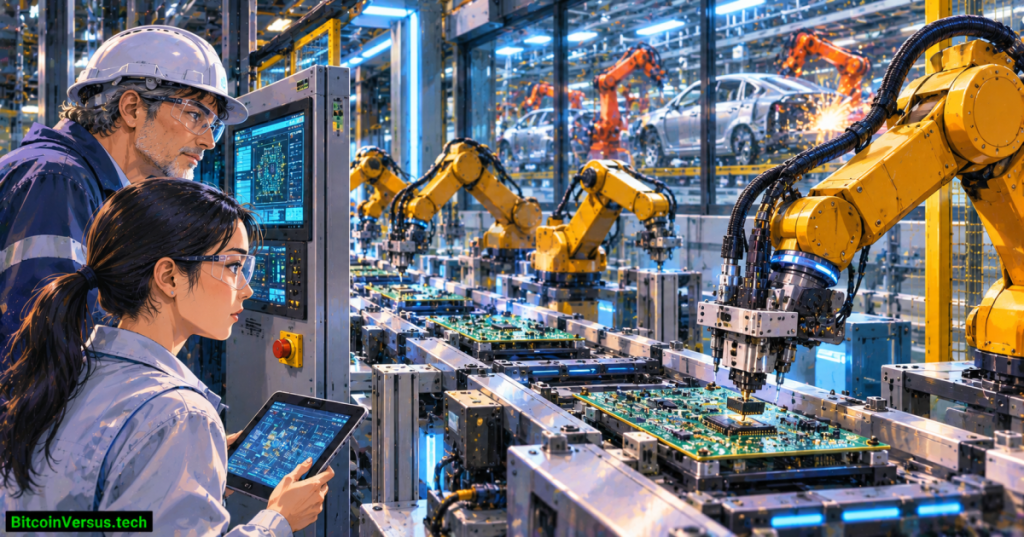
Editor’s Note: The anime cover is a conceptual illustration. The official IFR videos and 1X social demonstration are contextual multimedia, not substitutes for the IFR dataset. Public browser playback, responsive image loading and the exact secondary-logo reference match remain separate QA requirements.

BitcoinVersus.Tech publishes independent volunteer-supported reporting. An optional 5,000-satoshi donation supports research. Verify the address 3C9o19EH5HSiwEPyCTmEKzxhNCbo2X6TTb and amount before sending. Bitcoin transfers are generally irreversible.
We volunteer daily to ensure the information on this platform is Verifiably True. Coverage is educational and informational and does not constitute personalized engineering, tax, financial or investment advice.


Leave a Reply