
A company better known for Bitcoin mining financial tools has helped bring price insurance to the AI GPU rental market. On November 17, 2026, Luxor Technology, Architect Financial Technologies and Hyperbolic announced a privately negotiated option designed to hedge approximately $5 million in future NVIDIA B200 rental revenue. The companies describe the transaction as the first over-the-counter option based on GPU rental prices. Their announcement confirms the arrangement but does not establish a broader independent census of every private compute derivative.
The contract moves a familiar Bitcoin mining concept into AI infrastructure. A miner can hedge exposure to hashprice using financial derivatives; a GPU operator faces a different commodity-like risk because hourly rental prices change while expensive servers continue depreciating. Our earlier analysis of tradable mining hashrate explains the original model.
Crusoe AI Lab explains NVIDIA HGX B200 versus GB200 architecture in an independently sourced February 2026 video. Hardware background, not footage of the financial transaction. Watch at the original source.
The $5 million represents covered revenue, not an investment
Hyperbolic owns or manages GPU rental exposure. Architect helped structure a put option through its CFTC-registered introducing broker affiliate; Luxor priced and executed the trade as counterparty. The deal settles in cash each month over a one-year term against the Silicon Data B200 Rental Price Index, ticker SDB200RT. If index prices fall below the agreed exercise level, the put can compensate the buyer under the contract terms.
Importantly, the published $5 million notional amount is the scale of revenue exposure covered, not a disclosed option premium or amount paid upfront. The counterparties did not publish the strike, premium, number of B200s protected or exact payout formula. Predicting profit or loss from public information alone would be speculative.
Daily B200 rental rates have already moved
Silicon Data’s dated neo-cloud benchmark rose from $6.14 per GPU-hour on October 20 to $6.94 on November 18, approximately 13.0%. The intermediate readings were not smooth: the series reached $7.10 on November 17 before retreating the following day. Rates reflect standardized market observations, not necessarily what Hyperbolic earned on its specific machines. A higher historical index does not guarantee the hedge will pay out.
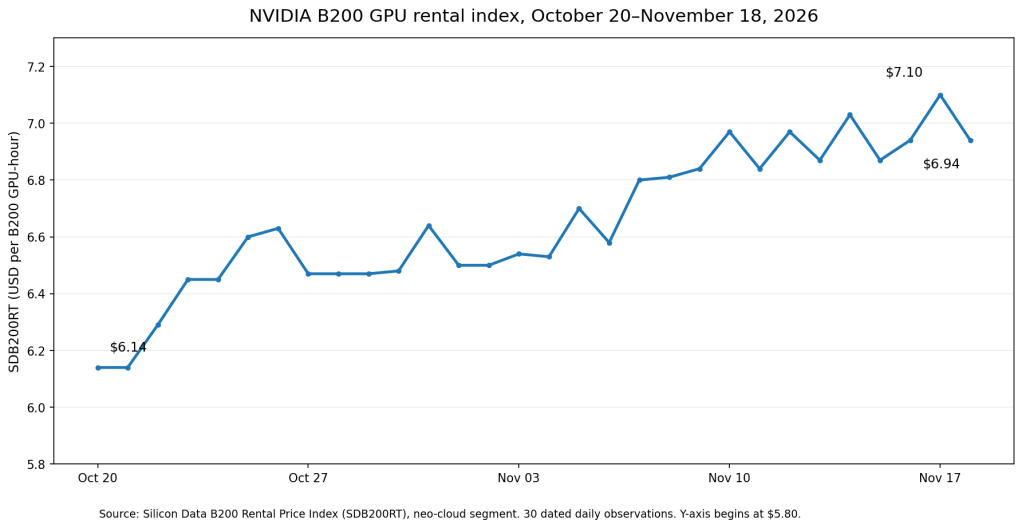
Three chart types were evaluated against the dataset: a line chart, a step chart and a vertical bar chart. A dated line best communicates daily market movement. Its nonzero axis is clearly labeled because line series can emphasize variation without presenting bar lengths as absolute magnitudes. For broader context, our investigation of GPU loans, insurance and futures anticipated increasingly sophisticated compute financing.
Original Luxor announcement, November 17, 2026. Read the source announcement on X.
Why a mining company is selling GPU risk management
Luxor expanded its Bitcoin mining pool and hashrate derivatives operation into AI infrastructure services during September. Its October $16 million funding round included mining hardware manufacturers Canaan and MicroBT. The new trade demonstrates a separate commercial use for Luxor’s pricing and risk expertise, rather than evidence that ASICs can run B200 workloads.
Official Luxor Technology video from June 2024 demonstrating Bitcoin hashrate forwards. Archival educational context, not the 2026 GPU option transaction. Watch at the original source.
Hedging price does not eliminate data-center costs
A GPU operator may still face low utilization, hardware failure, software outages, financing obligations, energy charges and depreciation. An index-based option also introduces basis risk if an individual contract’s realized rental rate diverges from the benchmark. OTC counterparties bear credit and liquidity risk, and hedging protection requires a premium or other negotiated consideration. The firms say exchange-listed GPU futures remain subject to regulatory review.
The distinction becomes clearer alongside PowerCompute’s small GPU rental pilot, where equipment, customers and actual rental receipts remain operational questions. Luxor’s announced option transfers selected price risk; it does not create computing demand or ensure profitability. AI compute is acquiring financial infrastructure resembling energy and Bitcoin mining markets, but its physical constraints remain.
Primary sourcing and disclosure
Primary documents: Luxor and Architect release, November 17, 2026; Hyperbolic’s confirmation, November 17; Silicon Data’s historical SDB200RT table through November 18. The price series is an observed third-party index. No contractual premium or strike was supplied; no estimated payoff was presented.
Reporting Note: The featured cover is original cinematic anime concept art rather than photographs of Luxor or Hyperbolic facilities. Both videos predate the transaction and explain GPU hardware or Bitcoin mining derivatives. Index data and signed contract terms are different forms of evidence.
Editor’s Note: We volunteer daily to ensure the credibility of information on our platform is Verifiably True. Support our research by scanning the QR code below to donate 5,000 sats.

For mobile scanning, open the article on another display and scan the QR code with a Bitcoin wallet. Verify receiving address 3C9o19EH5HSiwEPyCTmEKzxhNCbo2X6TTb before sending.
BitcoinVersus.tech provides technical and financial journalism for informational purposes only and does not provide investment, legal or cybersecurity assurance.


Leave a Reply