
Bitcoin miners are increasingly doing something commodity producers have done for generations: putting a market price on future production. A fresh October 1 Canaan industry note highlighted how mining reached this point earlier than much of the broader compute sector—first through hashprice indexes, then regulated hashrate futures, and now tokenized securities backed by Bitcoin mining compute.
The development is positive for an industry that has historically lived with volatile revenue and fixed infrastructure costs. Instead of relying only on the future spot price of Bitcoin, miners and investors are building financial tools around the thing a mining operation actually produces: hashrate.
Hashrate Is Starting to Look Like a Commodity
Canaan’s October 1 mining and compute newsletter points to a sequence that is now becoming clearer. Luxor built a public market reference for the value of hashrate, regulated futures later followed, and structured financial products are now attempting to package mining production into investable securities.
The foundation is hashprice: the expected revenue earned by a unit of Bitcoin mining hashrate over time. Luxor defines its Bitcoin Hashprice Index as the expected value of 1 PH/s of hashrate per day. In BTC terms, hashprice depends on the block subsidy, transaction fees, and network difficulty. In dollar terms, Bitcoin’s market price becomes another major input.
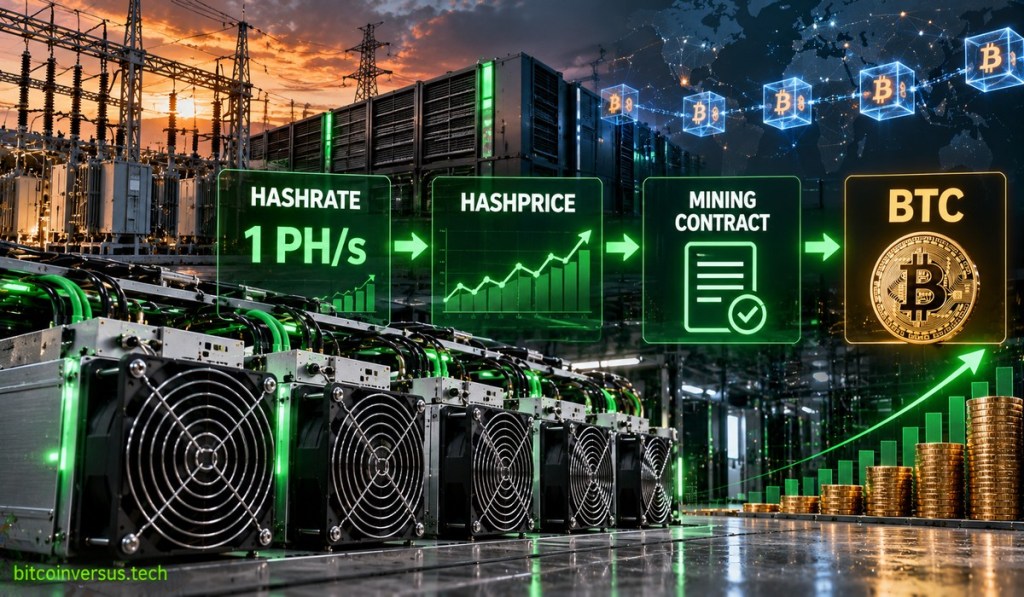
Luxor Put a Market Price on Mining Output
Luxor says it coined the term “hashprice” in 2019. The idea matters because Bitcoin miners do not simply own Bitcoin exposure. Their revenue also moves with network difficulty, block rewards, fees, uptime, and the amount of hashrate they can keep online.
That creates a different risk profile from simply holding BTC. A miner can correctly predict Bitcoin’s price and still miss its revenue target if difficulty rises faster than expected or fee revenue falls. Hashprice condenses those variables into a single operational revenue metric.
This is also why site efficiency, miner uptime, power cost, and fleet monitoring remain essential even when financial hedging improves. A contract can reduce revenue volatility; it cannot repair a failed hashboard or bring an offline megawatt back into production.
Then Hashrate Futures Reached a Regulated Exchange
In May 2024, Luxor and Bitnomial launched Bitcoin Hashrate Futures on Bitnomial’s U.S.-regulated derivatives exchange. The contracts use Luxor’s Bitcoin Hashprice Index as their reference rate and represent 1 PH of Bitcoin hashrate per contract.
That was an important step because miners gained something closer to the risk-management tools available to farmers, energy producers, and other commodity businesses. Instead of simply hoping future mining economics remain favorable, a miner can use forward or futures markets to lock in part of the expected value of future hashrate.
Luxor’s current derivatives platform also supports deliverable and non-deliverable hashrate forwards. The operational logic is straightforward: a mining company with machines, power contracts, payroll, repair expenses, and debt service may value predictable revenue even if that means giving up part of the upside from an unexpectedly strong hashprice month.
Now Bitcoin Mining Output Is Being Tokenized
The next step is more unusual. Omnes and Apex Group announced in March that they are tokenizing the Omnes Mining Note, or OMN, on Base. The structure is designed to give professional non-U.S. investors exposure to Bitcoin mining returns without requiring them to buy ASICs, negotiate power, maintain a facility, or operate a mining fleet.
Omnes’ current product page describes OMN as a tokenized debt security backed by productive Bitcoin mining hashrate. The current Series 1 terms list 1 PH/s of backing per note, a 36-month tenor, a $100,000 minimum investment, and Bitcoin distribution at maturity. The offering is intended for professional investors and is not offered to U.S. persons.
This Is Not the Same as Buying a Mining Stock
A publicly traded mining company exposes shareholders to far more than raw hashrate economics. Equity returns can move with management decisions, debt, dilution, land values, AI strategy, treasury policy, operating expenses, acquisitions, and the market’s valuation multiple.
A hashrate-linked financial product tries to isolate the productive mining layer more directly. That does not make it risk-free. Mining difficulty can rise, hashprice can fall, counterparties can fail, operational hashrate can underperform, and structured securities add legal, custody, liquidity, and smart-contract considerations of their own.
But the distinction is important. Bitcoin mining is beginning to support financial instruments built around compute production itself, not merely around the stock prices of companies that happen to own miners.
Why Miners Care About Hedging
Mining operations usually combine volatile revenue with costs that are much less flexible. Power contracts, employees, transformers, cooling infrastructure, repair shops, buildings, debt payments, and replacement hardware still have to be funded whether hashprice is high or low.
That makes revenue certainty valuable. A miner that can demonstrate predictable future cash flow may be better positioned to finance new infrastructure, replace aging hardware, negotiate credit, or survive periods when network economics tighten.
The same principle appears in traditional energy markets. BitcoinVersus has covered power purchase agreements because industrial operators often value predictable input costs. Hashrate derivatives apply a related idea to the other side of the equation: stabilizing the value of the compute output.
Bitcoin Mining Got There Before AI Compute
Canaan’s October 1 note makes an interesting comparison with AI. Exchanges are only now building products around GPU rental prices and tokenized compute, while Bitcoin mining has spent years developing hashprice indexes, forwards, and exchange-traded hashrate derivatives.
That does not mean Bitcoin mining and AI compute are economically identical. They are not. But miners have already helped demonstrate that large-scale compute output can be measured in standardized units, assigned a market price, hedged into the future, and eventually packaged into financial products.
It is another example of the mining industry becoming relevant far beyond the ASIC rack itself. Bitcoin miners helped pioneer power-first compute infrastructure; now their financial markets may also provide a template for pricing other forms of compute.
What Comes Next
The next stage will depend on liquidity. Financial products become more useful when enough miners, investors, market makers, lenders, and institutions participate for pricing to remain transparent and execution to remain reliable.
But the direction is already notable. Bitcoin mining has moved from simply selling freshly mined coins to building markets around the value of the computational work itself.
Hashrate used to be something miners measured. Increasingly, it is something markets can price, hedge, trade, finance, and tokenize.
BitcoinVersus.Tech
Editor’s Note: Hashrate derivatives and tokenized mining securities are financial products with material market, operational, liquidity, counterparty, legal, and custody risks. Product terms can change. OMN is described by its issuer as intended for professional non-U.S. investors and is not offered to U.S. persons. This article is informational and does not recommend any security or derivative.
We volunteer daily to improve the credibility of the information on this platform. If you would like to support the research, please donate here: 3C9o19EH5HSiwEPyCTmEKzxhNCbo2X6TTb
BitcoinVersus.tech is not a financial advisor. This media platform reports on technical and financial subjects purely for informational purposes.


Leave a comment