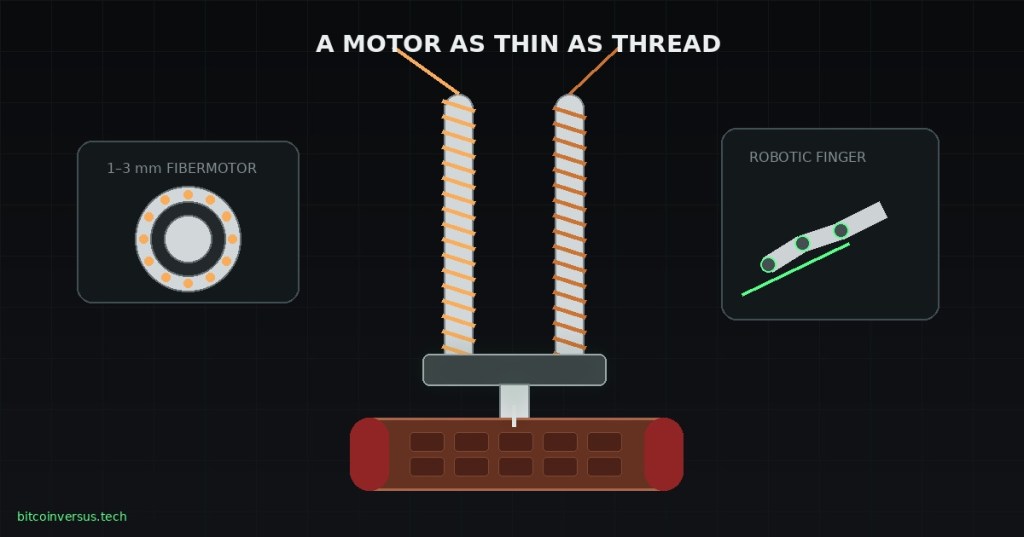
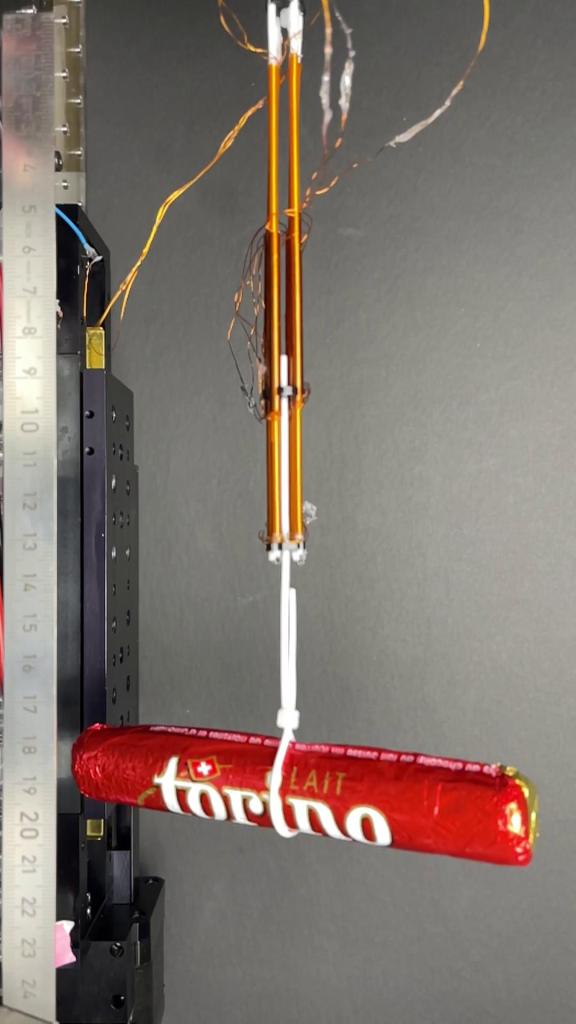
Engineers at EPFL have built a motor that looks more like thread than machinery. The new FiberMotor is only 1–3 millimeters in diameter, yet a bundle of four was able to lift a 46-gram chocolate bar and flex a tendon-driven robotic finger.
That is the fun part of the demonstration. The engineering idea behind it is even stranger: instead of spinning a shaft through gears, the motor creates linear motion by sliding one hollow fiber inside another.
EPFL demonstrates the FiberMotor and its soft-robotics applications.
The motor works like a tiny telescope
FiberMotor is made from two concentric hollow fibers wrapped with insulated copper-wire electrodes. When voltage is applied, electrostatic forces repeatedly pull those electrodes into alignment. The inner fiber then slides through the outer fiber in a motion EPFL compares to the tubes of a telescope.
That makes it fundamentally different from many artificial-muscle designs, which generate movement by stretching, contracting or bending a material. FiberMotor’s available travel is instead limited mainly by the length of the fibers themselves. The underlying research was published in Advanced Materials.
Why getting rid of gears matters
Conventional motors are excellent at spinning, but wearable machines often need compact pushing and pulling motion. Turning rotation into linear movement usually means adding gears, transmissions, lead screws or other rigid hardware. That can make a machine bulkier exactly where engineers want it to stay soft.
FiberMotor skips that conversion step. EPFL describes the device as silent, flexible, bidirectional and backdriveable. If an outside force pushes the system in the opposite direction, the fibers can slide instead of mechanically locking. That property is especially interesting for machines worn on the body, including the kind of exoskeleton and mobility technology engineers are trying to make less rigid and more natural to use.
Wearable robotics is already moving toward softer, clothing-like assistive systems; FiberMotor targets that same design direction at the actuator level.
Four threads versus one chocolate bar
An individual FiberMotor supported a stationary load equivalent to roughly 75 grams in EPFL’s laboratory tests. Bundling four together produced enough force to lift the chocolate bar and actuate a robotic finger. The researchers also integrated the motor into a prototype garment shaped around a knee.
The idea is not to hide one big motor somewhere in a suit. Because these actuators are thin and light, engineers could distribute many of them through fabric. In principle, a future wearable robot could spread force across clothing more like tendons spread force through a body.
Tiny motors could make robots feel less like machines
Soft robotics is increasingly about getting mechanical systems to conform to people and irregular objects rather than forcing everything around rigid joints. Recent work has pushed robotic hands toward much more delicate manipulation — including experimental hands learning tasks such as threading needles and working with silk embroidery.
FiberMotor attacks a different part of that problem: the actuator itself. A motor that can bend with clothing, operate quietly and generate straight-line motion without a gear train could make soft exosuits, haptic wearables, lightweight prosthetics and small robots easier to package.
What comes next
The EPFL team is now working on thinner electrodes, better materials, higher performance and improved durability. Researchers also want future versions to use feedback from a wearer’s position and motion so the actuator can respond to what the person is trying to do.
The chocolate bar is mostly a memorable laboratory flex. The larger point is that a motor does not necessarily have to look like a motor. Sometimes it can look like a piece of thread.
Editor’s Note: BitcoinVersus.Tech covers unusual engineering and technology developments for educational and informational purposes.
Disclosure: This article is informational and does not constitute financial, investment or product-purchase advice.


Leave a comment