
A soft underwater robot from North Carolina State University can rise, sink, hover, swim forward or backward and spin around its own axis with only two pneumatic actuators. The trick is not adding more motors. It is making the robot’s body do more of the work.
The researchers took inspiration from feather stars, marine animals whose many flexible arms let them maneuver through water in unusually versatile ways. Their new swimmer turns that idea into a four-wing robot whose structure can switch between several kinds of motion depending on how two simple air-powered inputs are timed. The work was published October 7 in Science Advances.
One robot, three swimming styles
The robot has four elastic wings extending from a central body. Those wings can bend and then snap back into shape. By changing which of the two actuators fires, and how quickly it fires, the same body behaves in three very different ways.
- Jellyfish mode: all four wings flap together, allowing the robot to climb, descend or hover.
- Fish mode: one side flutters like a tail fin, pushing the robot forward or backward.
- Rotor mode: alternating the two inputs makes the robot rotate, so it can reorient itself underwater.
Combining those modes gives the machine full three-dimensional maneuverability. NC State professor Jie Yin said a conventional design might use at least six actuators to achieve comparable motion. Here, the geometry and flexibility of the robot replace much of that extra hardware.
The clever part is the body
The researchers call the approach mechanical intelligence. Instead of asking software and a large collection of motors to control every possible movement, the physical structure naturally turns a small number of control signals into more complicated motion.
That idea also shows up elsewhere in soft robotics: flexible materials, stored elastic energy and carefully chosen shapes can sometimes replace gears, joints or bulky drive systems. It is a different philosophy from simply adding more computing power and more hardware.
In testing, the feather-star robot reached a maximum swimming speed of about 1.64 body lengths per second and a peak rotation speed of 90 degrees per second. Researchers also studied the vortices created around the wings to understand why each motion mode produces a different kind of thrust.
It can do more than swim around a tank
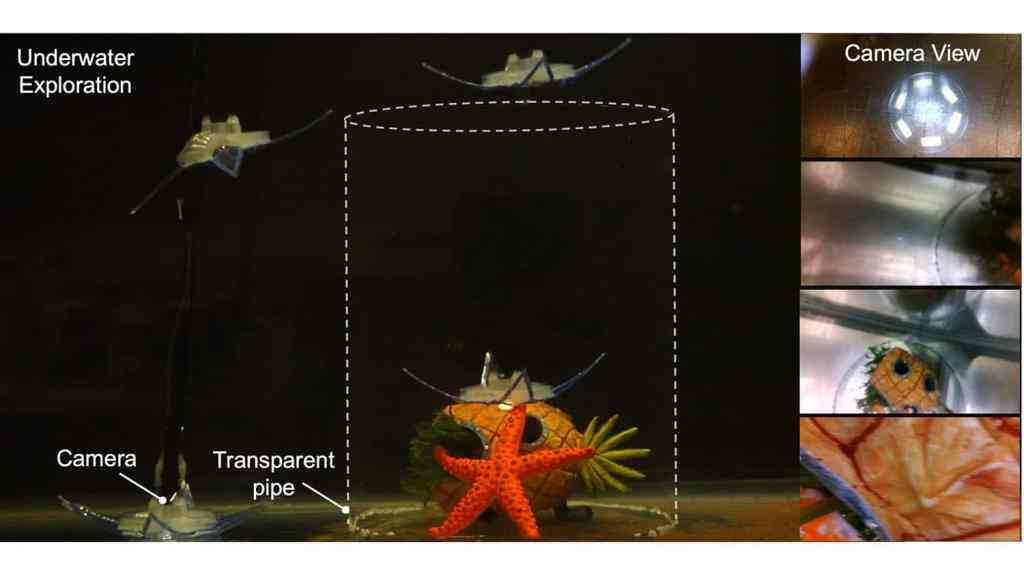
The team attached a camera to demonstrate underwater exploration, and the robots were also able to lift objects either alone or while working together. That makes the project more than a movement demo: a compact swimmer with fewer actuators could eventually carry sensors or tools into spaces where a larger rigid robot would be awkward.
The researchers are not calling it finished. One obvious next step is a fully wireless version. The current work is more interesting as a proof of design: sometimes a smarter mechanical shape can simplify the controls before software ever gets involved. That same principle matters for everything from small aquatic machines to future robot control systems.
For the full research release, see NC State University.
Editor’s Note: BitcoinVersus.Tech covers emerging technology, engineering, computing and digital infrastructure from an independent editorial perspective.
Disclaimer: This article is for informational and educational purposes and does not constitute engineering, investment or financial advice.


Leave a comment