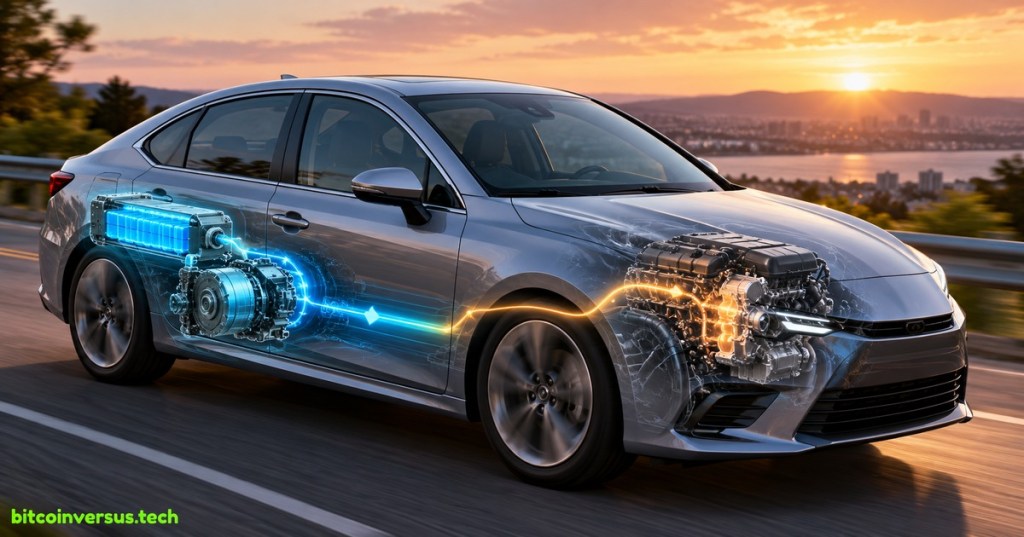
A hybrid car uses two kinds of power: a gasoline engine and an electric motor.
The car can use one, the other, or both depending on what you are doing. The goal is simple: use less fuel without making the driver think about the technology every few seconds.
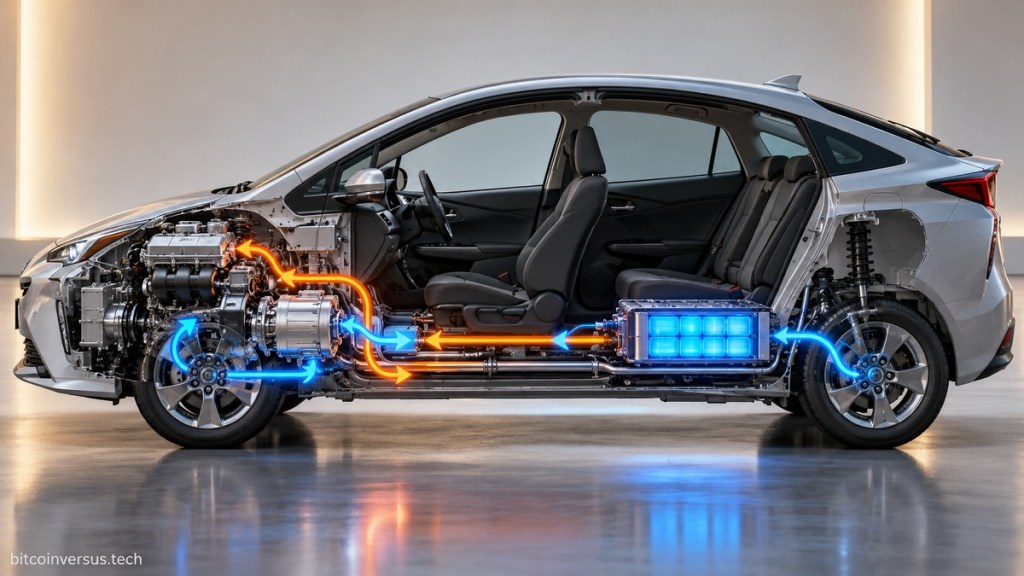
Why Use Two Power Sources?
Gasoline engines are useful for long-distance driving and can be refueled quickly. Electric motors are especially good at moving a car from a stop and can work efficiently at lower speeds.
A hybrid combines those strengths. The car’s computer decides when the engine, motor, or both should help move the vehicle.
What Does the Electric Motor Do?
The electric motor can help the car start moving, assist the gasoline engine during acceleration, and sometimes move the car by itself for short periods.
Because the motor can help with some of the work, the gasoline engine does not always have to work as hard.
Where Does the Battery Get Its Energy?
A normal hybrid does not need to be plugged into a wall.
It can recharge its battery while driving. One important method is regenerative braking. When the car slows down, the electric motor can work in reverse and help turn some of the car’s motion back into electricity.
The U.S. Department of Energy explains that standard hybrid-electric vehicles charge their batteries through regenerative braking and the gasoline engine rather than an external charger.
Pew Research Center found that hybrid vehicles remain an option many Americans say they would consider buying.
Is a Hybrid the Same as an Electric Car?
No. A normal hybrid still has a gasoline engine and fuel tank. A fully electric car runs only on electricity stored in a much larger battery.
A plug-in hybrid sits between the two. It still has an engine and an electric motor, but its larger battery can also be charged from an outlet or charging station.
If you want the broader idea behind replacing fuel-burning machines with electric ones, BitcoinVersus.Tech also has a simple overview of electrification.
Why Can Hybrids Use Less Gas?
The electric side can help during the parts of driving where a gasoline engine may be less efficient, such as starting from a stop or sitting in traffic.
The engine may also shut off when the car is stopped and restart when needed. Meanwhile, regenerative braking recovers some energy that would otherwise be lost as heat in the brakes.
Do You Drive One Differently?
Usually, no.
You press the accelerator, brake, steer, and refuel much like you would in a normal gasoline car. Most of the switching between gasoline and electric power happens automatically.
The Easy Way to Remember It
A hybrid car is a gasoline car with an electric helper.
The engine and electric motor work together, the battery stores electrical energy, and braking can help recharge that battery.
That is the basic idea.
References
- U.S. Department of Energy — How Do Hybrid Electric Cars Work?
- U.S. Department of Energy — Hybrid Electric Vehicles
BitcoinVersus.Tech
BitcoinVersus.Tech explains everyday technology in plain language.
BitcoinVersus.tech is not a financial advisor. Content is provided for informational purposes.


Leave a Reply