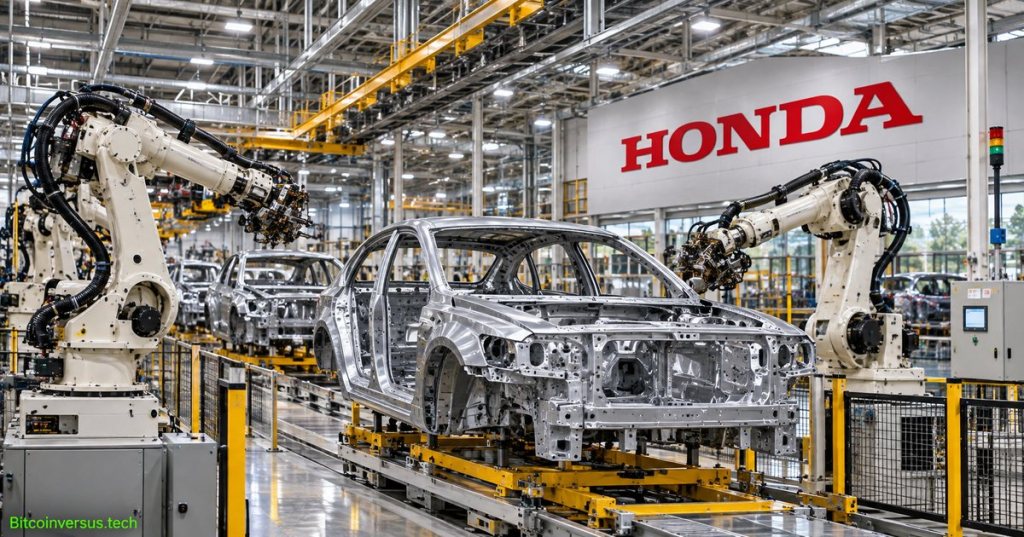
Honda announced plans on November 9, 2026, for a $3 billion automobile assembly plant in central Ohio with room to build 240,000 vehicles annually. The future facility, located between its Marysville and East Liberty plants, is expected to start production in 2029, subject to government approvals. The manufacturer also plans upgrades to engine and hybrid-system factories, expanding its ability to serve demand without committing every production line to a single propulsion technology.
Honda, “How Honda Hybrid Technology Works,” March 5, 2026. Official Honda YouTube explainer illustrating its existing two-motor hybrid system; background footage, not a recording of the November factory announcement.
A $3 Billion Factory Inside a $3.38 Billion Ohio Program
The new assembly plant represents approximately $3 billion of construction investment and more than 2,000 prospective jobs. Ohio’s governor and JobsOhio separately report $3.38 billion in total new Ohio commitments and 2,390 new jobs, including improvements at established facilities. The figures describe different scopes of the same manufacturing initiative, not competing estimates for the price of the new factory.
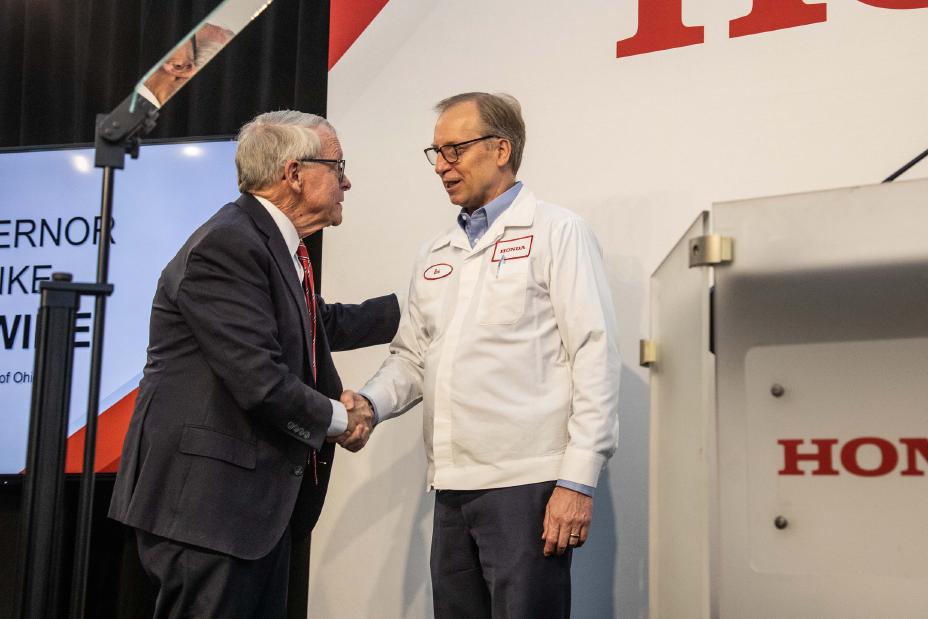
Honda says the additional plant will become its fourth Ohio automobile assembly facility and have manufacturing flexibility for conventional gasoline engines, hybrids and battery-electric vehicles. Construction and production remain future milestones. The company has not announced completed assembly lines, commercial output, or a verified per-vehicle manufacturing cost for the new site.
Capacity Rises 14.4%, but Output Must Catch Up
An accompanying Honda investor presentation gives a current 1.67 million-vehicle North American annual capacity baseline and a 1.91 million target for 2029. Dividing the expected 240,000 additional vehicle slots by the 1.67 million baseline yields a 14.4% increase. Honda separately projects U.S. annual vehicle capacity near 1.3 million after expansion. North American and U.S. totals use different geographic boundaries and should not be combined.
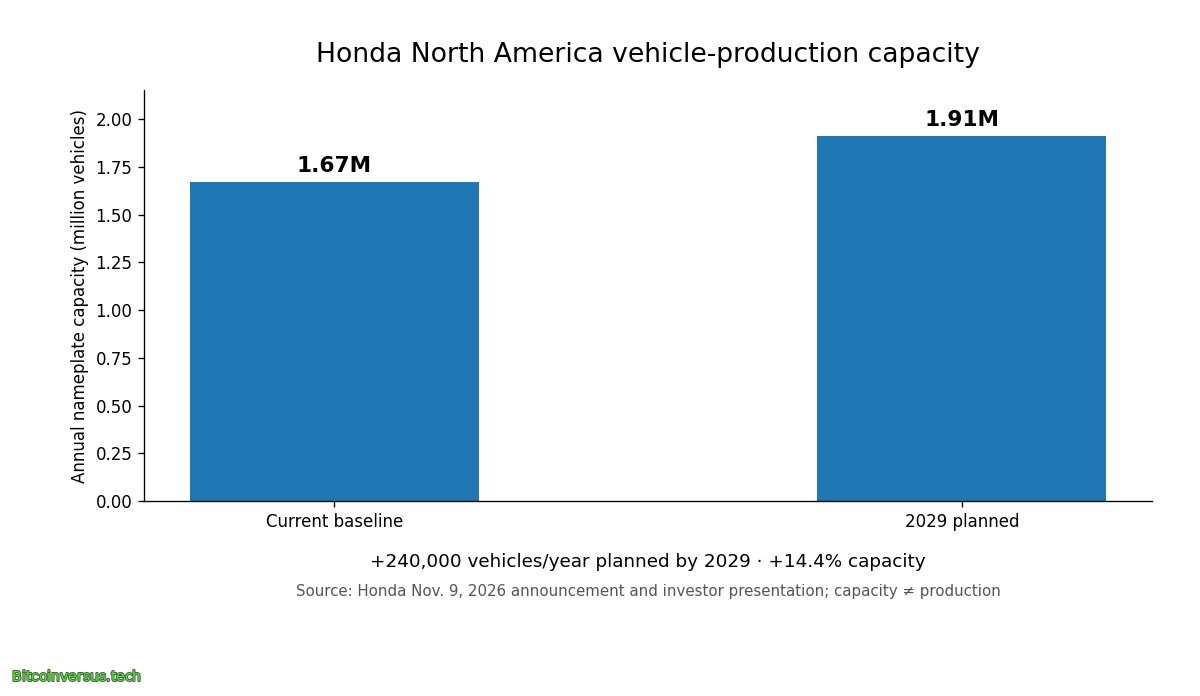
An announced nameplate capacity is a factory’s design potential, not vehicles already sold. Actual utilization will depend on factory readiness, supplier throughput, labor, model launches and market demand. A recent BitcoinVersus.Tech comparison of U.S. hybrid and battery-EV sales supplies demand context, but one quarter of retail performance cannot establish 2029 production volumes.
The Hybrid Supply Chain Is the Bigger Engineering Project
Honda is retooling its Anna Engine Plant for a new four-cylinder Atkinson-cycle engine and preparing two next-generation hybrid systems in Ohio, including equipment for larger vehicles. The Ohio transmission facility’s planned 250% increase in hybrid-system production capacity means a projected 3.5 times its prior capacity, not 250% of its prior level. Georgia will add a new hybrid assembly line; Alabama will receive upgrades supporting a new V6 hybrid engine.
A hybrid drivetrain combines combustion and electrical propulsion. Regenerative braking recaptures some motion energy, while Atkinson-cycle engine timing can favor thermal efficiency. Manufacturing flexibility remains relevant because battery vehicles face different pack, electrical architecture and supplier requirements. Related advances in industrial factory automation offer context, but Honda has not published detailed robot counts or confirmed line-level productivity gains for the planned plant.
Economic Benefits Remain Conditional
Honda’s Ohio announcement says a tax credit was approved on November 9, while additional JobsOhio assistance is subject to a future agreement. Project benefits therefore depend on construction execution, workforce recruitment, public-incentive terms and actual output. Honda’s filing to the U.S. Securities and Exchange Commission says the investment is not expected to materially affect consolidated results for the fiscal year ending March 31, 2027.
Honda plans hybrid models across multiple segments, rather than placing the entire new factory under a fixed all-electric mandate. Previous Honda electrification research demonstrates a broader technology portfolio, although the research is distinct from Ohio assembly investment. The key test will arrive when committed capital becomes operating capacity, commercial vehicles and sustained employment—not when the project is first announced.
Primary sources: Honda newsroom, November 9, 2026; Honda investor presentation, November 10; Ohio governor and JobsOhio, November 9; Honda SEC Form 6-K, November 9.
BitcoinVersus.Tech Editor’s Note
Published November 10, 2026. The $3 billion estimate applies to the proposed Ohio assembly plant; $3.38 billion describes the wider Ohio investment commitment. Honda’s 2029 opening date, factory capacity, employment targets and expanded hybrid-system throughput are plans, not measured achievements. The featured cover is a conceptual illustration, not a photograph or approved architectural rendering of the future plant. The event photograph comes from Honda Newsroom, and the capacity graphic is original analysis based on company disclosures. The Honda video describes existing hybrid technology and predates the announcement. Independent live player and mobile tests are documented separately.
We volunteer daily to ensure the information on the BitcoinVersus.Tech platform is Verifiably True. Independent reporting and technical research rely on dated primary sources and visible corrections. Readers can support the research by scanning the optional donation QR.

An optional 5,000-satoshi donation can support independent reporting. Scan the QR from a second screen with a Bitcoin wallet, or open a saved screenshot using a mobile wallet that supports image-based QR scanning. Confirm the receiving address 3C9o19EH5HSiwEPyCTmEKzxhNCbo2X6TTb and the amount independently before sending; a payment cannot be reversed.
BitcoinVersus.Tech is a volunteer-run research and editorial publication, not a financial adviser. Reporting is offered for informational and educational purposes, not as investment advice.


Leave a Reply