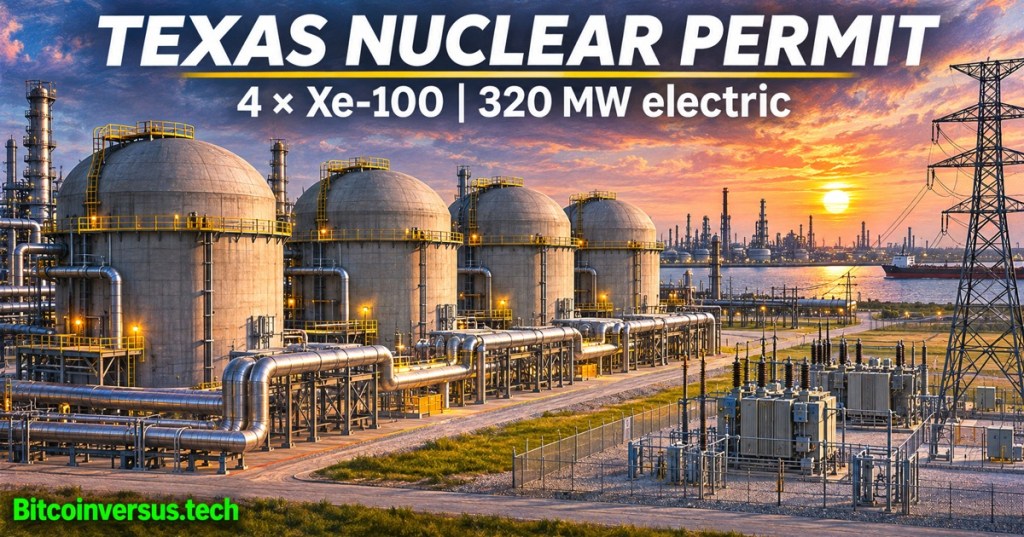
Dow and X-energy announced November 9, 2026, that the U.S. Nuclear Regulatory Commission approved a construction permit for the proposed Long Mott Generating Station at Dow’s Seadrift chemical-manufacturing complex in Texas. The four-reactor project would supply up to 320 megawatts of electricity alongside industrial steam. Approval is a regulatory milestone, not evidence that a reactor has been built, financed or authorized to operate.
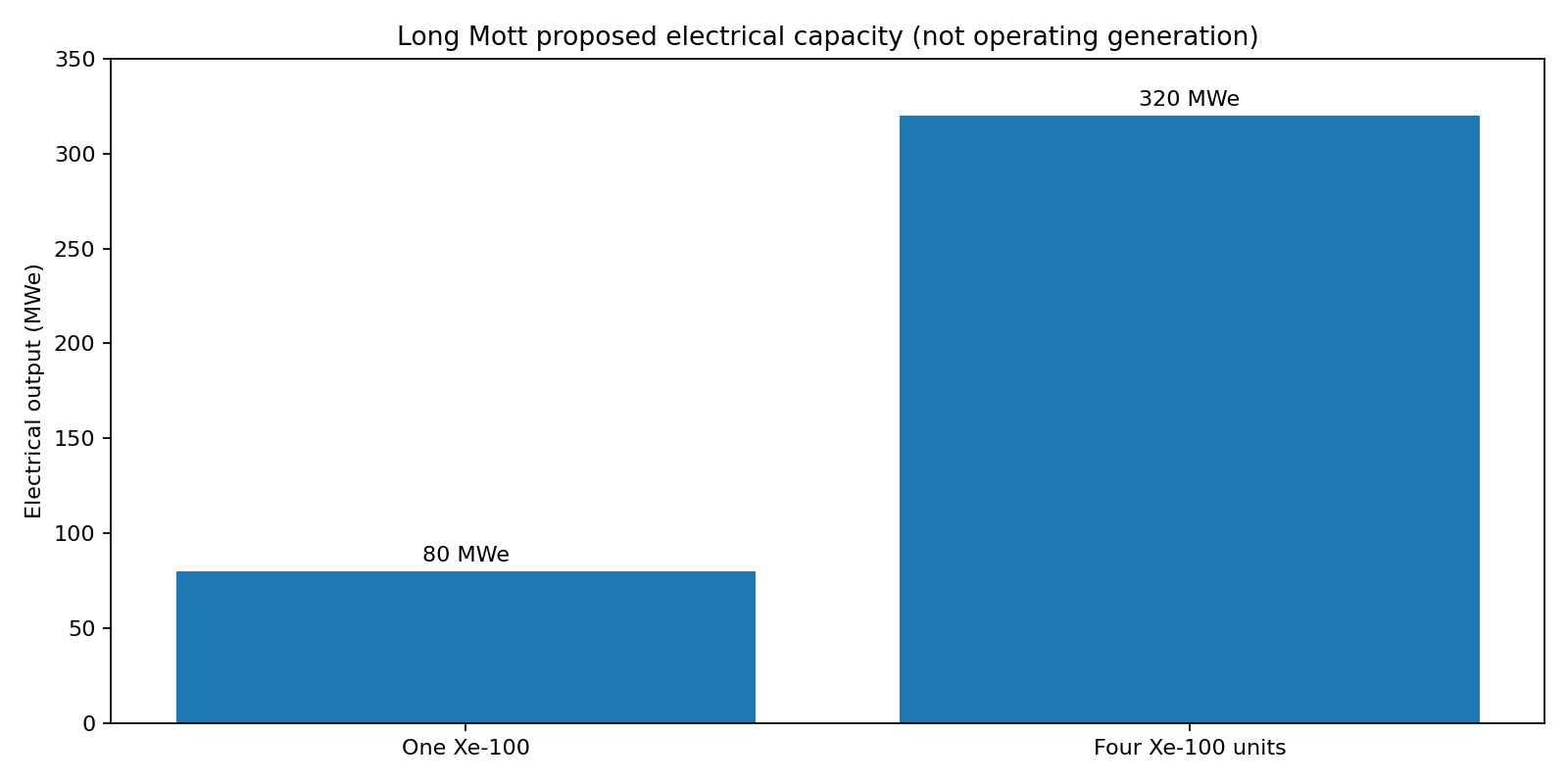
The proposed facility uses four Xe-100 high-temperature gas-cooled reactors. Each module is rated at 80 megawatts electric (MWe) and 200 megawatts thermal (MWt), giving a combined design rating of 320 MWe and 800 MWt. Thermal output and electrical output describe different energy flows; adding the two figures would double-count energy rather than establish a 1,120-megawatt power station.
Why industrial steam changes the economics
Most nuclear electricity plants convert reactor heat into steam that drives turbines. Chemical manufacturing also consumes substantial steam directly for processing. Long Mott is designed to serve both uses, potentially reducing reliance on aging conventional boilers and power infrastructure at the Seadrift site. The allocation between steam delivery and electricity production will affect operating economics and cannot be inferred from the nameplate ratings alone.
X-energy’s design circulates helium through a graphite-moderated pebble-bed reactor. Its TRISO fuel consists of uranium-bearing particles enclosed in multiple protective layers. The manufacturer argues that high-temperature fuel tolerance and passive reactor characteristics support a smaller emergency planning zone. Regulatory review of a proposed design does not eliminate construction, operating, fuel-supply or waste-management obligations.
For additional technical context, see X-energy’s steam-generator supply chain and the proposed AEP–X-energy Indiana project. Both illustrate how reactor component procurement and project agreements precede commercial electricity production.
What the permit authorizes
The NRC’s construction permit allows the project to advance toward building the approved facility, subject to applicable requirements. It does not constitute an operating license. Long Mott must separately apply for authorization to load fuel and operate the reactors. The regulator previously completed environmental review and held a public hearing, while Dow and X-energy continued technical and procurement work.
The November approval is notable because the companies describe it as the first construction permit for a high-temperature gas-cooled reactor in nearly six decades and the first for a pebble-bed reactor intended to serve a U.S. industrial site. Earlier coverage of nuclear electricity generation provides national context, but the Seadrift project is not yet included in operating generation totals.
X-energy’s official Xe-100 technology explainer describes the reactor concept. The manufacturer’s technical imagery and video are background material, not footage of an operating Long Mott plant.
A 2027 investment decision remains a major gate
Dow expects to consider a preliminary investment decision in 2027. Major construction would depend on a subsequent final investment decision, project economics, supply-chain readiness and additional licensing steps. The companies target first energy delivery in the early 2030s. None of those future milestones is guaranteed by the construction permit.
The four units could theoretically produce 320 MW × 8,760 hours = 2,803,200 MWh, or approximately 2.80 terawatt-hours, during a full year at continuous rated electrical output. Actual production would be lower whenever output is reduced, steam demand changes the operating configuration or the plant is unavailable. The calculation is a capacity ceiling, not a forecast of electricity sold.
Dow’s proposal also belongs to a broader push toward nuclear-backed industrial and computing loads, including Amazon-supported Xe-100 development. The decisive next indicators will be final capital approval, construction progress, licensing and independently observed operation.
Sources and editorial verification
Primary records: X-energy and Dow’s November 9, 2026 announcement; NRC Long Mott application and technical specifications; X-energy project description. The 2.80-TWh calculation assumes 100% electrical utilization and excludes downtime and other operating constraints.
Editor’s Note — November 10, 2026: Permit approval is reported from the companies’ dated announcement and checked against the NRC’s published project record. The 320-MWe capacity is proposed, not operating. The featured oil-painting-style cover is conceptual editorial artwork, not a photograph of the site. The original capacity chart is an arithmetic comparison, not a measured generation result. We volunteer daily to ensure the information on our platform is Verifiably True.
Support BitcoinVersus.Tech
Support independent research with an optional donation of 5,000 satoshis. Scan the QR using another screen, or use a compatible wallet’s saved-image scanning feature on mobile. Verify destination 3C9o19EH5HSiwEPyCTmEKzxhNCbo2X6TTb and the amount before confirming.

BitcoinVersus.Tech is not a financial adviser. Financial reporting is for informational purposes only.


Leave a Reply