
China National Nuclear Corporation has moved the fourth Hualong One reactor at Zhangzhou in Fujian province into another stage of construction. World Nuclear News reported on November 27 that workers placed the inner containment dome on November 26, six days after installing the last of three steam generators. The achievements concern construction, not reactor operation or electricity production. The installation follows earlier work at neighboring units in the same development.
Installing the containment structure
The dome measured approximately 46 meters across and had a lifting mass near 470 tonnes, according to CNNC figures reported by World Nuclear News. A crawler crane placed it roughly 45 meters above ground. The inner containment forms part of a multilayer structural barrier intended to limit the release of radioactive material. Its integrity ultimately depends on completed structural connections, penetrations, pressure testing and other acceptance requirements, not merely the installation of its roof. Comparable milestone distinctions matter at China’s San’ao Unit 2, where fuel loading represents a later stage of the development process.
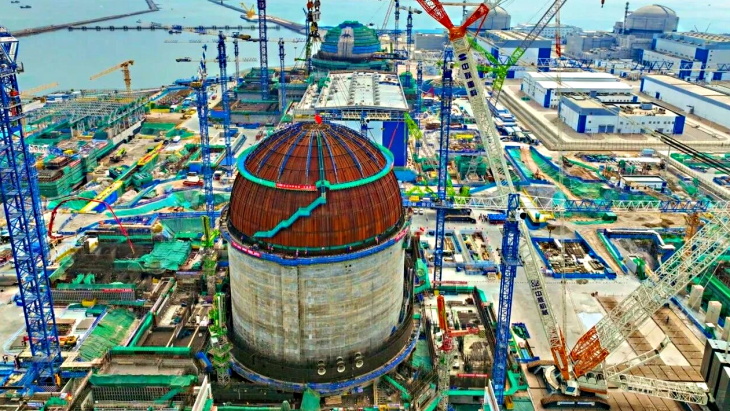
A simplified calculation illustrates the construction scale. Treating the reported mass as 470,000 kilograms, the static gravitational load is about 4.61 meganewtons at standard gravity. Actual rigging loads depend on lift geometry, acceleration, equipment weight, wind and the approved crane configuration. The crane’s nominal rating alone cannot establish safe capacity at a particular reach. Heavy component logistics require the same disciplined attention to engineering boundaries as the manufacture of steam-generator tubing for advanced reactors.
Transferring reactor heat
A pressurized-water reactor maintains its primary coolant at pressure so the water can transport heat without normal bulk boiling in the core. The steam generator transfers heat through metal tubing to a separate water circuit, where steam drives a turbine. Zhangzhou Unit 4 uses three ZH-65 steam generators, each reportedly weighing 365 tonnes and extending beyond 21 meters. Installing the final unit before closing the upper containment opening simplifies access for large equipment.
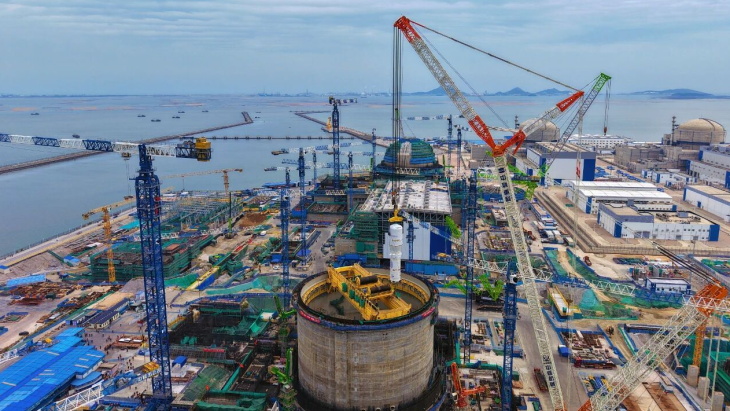
The Chinese government’s account of the second phase establishes the planned Hualong One expansion. Unlike the industrial heat application at the proposed Long Mott nuclear station, the Zhangzhou project represents a large conventional nuclear electricity installation. Repeat construction may allow lessons from earlier units to inform subsequent scheduling and manufacturing, although the available announcement does not quantify any reduction in construction costs or delays.
The next milestones include completion of equipment installation, electrical and instrumentation work, containment and system tests, regulatory authorization and eventual commissioning. Other proposals, including the proposed SovAI microreactor campus, illustrate a different scale of nuclear infrastructure. For Zhangzhou, the dome and steam generators demonstrate measurable progress in building a fourth unit, but they do not establish readiness to load fuel or generate commercial electricity.
We volunteer daily to ensure the credibility of the information on this platform is Verifiably True. If you would like to support to help further secure the integrity of our research initiative, please scan the QR code below.

For mobile scanning, open the article on another display and scan with a Bitcoin wallet. The voluntary donation amount is 5,000 sats. Verify the receiving address 3C9o19EH5HSiwEPyCTmEKzxhNCbo2X6TTb before sending.
BitcoinVersus.tech is not a financial advisor. This media platform reports on financial subjects purely for informational purposes.


Leave a Reply