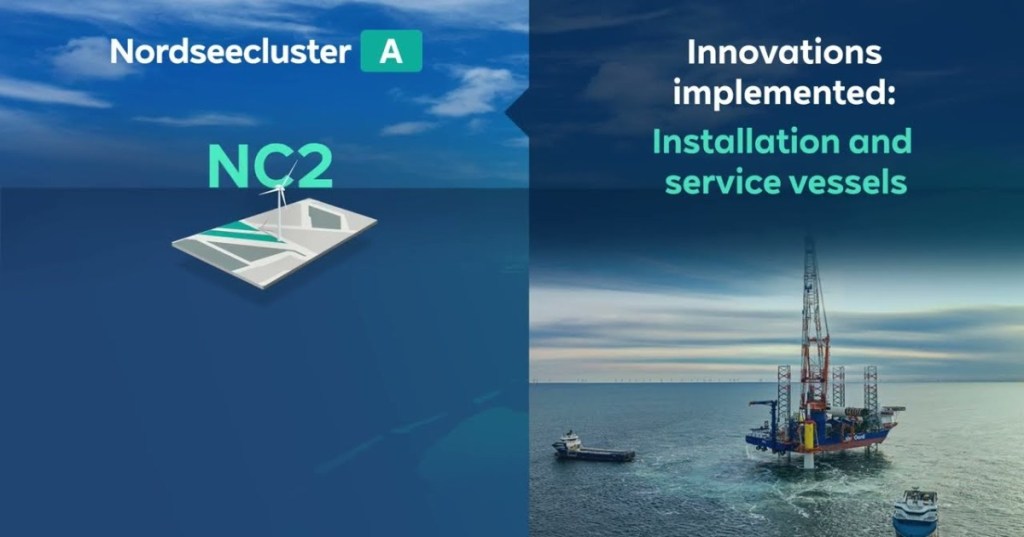
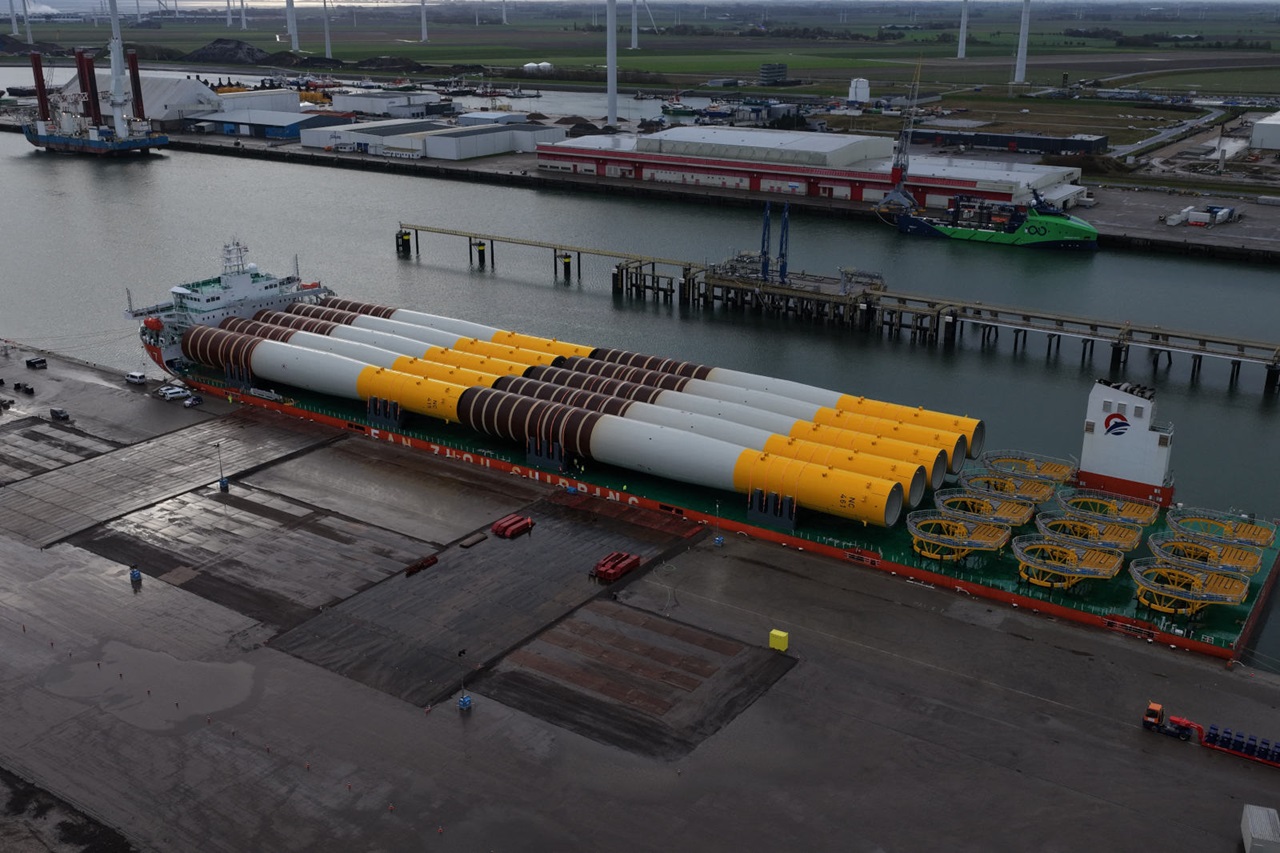
Ten foundations for the second phase of Germany’s Nordseecluster offshore wind development have arrived at Eemshaven in the Netherlands. RWE announced the shipment on November 23, describing a logistics milestone for Nordseecluster B, a planned 900 MW addition to the company’s existing construction program. The components have reached a port terminal, not their final offshore locations. Commercial operation of the second phase remains targeted for early 2029.
Transporting the monopiles
Each of the large tubular foundations measures approximately 81 meters in length and weighs about 1,350 tonnes on average. The first ten therefore represent an estimated 13,500 tonnes of steel foundations, with 60 components planned for handling at the terminal. The calculations use rounded company specifications rather than individual shipment measurements. Offshore wind projects require specialized shipping and lifting infrastructure, as the Green Volt floating wind development illustrates through a different foundation architecture.
Monopiles transfer structural loads from the turbine and tower into the seabed. Engineers must account for aerodynamic loading, wave forces, fatigue, corrosion, soil behavior and the dynamic response of the combined foundation and tower. Dimensions alone cannot determine the foundation’s capacity. Geotechnical surveys and installation monitoring are essential to establish whether each structure satisfies its design requirements.
A two-phase electrical development
According to RWE’s project overview, the two phases have capacities of 660 MW and 900 MW, totaling 1,560 MW. The second phase is designed around 60 turbines, implying a nominal average of 15 MW per turbine. Full operation of phase A is targeted for early 2027. Turbine installation and commissioning remain separate activities, as shown by Ecowende’s Dutch construction milestone.
The developer projects annual output of about 6.5 TWh once the entire development is operating. Dividing that estimate by 1.56 GW multiplied by 8,760 hours gives an implied annual capacity factor near 47.6%. Actual production will depend on wind conditions, electrical losses, maintenance and curtailment. A nameplate megawatt figure does not establish a constant electrical output.
RWE also reports an agreement with Amazon for 110 MW from the second phase. A contractual allocation should not be confused with a continuously delivered 110 MW power supply. Similar distinctions apply to Oracle’s wind procurement in Texas and AirTrunk’s Australian renewable energy strategy.
Foundation installation is scheduled for 2027, followed by turbine installation in 2028. Further evidence of progress will include completed offshore foundation placement, cable installation, energization and documented commissioning. The initial shipment indicates the second phase’s supply chain is moving, but the proposed 900 MW remains future generating capacity.
We volunteer daily to ensure the credibility of the information on this platform is Verifiably True. If you would like to support to help further secure the integrity of our research initiative, please scan the QR code below.

For mobile scanning, open the article on another display and scan with a Bitcoin wallet. The voluntary donation amount is 5,000 sats. Verify the receiving address 3C9o19EH5HSiwEPyCTmEKzxhNCbo2X6TTb before sending.
BitcoinVersus.tech is not a financial advisor. This media platform reports on financial subjects purely for informational purposes.


Leave a Reply