Schneider Electric presented a portfolio of semiconductor-based electrical distribution equipment in Woking, United Kingdom, on November 24. The manufacturer’s announcement includes an AC/DC interface converter, solid-state direct-current circuit breakers, software-managed low-voltage distribution and industrial motor controls. The products target installations in which batteries, solar arrays, electric vehicles and computing systems interact with conventional alternating-current supplies.
Why direct current needs different protection
Alternating current passes through zero periodically, which assists current interruption in suitably designed mechanical breakers. Direct current lacks a recurring natural zero crossing. A DC protection system must interrupt the fault path while managing stored energy in inductances and capacitances, and preventing excessive transient voltage. The challenge differs from the insulation and interruption requirements of high-voltage AC switchgear, even though both systems aim to isolate faults safely.
Solid-state breakers use controllable semiconductor devices to interrupt current instead of relying exclusively on physical contact movement. Schneider describes switching and conversion on microsecond timescales. The announcement does not provide a universally applicable fault clearing time, maximum interrupting current or comparison with every mechanical alternative. Semiconductor conduction losses, cooling, transient energy absorption and isolation requirements must also be considered. Existing electrical protection engineering, including medium-voltage protection and relay coordination, remains relevant when integrating the equipment.
Connecting different power domains
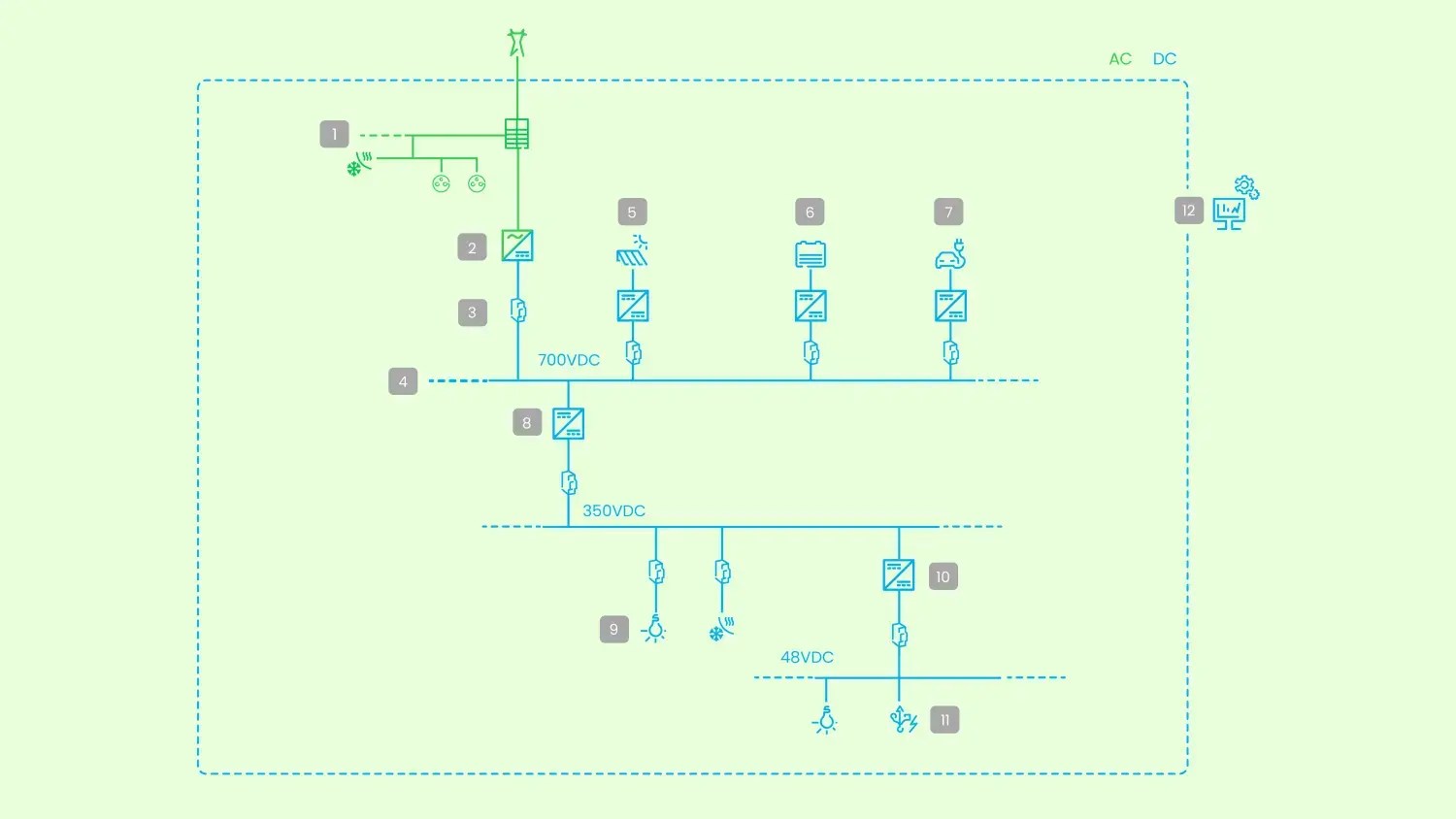
The InterLink Converter is intended to control power transfer between AC and DC sections. Schneider’s hybrid distribution architecture guide depicts a DC backbone with separate voltage conversion stages. An illustrative 100 kW load at 800 V requires 125 amperes, compared with 250 amperes at 400 V, neglecting conversion losses. For equal conductor resistance, doubling voltage reduces resistive losses to one-quarter. Actual conductor size, insulation, protection, equipment losses and installation constraints determine the overall result.
Motor drives already demonstrate the importance of conversion and transient control. Our analysis of VFD line reactors and DC chokes covers how inductive elements influence power-electronic systems. The new portfolio also includes TeSys iMCC software-defined motor control, intended to combine monitoring, switching and configuration. No independent test data establishes savings for every industrial application.
Hybrid systems may reduce unnecessary conversion stages, but system-level efficiency depends on where power is generated, stored and consumed. Large installations still require upstream infrastructure, including the transformers and substations discussed in the Johns Hopkins grid equipment analysis. The next milestones for Schneider’s portfolio are published ratings, certification, coordinated protection studies and independently measured operating performance. The announcement establishes a product direction, not an audited reduction in outages or energy consumption.
We volunteer daily to ensure the credibility of the information on this platform is Verifiably True. If you would like to support to help further secure the integrity of our research initiative, please scan the QR code below.

For mobile scanning, open the article on another display and scan with a Bitcoin wallet. The voluntary donation amount is 5,000 sats. Verify the receiving address 3C9o19EH5HSiwEPyCTmEKzxhNCbo2X6TTb before sending.
BitcoinVersus.tech is not a financial advisor. This media platform reports on financial subjects purely for informational purposes.


Leave a Reply